The spring…

This is the first part of a two-part story in the sustainable park series of stories.

First comes the summer rain, after weeks of drought. Then the wet drizzly, misty days, then the powerful storm from the bay of Biscay, and gradually the water table rises from its summer low.

The ancient spring fills and moves to the surface. Two generations ago, this spring fed into a pond where cattle drank. Locals picked water cress from the edges of its clear waters. This spring feeds our ancient oak (See: I bear their homes, too) and the old crack willow.

The old crack willow and the ancient oak in Trendlewood Park. [Photograph: Neil Ingram]

We celebrate the return of the spring like an old friend, as people have done for fifty thousand years or more. Water is our life. We have always known that.

Our spring feeds into a pond that we have built to contain it. Within twenty four hours the pond is full, and life settles down next to it.

All streams and rivers, even the mightiest, start from springs in muddy fields flowing in tiny streamlets, that join together as they travel towards the sea. In the past, people chose to build their homes close to rivers because of their need for water to live and to transport goods from place to place.

Photograph: The river Avon, that flows through Bristol to the Channel, starts life as springs in a field in Acton Turville in Gloucestershire. [Photograph: Derek Harper, https://www.geograph.org.uk/photo/5225584]

People use a lot of water in their homes and businesses, and the water table falls, even in winter. The springs and streamlets can dry up, affecting the flow of rivers. Dryer winters, caused by climate change, can make this even worse.

Rivers and streams are the drainage system of the landscape. When they flow freely, they carry rainwater away from our fields, towns, and roads. Global warming is bringing heavier and more frequent downpours, especially the autumn storms. This means much more water reaches the rivers in a shorter time. If the river channels are blocked by fallen branches, silt, or rubbish, the water cannot move quickly enough. It then spills out over the banks and floods the land around it.

Winter flooding in low lying floods around Nailsea, North Somerset. Small rivers and drainage ditches run next to these fields. [Photograph: Neil Ingram]

Healthy rivers also have space to spread out safely. When wetlands and flood meadows are protected, they act like a sponge. They slow the water, hold some of it back, and release it slowly. If these areas are lost or built over, the river has nowhere to go during a storm. So the extra rainfall caused by global warming becomes a bigger danger.

Keeping rivers clear and giving them room helps both people and wildlife. It reduces the risk of homes and roads being damaged. It also keeps the water cleaner for the plants and animals that depend on it. Maintaining rivers is one of the simplest ways we can prepare for a future with heavier rain.

Some indigenous peoples live by rivers and depend upon them for their survival. They often believe that their rivers are alive in ways that are more than just the lives of all of the organisms living there. These peoples believe that their rivers have rights and should be protected by laws.

  1. What protections do you think rivers should have? Who can protect them?

Notes on the story

Being and becoming in Nowhere Wood

…. and the pond

This is the second part of a two-part story in the sustainable park series.

Every year, the flow of the spring is rather erratic. In some winters it barely registers above ground, in other years it can flood the walkways and paths around the park. To reduce the risk of flooding, the Friends of Trendlewood Park decided to build a permanent pond to hold back the water, reducing the risk of flooding and (hopefully) providing new habitats for wetland creatures.

The pond was to be built next to the old oak and ancient willow, which are listed for protection by North Somerset Council. This means that the construction of the pond needed to be sustainable – with no artificial tools (like earthmovers) or materials (like plastic liners). The pond was to be built the hard way: with lots of manual labour and (mostly) natural ingredients.

Measuring the dimensions of the pond.
Measuring the dimensions of the pond. The ancient crack willow tree is in the background. [Photograph: Simon Stannard]

First, the dimensions of the pond were determined and marked with poles and string.

Digging the foundation of the pond involves a lot of spade work!
Digging the foundation of the pond involves a lot of spade work! [Photograph Simon Stannard]

Then teams of volunteers started the heavy spade work. It took time, but the efforts started to bear fruit.

The pond takes shape.
The pond takes shape. [Photograph: Simon Stannard]

The pond is designed to be tiered into layers. This creates ledges of different depths, that different plants and animals can utilise. It diversifies the habitat and creates new opportunities for animals and plants to live in the pond.

Digging the drainage channel for the pond.
Digging the drainage channel for the pond. [Photograph: Simon Stannard]

An earthen dam has also been built to reduce the risk of the water flooding out of the area onto the path around the park. A drainage channel has been dug into a nearby gulley to take the flood water away. In a rare concession to modern technology, the pipes are plastic sewer pipes. but covered in bentonite clay. We shall see if it can withstand the heavy winter rains.

The pond in November, as it fills after the autumn rains. [Photograph: Simon Stannard]

It has taken over a year to build the pond and we know from last summer’s trial that dragonflies were seen on the dry edges of the pond.

There were plant arrivals, too. ⁠Gypsywort, hop sedge and yellow loosestrife.

New arrivals at Trendlewood Park pond
New arrivals at Trendlewood Park pond. [Photographs: attributions at the end of the story]

It is unlikely that the pond will remain throughout the next year, that will depend on how dry and hot it will be, but it will be interesting finding out.

The Friends of Trendlewood Park Committee would like to thank: North Somerset Council for its permission for us to build the pond and for their ongoing support of the project and whole of Trendlewood Community Park. Nailsea Town Council for its enthusiasm and financial support for the materials needed to build the pond. Linsday Moore for her botanical expertise. Thank you to the many people who gave their time, energy and expertise to work on the project, including the Somerset Wood Recycling (the Green Team), and volunteers from the Wildlife Action Group volunteers, the Belmont Estate corporate workday volunteers and the Friends of Trendlewood Park.

Image attributions:

Yellow loosestrife, Photograph by: NaJina McEnany, under the Creative Commons Attribution-Share Alike 2.5 Generic licence, via Wikimedia Commons,.

Hop Sedge, Photograph by: Quinn Dombrowski, under the Creative Commons Attribution-Share Alike 2.0 Generic licence, via Wikimedia Commons.

‘Creating ponds are ways of increasing the biodiversity of a habitat’. What does this mean, and why is it generally thought to be a good idea?


Notes on the story

The sustainable park (1)

The tunnelling armies beneath carpets of gold


It is early November in the park, and carpets of fallen leaves are piling up across the earth in sodden heaps, driven by the autumn winds and rains. The browns of the oak, the sycamore ambers and the golds of the beeches.

A carpet of fallen leaves in Nowhere Wood. [Photograph: Neil Ingram]

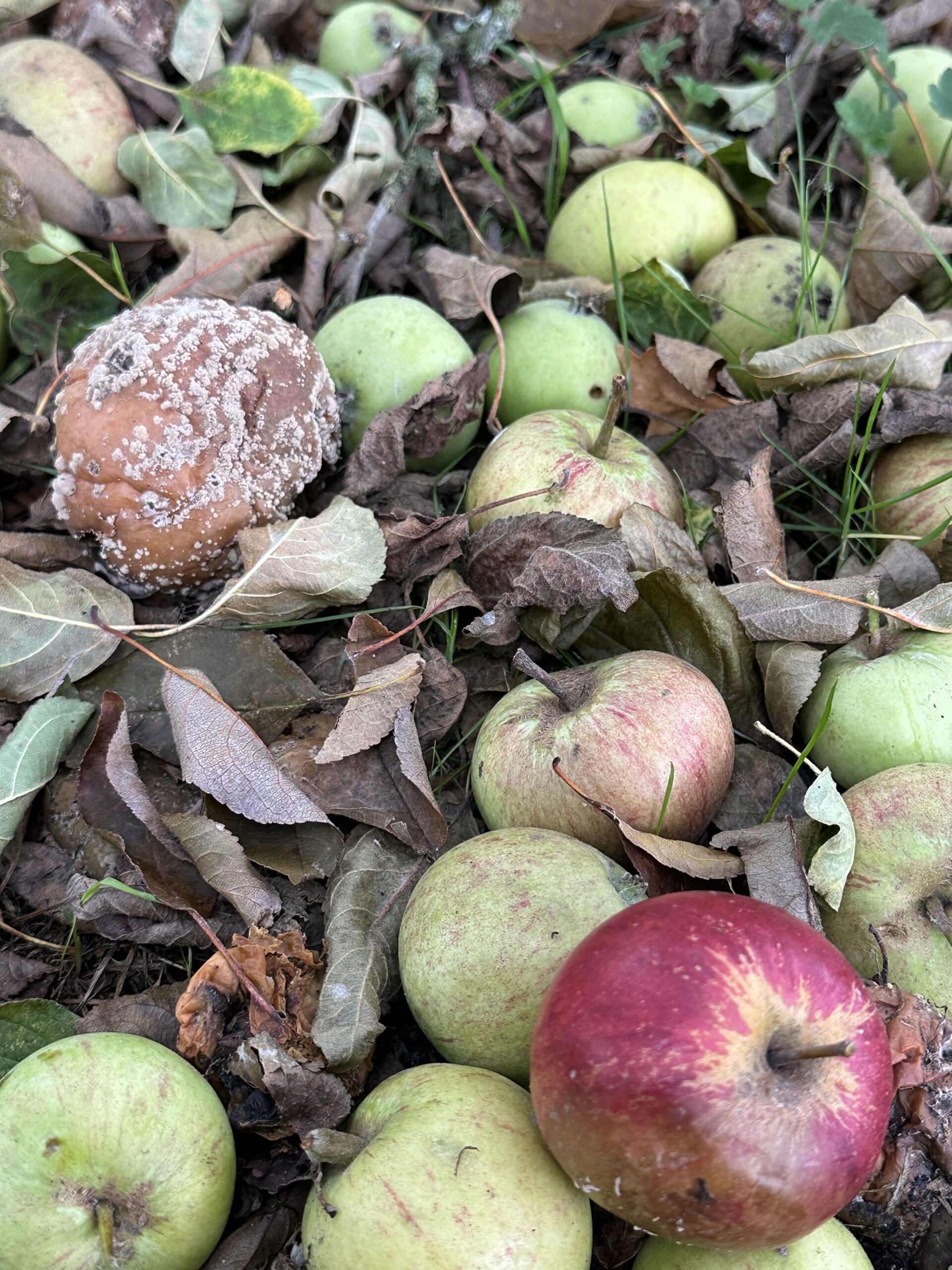
Beneath the old apple tree, the king of the orchard, fallen apples lie on top of the leaf-litter, wind-shaken and bruised. Their skins cracked, their flesh softening, their scent faintly sweet but sharp in the still air. To almost every walker, they are simply decaying fruit to be sidestepped or stepped on. But down below, for the mini beasts of the soil, these apples are the food for their futures.

Fallen apples in Trendlewood Park
Fallen apples in Trendlewood Park. [Photograph: Neil Ingram]

These apples, built by the tree from sunlight and salts, now become a banquet for a micro-world. First slugs and woodlice nibble the breaking skins.

As leaves and apple flesh break down, bacteria and fungi colonise. Fungi thread through leaves, breaking tough lignin and cellulose into sugars. Bacteria feed on these sugars and their growth increases.

Then the springtails and mites gather. But the major transformation begins when the earthworms arrive.

In this video from @PlayEarth we can see how apples are consumed by earthworms: in our park, the same players are at work, but working at much slower rhythms.

As the earthworms burrow, they drag down leaves and fragments of apple into the soil, creating tunnels rich in oxygen and moisture. The earthworms grind the material in their guts, making it more digestible for microbial armies.

As they pass through, the earthworms consume the microbe-rich soil, expelling the soil as finely ground particles. Their work accelerates the breakdown of the leaves and apples.

The result? The fallen apples, once crisp and bright, become part of the soil. Nutrients such as nitrogen, phosphorus and potassium return to the ground. The soil structure improves. Tiny pores hold water. Seeds waiting in the seed-bank sense the difference. Saplings in spring find richer soil, more ready to grow.

In our small park, what seems like waste—leaves and fallen apples— are the lifeblood of food webs, cycles and renewal. Life depends on life. The work of the worms and other soil organisms is quiet, unseen, but foundational. Without it, the leaf carpet would build up, decomposition would slow, nutrients would be locked away.  Instead, the earth beneath is alive and renewing, waiting for the spring.

  1. Many people tidy up the fallen leaves from their garden lawns and flower beds. Why might it be better to leave them where they fell? 


Notes on the story

Trampling acorns underfoot 


You might also like to read: 

Trick or treat?

Traveller's joy or OId man's beard. Growing on the edges of the meadow, Tendlewood Park
Traveller’s joy or OId man’s beard. Growing on the edges of the meadow, Tendlewood Park. [Photograph: Neil Ingram]

A traveller on the pathways, weary after many miles of walking, looks up into the hedgerow and sees the silky feathery threads surrounding the dark fruits. The sight brings the traveller an uplifting joy, at least according to John Gerard in his 1597 herbal. He called it ‘travellers joy’.

It has other names. It is ‘old man’s beard’ in Hampshire and Wiltshire and called the delightful ‘Withywine’ in Somerset. Its formal name is Clematis vitalba and it has distinctive flowers and fruits.

Drawings of the flowers and seed heads of Clematis vitalba.

Vitalba means ‘vital’, full of energy. It certainly grows rapidly, especially in new habitats, where it can form dense thickets. This is the secret of its success as a coloniser of hedges and woodlands.

But, its rope-like branches can choke and strangle the trees over which it invades. Little wonder that frustrated woodsmen have given it a range of darker names, such as ‘devil’s twister and ‘devil’s guts’.

Trick or treat? It is halloween, and it is for you to decide.

  1. Given the large number of local names for plant species, why was it important to create a recognised system of formal names?


Notes on the story

Being and becoming in Nowhere Wood

The sustainable park (2)


An ash tree showing symptoms of ash dieback disease
An ash tree showing symptoms of ash dieback disease. [Photograph: M. J. Richardson, https://www.geograph.org.uk/photo/5465604]
We did not want those trees in Nowhere Wood to be felled, but we accepted that the trees were infected with Ash die-back disease and had to go. 

Growing and managing trees is something that people of done for tens of thousands of years. One secret is to use every part of the tree mindfully, to benefit the community.

And so it was that fifteen volunteers from the Friends of Trendlewood group came together to drag the fallen branches (“brash”) to the edge of the pond.

Dragging Ash branches to the pond
Dragging Ash branches to the pond. [Photograph: Neil Ingram]
We worked alongside the council parks team, who piled wooden stakes in the ground across the edge of the pond. We then weaved layers of  branches between the stakes to create a “dead hedge”, separating the pond from the children’s playground. 

Laying a dead hedge, using ash branches
Laying a dead hedge, using ash branches. [Photograph: Neil Ingram]
The pond is fed by streams and disappeared for many decades, only to return as a permanent feature in the last few years. Watercress plants grow in the water, as they would have done in the 1800’s, when people used to collect them to eat.

Water cress plants
Water cress is a salad crop. [Photograph: Laura Whitehead, https://www.flickr.com/photos/thewhiteheads/8693844036]
It took a morning to build the dead hedge, which will help to protect children and dogs from getting wet in the pond. It is a good use of waste wood  that would otherwise be burned. Burning wood releases stored carbon into the atmosphere as carbon dioxide.

The completed dead hedge.
The completed dead hedge. [Photograph: Simon Stannard]
It is another example of how the park is managed in sustainable ways.

Sustainability is an important idea. The United Nations has a sustainable development goal for life on land, (number 15). Find out what it says and why it is important.


Notes on the story

What can eat a tree like this?

The sustainable park (1)

The old willow tree in Trendlewood park
The old willow tree in Trendlewood park. [Photograph: Neil Ingram]
This willow tree in the park is very old. Maybe a hundred years or so. Look how its bark is gnarled and twisted. It is a great friend of the park and is home to many different insects and birds. One year, a female mallard duck even made a nest on the flat top of the tree!

The willow keeps on growing because every few years, it’s friends cut off all of its branches!

This really does encourage the tree to grow strongly. 

We call the removal of the branches ‘pollarding’.

This ancient willow tree has recently been pruned
Pollarding trees is a way of keeping them alive. [Photograph: Neil Ingram]
This week, it was the old willow’s turn to be pollarded. You can see the cut stumps where the branches used to be.

Woods have always been important to people. In the 17th century, new forests were planted to provide enough timber for the boats for the Royal Navy.

People have pollarded woodland trees for thousands of years.  It was their main source of wood for building, making furniture, for charcoal and for fuel to heat their homes.


Wood is a very useful sustainable resource, when managed in this way. It is sustainable because the tree carries on growing and making new wood.

Pollarded willow wood is special. It is used to make cricket bats and weave baskets.  For generations, this provided income for poor families  in Somerset.

It is also a good way of making new fences. This is because cut branches of willow will grow new roots when they are placed in water.

The cut stems will grow into new trees and can become a hedge when they are planted closely together.

Two volunteers from the Friends of Trendlewood Park soaking the branches of willow
Two volunteers from the Friends of Trendlewood Park soaking the branches of willow. [Photograph: Neil Ingram]
The photograph shows two volunteers from the Friends of Trendlewood Park preparing willow branches to build into a new hedge in the area near the playing fields.

They place the cut ends of the branches into water.

A newly planted willow hedge in Tendlewood Park
A newly planted willow hedge in Tendlewood Park. [Photograph: Neil Ingram]
In a few months’ time, when the weather is warmer, this hedge should be growing strongly and could grow for many years.

  1. This species of willow is called the brittle willow, because branches break off easily. Suggest why it is an advantage to the willow for these branches to be able to grow into new trees.
  2. This species of willow has two ways of reproducing. It flowers and makes seed and also can propagate through fallen branches. Find out why it is useful for the species to be able to reproduce in these two ways.

After the story:

Just after I finished writing this story, it was announced that young trees grown from seeds of the Sycamore Gap tree are to be given to charities, groups and individuals as “trees of hope“. This ancient sycamore tree, from Northumberland, was cut down in September 2023.

new growth from there Sycamore gap tree
Image from https://www.thesill.org.uk/sycamore-gap-tree-is-sprouting/

This is a lovely, kind idea. The tree lives on, not only through its seeds, but  also in the new stems that are growing from its cut stem. This shows the power of nature to recover and re-grow. Life is resilient, it does not give up.


Notes on the story

Apples and the New Year

It’s Flying Ant Day!

Today is Flying Ant Day: the day that ants take to the air and fly at the same time. The ants are from different colonies that can be several hundred metres apart.

Let’s celebrate Flying Ant Day!

Swarm of flying yellow ants in Nowhere Wood.
Swarm of flying yellow ants in Nowhere Wood. [Photograph: Andrew Town]
To some, it’s a minor nuisance. They land in your lemonade, tangle in your hair, and make picnics suddenly less romantic. A swarm of tiny aviators with no regard for personal space.

Flying ants on the flowers of common ragwort.
Flying ants on the flowers of common ragwort. [Photograph: Andrew Town]
Is there really anything much to celebrate? Would we not be better off without ants?

But pause a moment—really look. This is the wedding flight, the briefest of honeymoons, when new queens and males take to the skies to mate and search for new grounds and new beginnings. It’s a natural marvel unfolding on our doorsteps, so what is going on below the surface?

It starts underground, beneath a cracked paving stone, under a patch of sun-warmed earth:  this is the colony, the kingdom of the ants. The colony pulses with organised  purpose.

Yellow meadow worker ants.
Yellow meadow worker ants in Nowhere Wood. [Photograph: Andrew Town]
Tunnels and chambers run through the soil, branching and looping. Here, everything has a rhythm. The queen lays eggs, which are tended and nurtured. The queen is guarded with  reverence because she is the provider of life to the colony.

Their larvae are fed and thousands of identical worker ants are formed.  These do not have wings.

The power of ants lie in their numbers.

Some ants are the pirates of the wood: ferocious and aggressive, they will attack those who cannot defend themselves or have not learned to work with the ants. Like pirates, ants will protect anything that gives them what they want – usually food.

Some species roam in teams, tracking down caterpillars, beetle larvae, or even spiders. They subdue them not with brute force, but with strategy: surround, immobilise, overwhelm. A single ant may be no match for a wasp larva, but a dozen? A hundred? That’s a different story. Their venom can paralyse, their mandibles shear, and their numbers do the rest.

These ants are farming blackflies
These ants are farming blackflies. [Photograph: Andrew Town]
Other ants are the gentle manipulators of blackfly insects, tending huge herds of them.

Blackflies suck the juices of a plant, excreting sweet sticky “honey dew”, which feeds the ants in the colony. In exchange, the ants give the blackflies protection and time to reproduce. Some ants actively”farm” the blackflies, by stroking them gently with their antennae to encourage them to produce honeydew. Like milking a cow.

Biologists call ants ‘keystone’ species. In architecture, the keystone is the stone at the top of an arch that holds the whole structure together. Remove it, and everything collapses.

Ants play this role in the architecture of the wood. Their tunnelling aerates the soil, letting water and oxygen reach the roots of plants. They break down waste, dead insects, and fallen leaves—recycling the detritus of life into the ingredients for growth.

Some species plant seeds by accident, dropping them underground where they germinate safely. Others protect plants from pests or farm aphids like cattle. A colony is not just a nest: it’s an engine of fertility, a subterranean society that quietly underpins the world above.

Take them away, and you begin to see the gaps. Soils become compacted. Nutrients stop cycling. Other animals—birds, lizards, even mammals—that feed on ants start to vanish too. The threads of connection begin to unravel.

The world is a better place with ants – and the flying ants are crucial, for this is where new queens mate with males and go to form new colonies, so the cycle of life continues for one more year. As long as the old colonies have healthy queens, they will continue, so that Flying Ant Day is a way of mixing together different colonies, to make and spread new ones.

The ants benefit, and so does Nowhere Wood, so, let’s celebrate Flying Ant Day!

  1. Why is it an advantage for a new queen ant to fly away from the colony before laying her eggs?


Notes on the story

Being and becoming in Nowhere Wood