Trick or treat?

Traveller's joy or OId man's beard. Growing on the edges of the meadow, Tendlewood Park
Traveller’s joy or OId man’s beard. Growing on the edges of the meadow, Tendlewood Park. [Photograph: Neil Ingram]

A traveller on the pathways, weary after many miles of walking, looks up into the hedgerow and sees the silky feathery threads surrounding the dark fruits. The sight brings the traveller an uplifting joy, at least according to John Gerard in his 1597 herbal. He called it ‘travellers joy’.

It has other names. It is ‘old man’s beard’ in Hampshire and Wiltshire and called the delightful ‘Withywine’ in Somerset. Its formal name is Clematis vitalba and it has distinctive flowers and fruits.

Drawings of the flowers and seed heads of Clematis vitalba.

Vitalba means ‘vital’, full of energy. It certainly grows rapidly, especially in new habitats, where it can form dense thickets. This is the secret of its success as a coloniser of hedges and woodlands.

But, its rope-like branches can choke and strangle the trees over which it invades. Little wonder that frustrated woodsmen have given it a range of darker names, such as ‘devil’s twister and ‘devil’s guts’.

Trick or treat? It is halloween, and it is for you to decide.

  1. Given the large number of local names for plant species, why was it important to create a recognised system of formal names?


Notes on the story

Being and becoming in Nowhere Wood

I bear their homes, too

For Jules Acton, author of Oaklore.

The old oak tree said to the traveller passing by:

“You know me, you see me everyday. I am that oak tree that has stood here longer than any of can you remember.”

The oak tree in Trendlewood Park dominating the view
The oak tree in Trendlewood Park, viewed from the author’s study. [Photograph: Neil Ingram]

“I am on the 1840 Ordnance Survey map and I was a sturdy tree, even back then. Let’s say, I’m two hundred years old? I am still in my prime, though. I won’t be celebrated as old for another two or three hundred years. Don’t wait up for me.”

A leaf of an English oak.
A leaf of an English oak. [Photograph: Neil Ingram]

“I am a patriot, a true blue English oak: look at the ear-shaped lobes at the bottom of my leaves and the very short leaf stalks. Pedigree characteristics, those.”

Long stalks on the growing acorns of an English oak tree.
Long stalks on the growing acorns of an English oak tree. [Photograph: Neil Ingram]

“And look at the length of the stalks that hold up my acorns – the longer the better. Need I say more, I am as English as St George, cricket and cider.”

“I have never been a wildwood oak: a farmer’s tree, that’s me. My roots are deep in the clay, fed  by a spring that kept the animals safe and watered. I had space: my limbs lifted upwards to touch the sky. I’ve seen the storms lash the fields and the brambles come and go. I wear the years in my bark and the seasons in my leaves.”

The oak tree is about 200 years old
The oak tree is about 200 years old. [Photograph: Neil Ingram]

“I am a good neighbour – well after all of this time, why not? In the summer I play host to lots of welcome visitors.”

Spangle gall on an oak leaf.
Spangle gall on an oak leaf. [Photograph: Neil Ingram]

“The gall wasp comes to lay her eggs on my new leaves and I make spangle cradles to help to keep them safe.”

oak galls
oak galls. [Photograph” Neil Ingram]

“It happens again and again. Not just the spangles. Look beneath my leaves and you might find round, knobbly balls, like hard brown marbles. These are oak apples, swollen with the same curious purpose. A different gall wasp requests a grander chamber, and I oblige. Within each one lives a single larva, safe and fed by the very cells I’ve grown to protect my own buds.

Why do I do it? I don’t know. Perhaps I am too old to care. Or perhaps I understand that these wasps—these minute engineers—are part of the pattern. They do no great harm. My crown still grows. My acorns still drop. My fungi and birds and lichens still cling and sing and creep through me.

So I let them stay.

When my leaves fall, the spangles fall with them. Some young mothers emerge come spring, and they begin again—quietly weaving their lives into mine, asking nothing more than a shelter made of leaf or bark.

I am not hollowed by this. I am enriched. Insects, wind, rain, rot, and sunlight—they all shape me. I am a home, not a fortress. I bear their homes, too.

And you, traveller —if you lie on your back and look up through my summer canopy, you might see more than green. You might see a world.”

  1. Jules Acton’s book, Oaklore, Greystone books, 2024, is an essential companion piece to this story. Jules helps us to think about all of the things that the English oak tree has given us as society and individuals.

Update, 20/07/25:


A new gall has appeared on our favourite oak tree. This is a Knopper gall, caused by the gall wasp Andricus quercuscalicis. The wasp secretes chemicals that distort the growth of an acorn.  This is a rather more serious pest to the tree than the two show above, because it can reduce fertility of the tree.

Protected inside the gall is a developing larva, which will develop into a pupa and will emerge as an adult wasp in the next spring.


Notes on the story

Being and becoming in Nowhere Wood

The Apple Tree Man of Nowhere

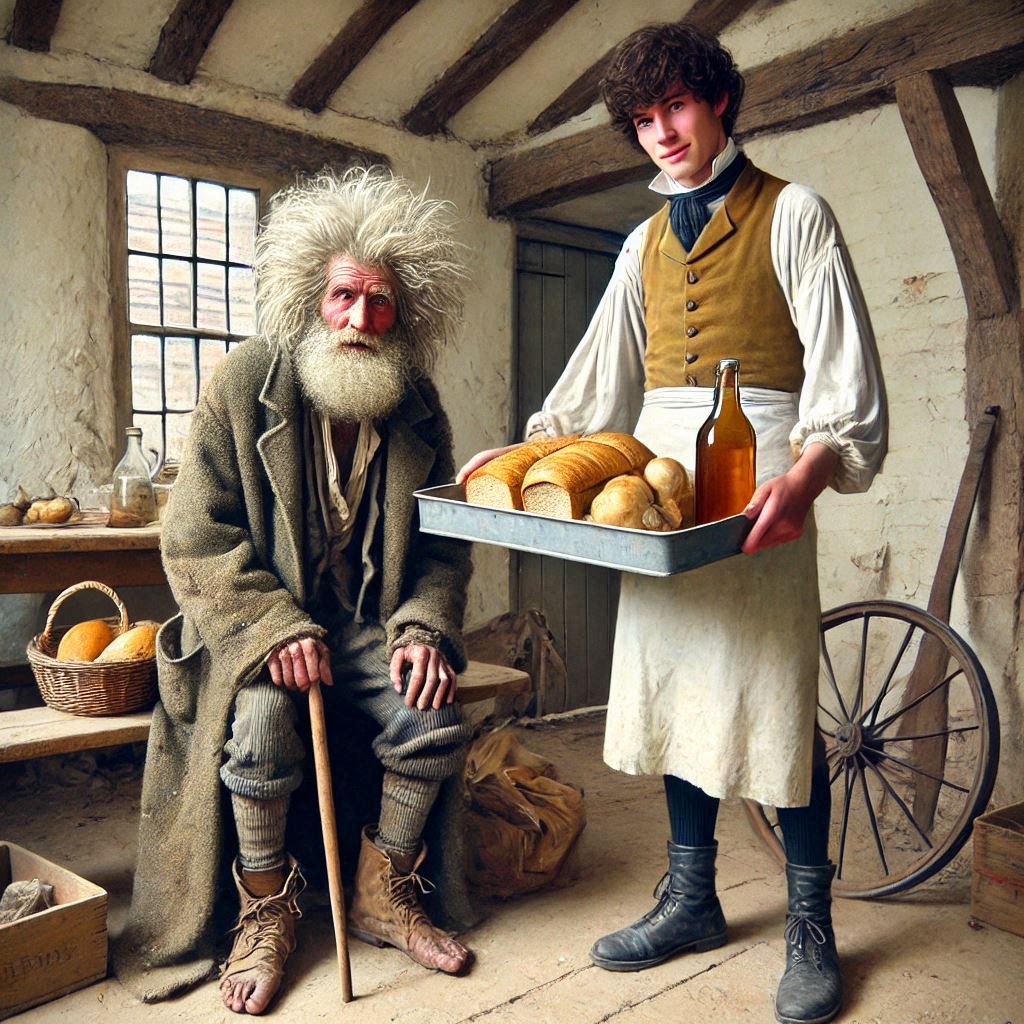
Once upon a time, there lived a young man called Henry Summers, who lived at the Farmhouse over at the East End, just below the quarry. He was a wise man, strong in the arm and of calm manner. He never beat his animals or his wife. The family farmed ten fields and had several beautiful apple orchards.

Among the trees, there was one particularly ancient apple tree that Henry’s great grandfather planted and around which all of his children had played. The tree stood tall and strong, even though it was very old.

Henry believed that this tree was extra special, and he called it the ‘Apple Tree Man’. Henry always took great care of this tree, speaking to it kindly and ensuring it had plenty of water and cider at the wassail.

One cold winter’s night, Henry was visited by a stranger who had walked from Bristol and wanted to find friends in Nowhere. His clothes were dirty and his shoes were worn out. Henry was as kind to people as he was to his goats, welcomed the stranger into his home and gave him food and cider.

The wanderer meets the young farmer

His wife looked out some more shoes for him.  The stranger slept soundly in his clean bed that night.

The next day, the happy stranger revealed that he was, in fact, the spirit of the Apple Tree Man who had taken the form of a wanderer to test the farmer’s kindness.

The Apple Tree Man promised the farmer that as long as he continued to care for the apple trees, his orchards would make so many lovely apples every year, that he and his family would be wealthy and  joyful.

The apple trees produced many beautiful apples

The Apple Tree Man was true to his word, the orchards flourished, and the farmer and his descendants enjoyed bountiful harvests for many generations. And the people of Nowhere enjoyed their cider for years to come.


Notes on the story

Climate change: new arrivals in Nowhere Wood


Yellow flowers

Early spring in Nowhere Wood is the season of yellow flowers. Cowslips have an inelegant name: originally called ‘cow slops’, they were thought to grow where cows have trodden their poo into the ground. The old Somerset name of “bunch of keys” is much nicer – the arrangement of flowers on the head were thought to look like a set of jangling keys.

Cowslips on the edge of Nowhere Wood.
Cowslips on the edge of Nowhere Wood. [Photograph: Neil Ingram]
Primroses are a most loved flower of Springtime. Called the “early rose” in Somerset, they are the flowers of Easter displays, with bunnies and eggs.

Primroses on the edge of Nowhere Wood
Primroses on the edge of Nowhere Wood. [Photograph: Neil Ingram]
 

But look at this:

A hybrid between primrose x cowslip on the edge of nowhere Wood
A hybrid between primrose x cowslip on the edge of nowhere Wood [Photograph: Neil Ingram]
Growing between the cowslip and the primrose is a plant that is similar to both, but different, too. It looks as if it is half way between the two types of plant.

Cowslips and primroses are quite closely related plants. This new plant has both cowslip and primrose as parents. It is called the “false oxlip” and is a hybrid.

close up of the hybrid
close up of the hybrid [Photograph: Neil Ingram]

  1. The hybrid has formed naturally as a result of “cross-pollination” between cowslip and primrose parents. Hybrids can sometimes occur in animals, too. Find about how mules and ligers form.


Notes on the story

The story of bluebells

The fairy ring

Fairy ring fungus
Fairy ring fungus [Photograph: Andrew Town]

Just outside of Nowhere Wood, next to the school playing fields, you can, on a summer evening, sometimes see a fairy ring. The photograph shows parts of this fairy ring: sometimes you can find rings that form a perfect circle.


How many fungi can you see here? There are about 15 mushrooms – the fruiting bodies, but only one fungus. In the soil, the fungus exists as a tangle of small thin threads called hyphae. The hyphae, which make up bodies of all fungi,  are called mycelia.

Fungal mycelia can grow to enormous sizes. There is a fungus in a forest in Oregon, USA, which is 3.5 miles across and covers over 2000 acres. It could be up to 8.5 thousand years old!

The grass growing around a fairy ring fungus
The grass growing around a fairy ring fungus [Photograph: Andrew Town]

The fungus is good at feeding on dead organisms, and returning the nutrients to the soil. This helps the grass growing around the circle to grow taller than the grass growing further away from the fungus.


Fairies dancing in a fairy ring
Fairies dancing in a fairy ring [image: Walter Jenks, The fairy ring. https://britishfairies.wordpress.com/tag/down-tor/]

People love fairy rings and make up stories about them. In English folklore, fairy rings are caused by fairies dancing in a circle. Be careful if you see one though. The stories say that if people join in the dance they would be punished by the fairies, and made to dance in the ring until they fall asleep. 


  1. Why do you think that fungi are useful in our woods and fields?
  2. William Shakespeare is thought to have written these lines:
“If you see a fairy ring
In a field of grass,
Very lightly step around,
Tiptoe as you pass;
Last night fairies frolicked there,
And they’re sleeping somewhere near.
If you see a tiny fay
Lying fast asleep,
Shut your eyes”


William Shakespeare wrote “A Midsummer’s Night’s Dream” in about 1596.  In the play a group of powerful fairies cast spells on people, making their lives very difficult. Many people believed in such ideas in Elizabethan times.
 
Why do you think many people no longer think like this?


Notes on the story

Hard hats, safety specs and camouflage jackets

What’s in a name?

Dryads Saddle
Dryad’s saddle [photograph: Andrew Town]

This fungus grows in Nowhere Wood. It has the glorious scientific name of Polyporus squamous. That’s hard to say, harder to spell and even harder to remember!!

Scientific names are important though: they give the accurate name of the organism, and they also tell scientists quite a lot about how the organism lives. These scientific names are a kind of code that give the name and address of the organism in the living world.

However, the names that ordinary people give organisms are just as important. They are easy to remember and often tell an interesting story.  This fungus above is called the Dryad’s saddle. If you look carefully, you can see that it shaped a bit like a saddle that someone would use when riding a horse.

Is this what a dryads looks like?
Is this what a dryad looks like? [An AI generated image]

Dryads are nymphs that live in the world of myths and legends. They live inside trees, often oaks.

Oak trees can live for a 1 000 years, and the dryads are the spirits of the woods, protecting and nurturing the trees. They are the guardians of the woodlands. They are invisible, unless they choose to reveal themselves to us.

Perhaps you will see a dryad in Nowhere Wood? You will have to be quiet and be thinking the right kinds of thoughts.


Dryads observe the changes in the seasons, the rhythms of nature and their deep connection to the Earth. Perhaps we need to think the same way if we are to be allowed to see them for ourselves.

Scarlet elf cup
Scarlet elf cup [photograph: Andrew Town

There are lots of fungi with interesting fairy names. This is the scarlet elf cup and grows in Nowhere Wood, feeding on fallen sycamore and hazel wood.

  1. Find out what the scientific name is for our human species. What do the words mean in English? Do you think they are a good description of us?
  2. Very few people believe that there are dryads protecting our woods. Can you think of any benefits to thinking like this? Are there any disadvantages?

Notes on the story

The fairy ring