

For Jules Acton, author of Oaklore.
The old oak tree said to the traveller passing by:
“You know me, you see me everyday. I am that oak tree that has stood here longer than any of can you remember.”

“I am on the 1840 Ordnance Survey map and I was a sturdy tree, even back then. Let’s say, I’m two hundred years old? I am still in my prime, though. I won’t be celebrated as old for another two or three hundred years. Don’t wait up for me.”
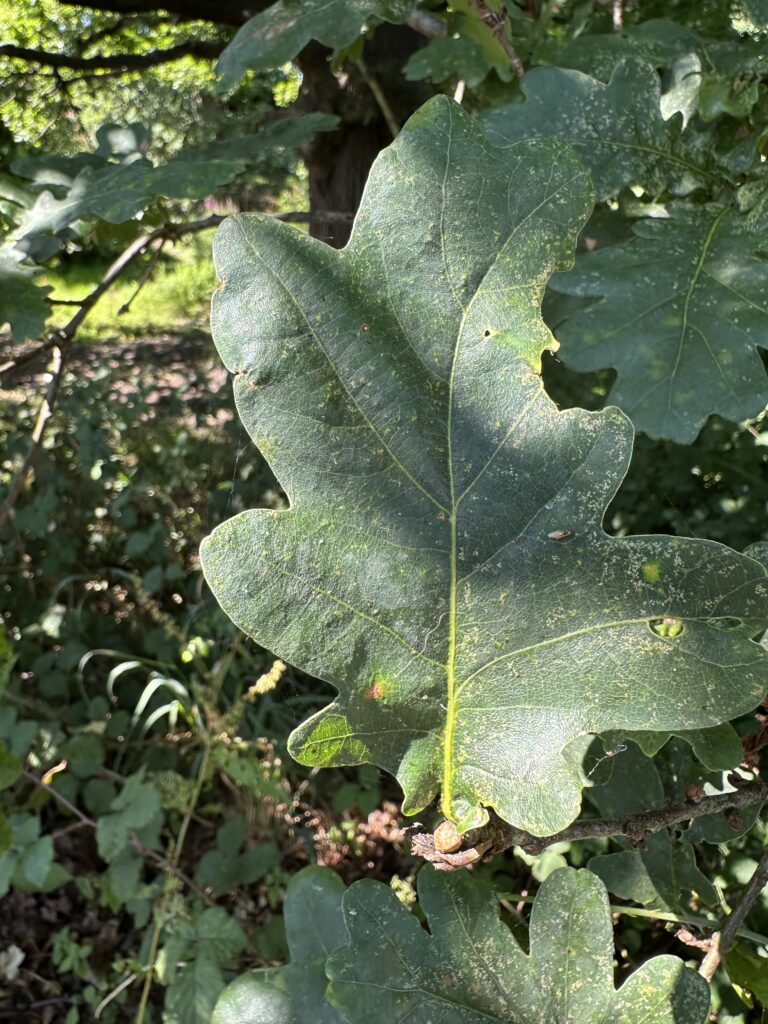
“I am a patriot, a true blue English oak: look at the ear-shaped lobes at the bottom of my leaves and the very short leaf stalks. Pedigree characteristics, those.”

“And look at the length of the stalks that hold up my acorns – the longer the better. Need I say more, I am as English as St George, cricket and cider.”
“I have never been a wildwood oak: a farmer’s tree, that’s me. My roots are deep in the clay, fed by a spring that kept the animals safe and watered. I had space: my limbs lifted upwards to touch the sky. I’ve seen the storms lash the fields and the brambles come and go. I wear the years in my bark and the seasons in my leaves.”

“I am a good neighbour – well after all of this time, why not? In the summer I play host to lots of welcome visitors.”
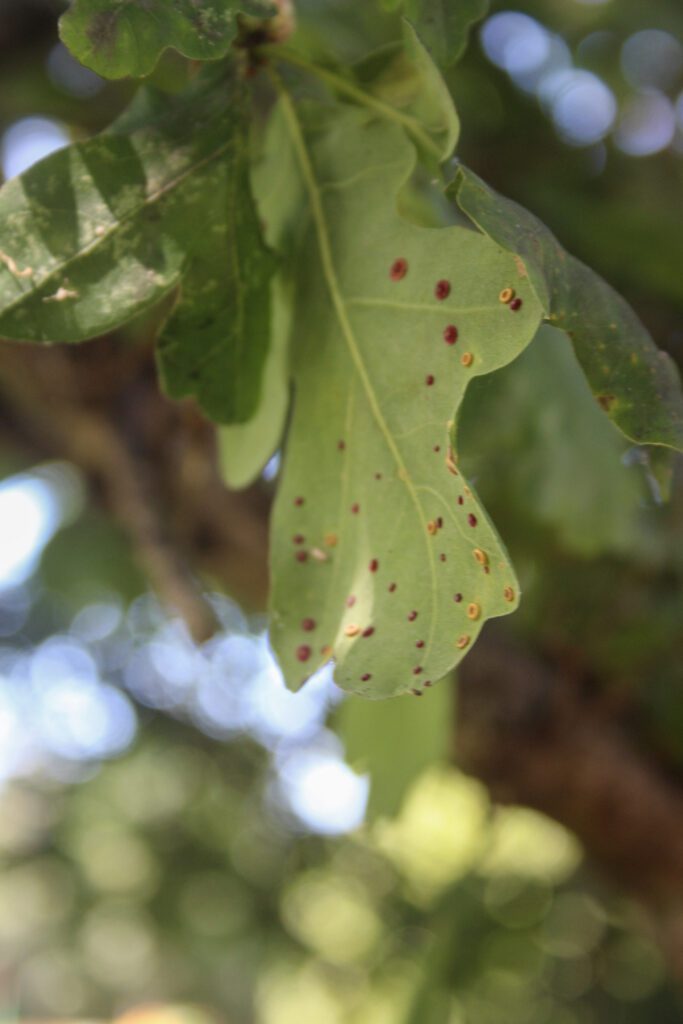
“The gall wasp comes to lay her eggs on my new leaves and I make spangle cradles to help to keep them safe.”

“It happens again and again. Not just the spangles. Look beneath my leaves and you might find round, knobbly balls, like hard brown marbles. These are oak apples, swollen with the same curious purpose. A different gall wasp requests a grander chamber, and I oblige. Within each one lives a single larva, safe and fed by the very cells I’ve grown to protect my own buds.
Why do I do it? I don’t know. Perhaps I am too old to care. Or perhaps I understand that these wasps—these minute engineers—are part of the pattern. They do no great harm. My crown still grows. My acorns still drop. My fungi and birds and lichens still cling and sing and creep through me.
So I let them stay.
When my leaves fall, the spangles fall with them. Some young mothers emerge come spring, and they begin again—quietly weaving their lives into mine, asking nothing more than a shelter made of leaf or bark.
I am not hollowed by this. I am enriched. Insects, wind, rain, rot, and sunlight—they all shape me. I am a home, not a fortress. I bear their homes, too.
And you, traveller —if you lie on your back and look up through my summer canopy, you might see more than green. You might see a world.”
- Jules Acton’s book, Oaklore, Greystone books, 2024, is an essential companion piece to this story. Jules helps us to think about all of the things that the English oak tree has given us as society and individuals.
Update, 20/07/25:

A new gall has appeared on our favourite oak tree. This is a Knopper gall, caused by the gall wasp Andricus quercuscalicis. The wasp secretes chemicals that distort the growth of an acorn. This is a rather more serious pest to the tree than the two show above, because it can reduce fertility of the tree.
Protected inside the gall is a developing larva, which will develop into a pupa and will emerge as an adult wasp in the next spring.

Leave a Reply