Cuckoo flowers in the spring

Spring has arrived—but the world is not yet settled.

In an uncertain climate, people choose uncertainty and so does the weather. Sun, rain, frost and wind – the persistent wind blowing through the meadows. Spring marches onwards, regardless.

The cuckoo flower in Trendlewood Meadows. [Photograph: Neil Ingram]

The cuckoo flower with its dainty lilac flowers hides in the unmown grass, shielded from the biting winds. Some look white at a distance, as pretty as a lady’s smock, which is another of its names. And ladies always want to look their best in spring.

Springtime when, historically, milkmaids and farm boys thought of romance, and their parents looked away. It captured Shakespeare’s imagination, too:

“When daisies pied and violets blue,
And lady-smocks all silver-white,
And cuckoo-buds of yellow hue,
Do paint the meadows with delight,
The cuckoo then, on every tree,
Mocks married men; for thus sings he:
“Cuckoo! Cuckoo, cuckoo!”
O, word of fear,
Unpleasing to a married ear!”

The ladies smock in in Trendlewood Meadows. [Photograph: Neil Ingram]

In the days when country gentlemen wrote letters on paper to the Times, each year there was a race to announce that the first returning cuckoo had been heard in England. 

The flowering of this meadow beauty coincided with the returning cuckoos, and so the name also became a signifier of spring.

Cuckoos are cheating birds, deceiving male birds of other species into raising their young for them. This is how a wife’s infidelity became the ‘cuckolding’ of her innocent husband.

The cuckoo flower became tainted by these unsavoury associations. They were not thought to be appropriate to pick and bring into the house, in case they brought bad luck.

The cuckoo flower needed saving from this undeserved fate, and in some parts of the country they became associated with the purity of the Virgin Mary.

The cuckoo flower in Trendlewood Meadows. [Photograph: Neil Ingram]

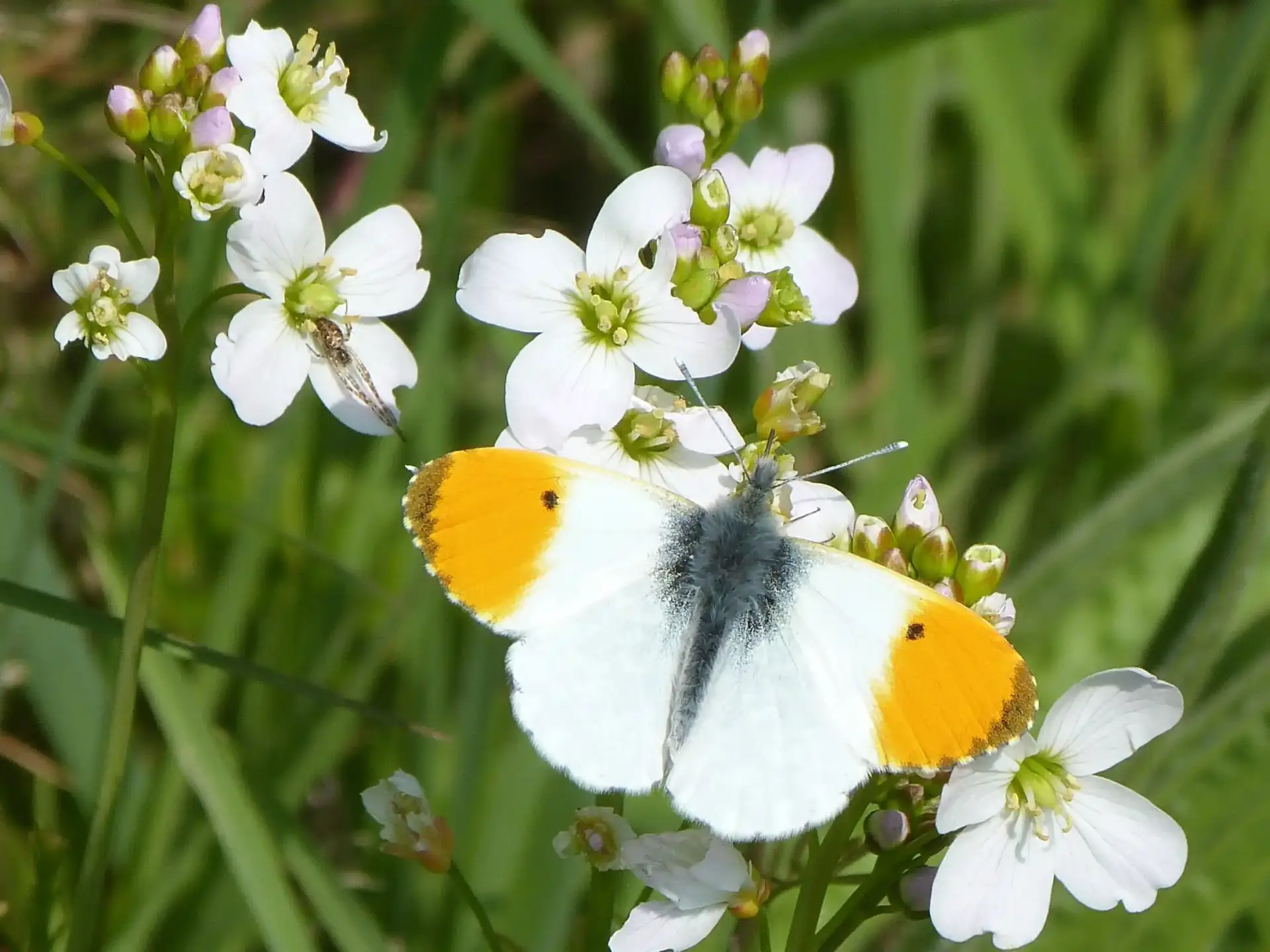
Country folk live with these flowers and their stories, which have become part of our culture. We love them in the park because they are food plants for the caterpillar of the orange tip butterfly, which is also friend of the park. Each female lays one egg beneath a cuckoo flower, and the emerging caterpillar feeds on the seeds of the plant.

Orange tip butterfly in Trendlewood Park. [Photograph Andrew Town]
A single egg of an orange tip butterfly on a cuckoo plant in the Meadows, Nowhere Wood, 22/04/26. [Photograph: Neil Ingram]

  1. Find out how the orange tip butterfly depends upon the cuckoo flower.


Notes on the story

A tale of two butterflies

The titmice of Nowhere Wood

[titmice is an old English name for birds of the Paridae family, including blue and great tits. It is also a term familiar to the American readers of these stories.]

This is a bright and early sunlit story, chipper with the sounds of Spring: 

“Ti-ti-pu, ti-tipu….tsee-tsee-tsee”. 

The quick, little, sharp notes, ticking up from the hazel beside the path, like a tiny clock wound too tight. I stop and look up. Far up high in the tree, a blue tit darts between the twigs, hopeful as a scrap of summer sky—blue crown, white cheeks, yellow breast flashing through the bare twigs.

Blue tit in Trendlewood Park. [Photograph: Andrew Town]

It paused only long enough to scold me before flitting deeper into the wood.

I walked on.

Nowhere Wood is just beginning to wake into spring. The oaks are still bare but their buds have swollen, and soon the leaves will open. When that happens, the caterpillars will come—thousands of them, hanging in the branches like green commas.

The small birds of the wood are waiting.

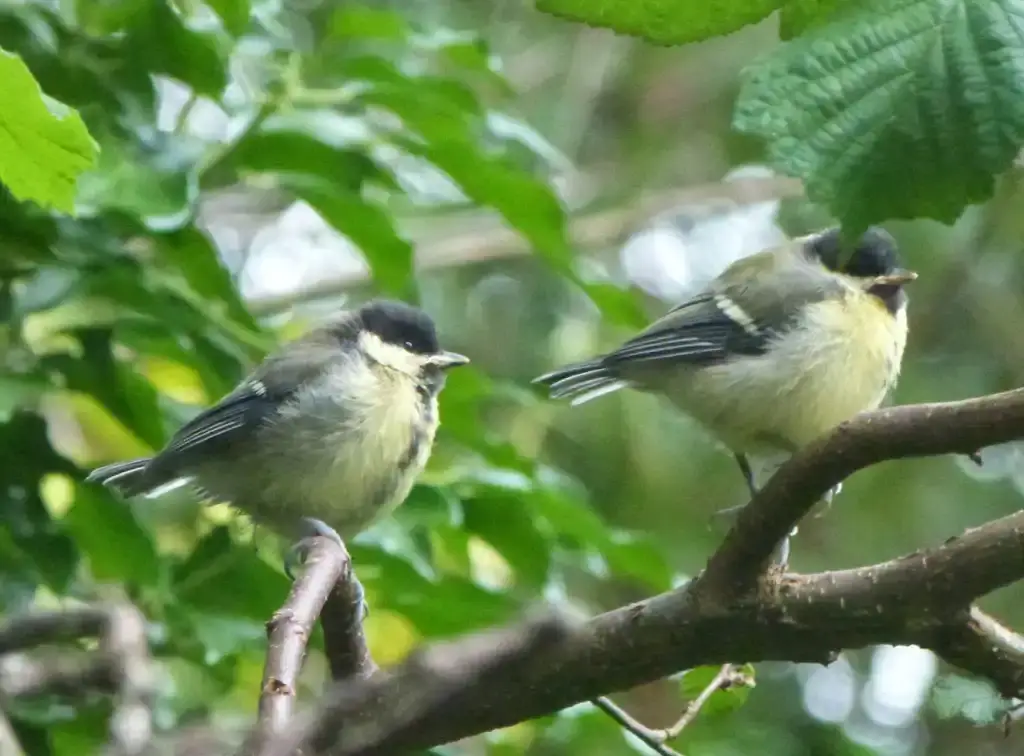
Blue tits in Trendlewood Park. [Photograph: Andrew Town]

Further along the path I hear another call, slower, deeper and more deliberate: teacher-teacher. A great tit landed on the trunk of an old oak and turned its head to look at me. Compared with the restless blue tit it seemed calm, almost thoughtful, its black breast stripe neat against the yellow. A bird with presence and authority.

For a moment the bird stayed there, gripping the bark.

Then it flew slowly, deliberately, away to an important meeting.

I follow the path round a bend where the hazels thickened. Suddenly the wood becomes alive with movement. Two blue tits chase each other through the branches, and the great tit returned, hopping along a twig above them.

They were not quarrelling. Instead, they searched the branches together, peering beneath buds and along the bark.

One of the blue tits hung upside down to inspect the underside of a twig. Then it seized something invisible and swallowed it.

Food.

Blue tits in Nowhere Wood. [Photograph: Andrew Town]

Soon there would be much more of it. When the oak leaves open the caterpillars will appear in a sudden green flood, and somewhere nearby these birds will be prepared for it.

In a hole in an old tree—or perhaps in a nest box hidden in the wood—a female tit might be sitting on a clutch of pale speckled eggs. One egg laid each morning until the nest held eight, or nine, or even ten.

When the chicks hatch, the parents will work without rest, carrying caterpillars back to the nest again and again and again.

The birds above me moved on, drifting through the branches lightly in the breeze

A moment later they were gone.

I walked a little further and noticed a feather lying on the path. Olive green, with a hint of yellow at the edge. A great tit’s feather, most likely.

I picked it up, then set it back down.

Somewhere behind me the ticking call of the blue tit began again.

The wood, it seems, is full of them.

  1. Titmice are popular visitors to gardens with bird feeders, especially in the winter. What are the advantages and disadvantages of feeding birds with bird feeders?


Notes on the story

More spring stories

The badgers of Nowhere Wood – a February story

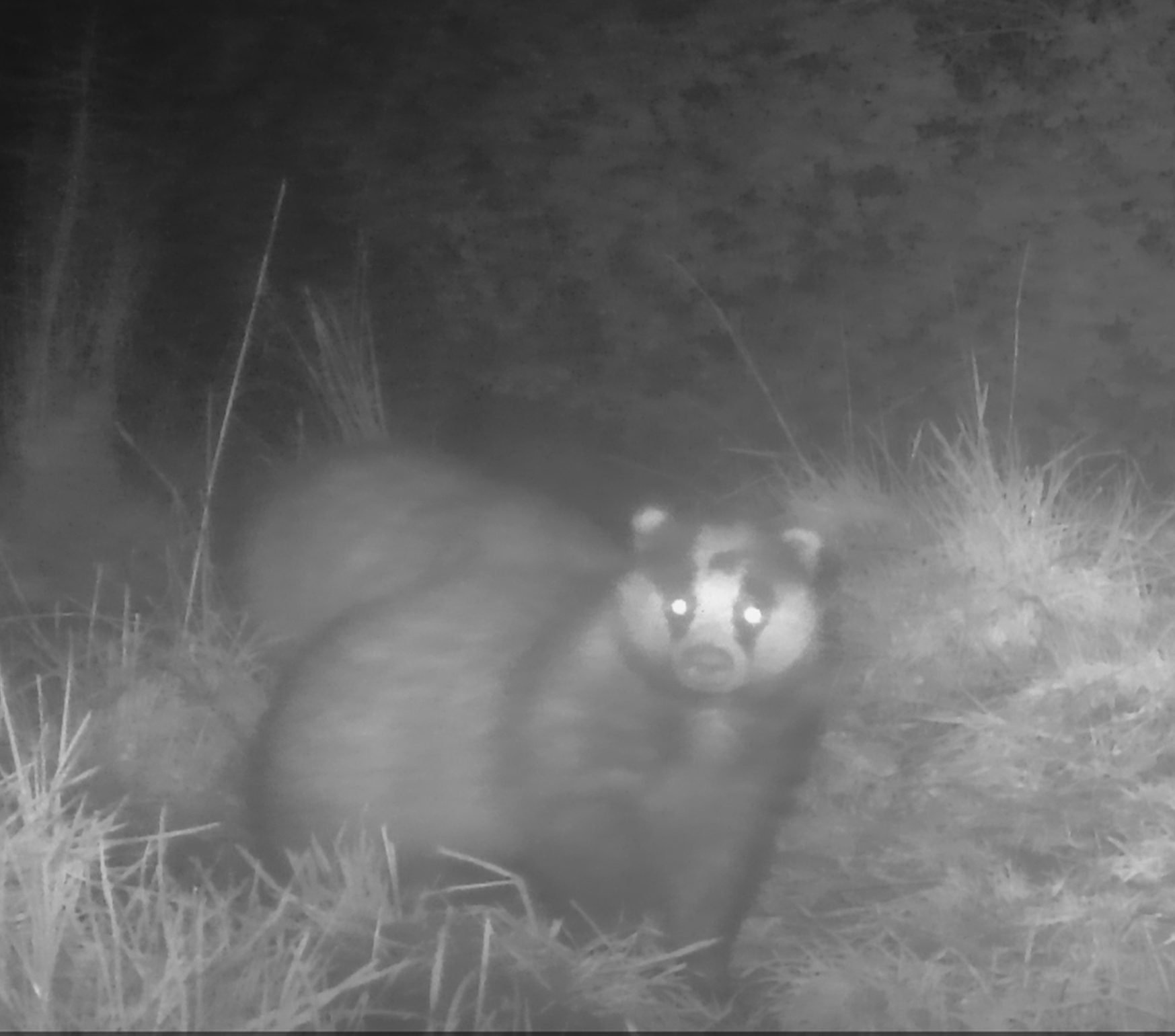
Male badger near Nowhere Wood, February 2026
Male badger near Nowhere Wood, February 2026. [Photograph: Neil Ingram]

There are badgers in Nowhere Wood. For the first time, we think. This is their February story.

Imagine living in a dark world shaped by scent, vibration and touch — where wind carries stories and the air itself guides you back to the mouth of your sett. A world of kinship and inherited ground. Of rival clans pressing at territorial edges. Of sudden violence in the margins between families.

Imagine spending each day feeding on the earth itself. Earthworms drawn from damp soil; fallen fruit when it ripens; carrion when it is found — but mostly worms. Reliable food, abundant in spring when the ground softens and the night stays wet.

The animals emerging at night to feed and play-fight — no claws unsheathed, no teeth bared — are likely subadult males. They circle, shoulder, and grapple in the leaf litter, testing strength without drawing blood. In time they will disperse, edging beyond the safety of their natal territory and pressing at the boundaries of neighbouring clans.

The breeding females remain underground. Late winter is the season of birth: cubs lie blind and furred in the nesting chambers, sustained by milk and warmth. We must wait several weeks before they appear above ground, tentative in the dusk outside the sett.

Male badger near Nowhere Wood, February 2026
Male badger near Nowhere Wood, February 2026. [Photograph: Neil Ingram]

We will follow the badgers through their year, as they explore their new world of scents and smells.

  1. How can badgers live safely alongside people?


Notes on the story

Subterranean superheroes

The spring…

This is the first part of a two-part story in the sustainable park series of stories.

First comes the summer rain, after weeks of drought. Then the wet drizzly, misty days, then the powerful storm from the bay of Biscay, and gradually the water table rises from its summer low.

The ancient spring fills and moves to the surface. Two generations ago, this spring fed into a pond where cattle drank. Locals picked water cress from the edges of its clear waters. This spring feeds our ancient oak (See: I bear their homes, too) and the old crack willow.

The old crack willow and the ancient oak in Trendlewood Park. [Photograph: Neil Ingram]

We celebrate the return of the spring like an old friend, as people have done for fifty thousand years or more. Water is our life. We have always known that.

Our spring feeds into a pond that we have built to contain it. Within twenty four hours the pond is full, and life settles down next to it.

All streams and rivers, even the mightiest, start from springs in muddy fields flowing in tiny streamlets, that join together as they travel towards the sea. In the past, people chose to build their homes close to rivers because of their need for water to live and to transport goods from place to place.

Photograph: The river Avon, that flows through Bristol to the Channel, starts life as springs in a field in Acton Turville in Gloucestershire. [Photograph: Derek Harper, https://www.geograph.org.uk/photo/5225584]

People use a lot of water in their homes and businesses, and the water table falls, even in winter. The springs and streamlets can dry up, affecting the flow of rivers. Dryer winters, caused by climate change, can make this even worse.

Rivers and streams are the drainage system of the landscape. When they flow freely, they carry rainwater away from our fields, towns, and roads. Global warming is bringing heavier and more frequent downpours, especially the autumn storms. This means much more water reaches the rivers in a shorter time. If the river channels are blocked by fallen branches, silt, or rubbish, the water cannot move quickly enough. It then spills out over the banks and floods the land around it.

Winter flooding in low lying floods around Nailsea, North Somerset. Small rivers and drainage ditches run next to these fields. [Photograph: Neil Ingram]

Healthy rivers also have space to spread out safely. When wetlands and flood meadows are protected, they act like a sponge. They slow the water, hold some of it back, and release it slowly. If these areas are lost or built over, the river has nowhere to go during a storm. So the extra rainfall caused by global warming becomes a bigger danger.

Keeping rivers clear and giving them room helps both people and wildlife. It reduces the risk of homes and roads being damaged. It also keeps the water cleaner for the plants and animals that depend on it. Maintaining rivers is one of the simplest ways we can prepare for a future with heavier rain.

Some indigenous peoples live by rivers and depend upon them for their survival. They often believe that their rivers are alive in ways that are more than just the lives of all of the organisms living there. These peoples believe that their rivers have rights and should be protected by laws.

  1. What protections do you think rivers should have? Who can protect them?

Notes on the story

Being and becoming in Nowhere Wood

The tunnelling armies beneath carpets of gold


It is early November in the park, and carpets of fallen leaves are piling up across the earth in sodden heaps, driven by the autumn winds and rains. The browns of the oak, the sycamore ambers and the golds of the beeches.

A carpet of fallen leaves in Nowhere Wood. [Photograph: Neil Ingram]

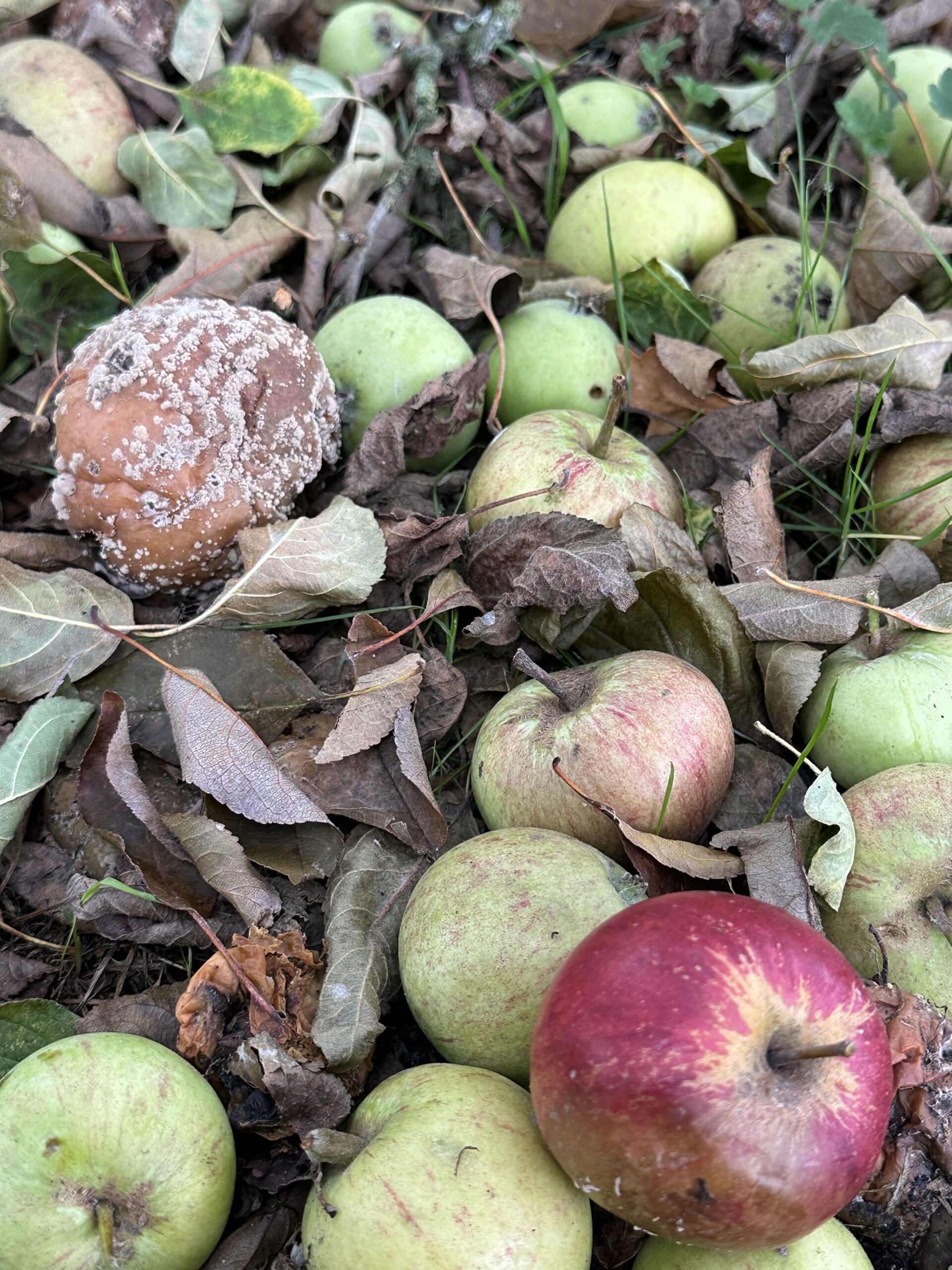
Beneath the old apple tree, the king of the orchard, fallen apples lie on top of the leaf-litter, wind-shaken and bruised. Their skins cracked, their flesh softening, their scent faintly sweet but sharp in the still air. To almost every walker, they are simply decaying fruit to be sidestepped or stepped on. But down below, for the mini beasts of the soil, these apples are the food for their futures.

Fallen apples in Trendlewood Park
Fallen apples in Trendlewood Park. [Photograph: Neil Ingram]

These apples, built by the tree from sunlight and salts, now become a banquet for a micro-world. First slugs and woodlice nibble the breaking skins.

As leaves and apple flesh break down, bacteria and fungi colonise. Fungi thread through leaves, breaking tough lignin and cellulose into sugars. Bacteria feed on these sugars and their growth increases.

Then the springtails and mites gather. But the major transformation begins when the earthworms arrive.

In this video from @PlayEarth we can see how apples are consumed by earthworms: in our park, the same players are at work, but working at much slower rhythms.

As the earthworms burrow, they drag down leaves and fragments of apple into the soil, creating tunnels rich in oxygen and moisture. The earthworms grind the material in their guts, making it more digestible for microbial armies.

As they pass through, the earthworms consume the microbe-rich soil, expelling the soil as finely ground particles. Their work accelerates the breakdown of the leaves and apples.

The result? The fallen apples, once crisp and bright, become part of the soil. Nutrients such as nitrogen, phosphorus and potassium return to the ground. The soil structure improves. Tiny pores hold water. Seeds waiting in the seed-bank sense the difference. Saplings in spring find richer soil, more ready to grow.

In our small park, what seems like waste—leaves and fallen apples— are the lifeblood of food webs, cycles and renewal. Life depends on life. The work of the worms and other soil organisms is quiet, unseen, but foundational. Without it, the leaf carpet would build up, decomposition would slow, nutrients would be locked away.  Instead, the earth beneath is alive and renewing, waiting for the spring.

  1. Many people tidy up the fallen leaves from their garden lawns and flower beds. Why might it be better to leave them where they fell? 


Notes on the story

Trampling acorns underfoot 


You might also like to read: 

Trick or treat?

Traveller's joy or OId man's beard. Growing on the edges of the meadow, Tendlewood Park
Traveller’s joy or OId man’s beard. Growing on the edges of the meadow, Tendlewood Park. [Photograph: Neil Ingram]

A traveller on the pathways, weary after many miles of walking, looks up into the hedgerow and sees the silky feathery threads surrounding the dark fruits. The sight brings the traveller an uplifting joy, at least according to John Gerard in his 1597 herbal. He called it ‘travellers joy’.

It has other names. It is ‘old man’s beard’ in Hampshire and Wiltshire and called the delightful ‘Withywine’ in Somerset. Its formal name is Clematis vitalba and it has distinctive flowers and fruits.

Drawings of the flowers and seed heads of Clematis vitalba.

Vitalba means ‘vital’, full of energy. It certainly grows rapidly, especially in new habitats, where it can form dense thickets. This is the secret of its success as a coloniser of hedges and woodlands.

But, its rope-like branches can choke and strangle the trees over which it invades. Little wonder that frustrated woodsmen have given it a range of darker names, such as ‘devil’s twister and ‘devil’s guts’.

Trick or treat? It is halloween, and it is for you to decide.

  1. Given the large number of local names for plant species, why was it important to create a recognised system of formal names?


Notes on the story

Being and becoming in Nowhere Wood

A different kind of woodpecker

A green woodpecker in Nowhere Wood
A green woodpecker in Nowhere Wood [photograph: Andrew Town]

If you look carefully at this image, you can see another woodpecker, but one that is quite different to the great spotted woodpecker that starred in our last story. This is a green woodpecker. Can you see why?


These two kinds of woodpecker are able to live together all year round in the wood, without getting in each other’s way. This is because they have different lifestyles.

AI generated woodpecker
An AI generated render of a green woodpecker

This AI generated image of the green woodpecker shows its special characteristics: the green feathers on the back and wings and the paler feathers on the belly. The red head and the black ‘moustache’ around the beak. Males have a red centre to the moustache, so this image is of a young female.


She has a sharp beak , like the great spotted woodpecker. Male green woodpeckers also use their beaks to dig holes for nesting sites.

A green woodpecker digging a nest in Nowhere Wood.
A green woodpecker digging a nest in Nowhere Wood. [photograph: Andrew Town]

 However, male green woodpeckers sing a special call to attract females to their nests. The call sounds like the woodpecker is laughing, and the bird is sometimes called a ‘yaffle’ or ‘laughing Betsy’. You can the various calls of the green woodpecker, here.


Unlike, the great spotted, the green woodpecker does not feed on insects found on the tree. Rather, it hunts for the ants that live in the open spaces near the wood. You might see them in the meadow that runs alongside the wood.

It is these differences in appearance and lifestyle that mean that the two woodpeckers can life happily alongside each other in the wood all year round.

  1. Green and great spotted woodpeckers have different ways of feeding. How does this help them to live alongside each other in Nowhere Wood?
  2. What might happen if they shared the same food supply?


Notes on the story

The sustainable park

Celebrating mushroom season!

A close up of a honey fungus, showing its gills and stem,
A close up of a honey fungus in Nowhere Wood, showing its gills and stem. [Photograph: Neil Ingram]

Everyone agrees, it is an outstanding mushroom season. The dry summer and the warm wet autumn have created the perfect conditions for these mysterious forms which spend most of their lives living underground. Quietly, but with ruthless effectiveness, they influence and shape the growth of the trees in the wood.

But, what is a mushroom? The people living in Nowhere a century and a half ago would distinguish between mushrooms (which they could eat) and toadstools (which they could not). Learning how to tell them apart was (and is) very important for mushroom foragers. Their children would have been taught that if they were not certain, they should leave well alone. Still good advice, today.

To a mycologist (a biologist of fungi) the term toadstool is not used, and the term ‘mushroom’ is used to describe the fruiting bodies of all these fungi.

Bracket fungus on the old beech tree in Nowhere Wood. [Photograph: Pat Gilbert]
This bracket fungus is growing on the old beech tree. It is probably a Giant Polyphore. [Photograph; Pat Gilbert]

So, this wonderful bracket fungus is still called a mushroom by biologists.

Honey fungus growing in Nowhere Wood.
These mushrooms may be of the honey fungus in Nowhere Wood. [Photograph: Neil Ingram]

Which fungi do not produce mushrooms? Well, yeasts are single-celled fungi that do not produce mushrooms. They often grow on the surface of fruit and help to turn apples into cider. Moulds and rusts are also fungi that do not produce mushrooms. They form fuzzy or powdery growths that spread quickly.

Yeasts and other fungi on fallen apples in Tendlewood Park. [Photograph: Neil Ingram]
Mould fungi on fallen apples in Trendlewood Park. [Photograph: Neil Ingram]

Moulds play an important role in helping to break down fruits in the orchard, releasing nutrients back into the soil.

What are mushrooms for? The photograph at the top of the page shows the gills of the mushroom, under its surface. The gills make and store spores, which blow away in the wind. Spores can settle and grow into new fungi.

  1. Imagine what would the world be like without fungi.

Notes on the story

Trick or treat?

Also see: 

The fairy ring

Moving things on

Hard hats, safety specs and camouflage jackets

It is a January morning, misty and still. The air hangs silently in Nowhere Wood. Suddenly close,  but just out of sight, a loud and fast drumming shakes the stillness. Then a silent pause, followed by a quieter drumming coming from the other end of the wood.

Let’s find the first drummer. He’s hard to see, high up in the tree, but there he is, pressed against the tree trunk: a male great spotted woodpecker. The other drummer in the distance is a young female. The woodpeckers are having an adventure in Nowhere Wood.

A female great spotted woodpecker approaching her young in Nowhere Wood.
A female great spotted woodpecker approaching her young in Nowhere Wood. [Photograph: Andrew Town]

Our male is digging a hole in his tree, hoping to impress the female. If it works, she will lay their eggs in the hollow space in the tree. This photograph, taken a few weeks later in Nowhere Wood,  shows the new mother feeding her fledgling chick.

How can these woodpeckers drill such large holes in trees without injuring themselves? Well, it looks as if all parts of their bodies have special characteristics that enable the birds to do this. Scientists call these special characteristics, adaptations.

Look at this video of a great spotted woodpecker pecking at a tree. Look at his  feet. He has three toes on each foot, with two toes facing forwards to grip and hold onto the tree trunk. This prevents him falling off when he pecks the tree! The beak is made of a tough material that keeps growing and keeps the beak sharp.

The adaptations to the skull and tongue of the woodpecker
The adaptations to the skull and tongue of the woodpecker. [Illustration by Denise Takahashi, https://www.birdwatchingdaily.com/news/science/woodpeckers-hammer-without-headaches/]

His skull is especially strengthened, like a builder’s hard hat. The brain presses right up against it and cannot move around.

The tongue extends backwards into the head as a long thin tube of bone and cartilage that runs right round the inside of the skull of the woodpecker. This acts like a seat belt, holding the brain in place.

The tongue is especially long and sticky, so it can go right into the tree holes, searching for insects.

Close up of the woodpecker, showing the feathers that protect the eyes from wood chipping.
a close up of a woodpecker. [Photograph: https://www.core77.com/posts/81063/Why-Woodpeckers-Dont-Need-Safety-Goggles-and-Why-Their-Beaks-Never-Get-Stuck-in-the-Wood]

The eyes fit tightly inside the skull, and do not vibrate whilst the bird is pecking. Their eyes have a special transparent membrane that closes across the front of the eye to prevent splinters of wood scratching the eyes. The feathers around the eyes and beak also stop wood reaching the eyes. Together, they act as safety spectacles!

Finally, a woodpecker is quite vulnerable to attack by larger birds when it is drumming against the tree. The patterns of lines and stripes act  like a camouflage jacket, making the bird hard to see against the tree surface.

  1. Woodpeckers have a lot of adaptations to help them to survive in Nowhere Wood. This story contains a photograph that suggests that the woodpeckers are living successfully here. What does the photograph tells us about the future of woodpeckers in Nowhere Wood?
  2. Woodpeckers have developed these adaptations through evolution.  Charles Darwin is the scientist who first suggested a possible way evolution could happen. This is called natural selection. Find out what natural selection is.

Notes on the story

A different kind of woodpecker


Fruits of the autumn

Autumn fruits in Nowhere Wood
Autumn fruits in Nowhere Wood. [photograph: Neil Ingram]
Autumn is the time for fruits to become ripe enough for animals to eat. This time last year, Nowhere Wood was full of ripe acorns and the squirrels and birds had a heyday. This year, there are no acorns, at all. Life is uncertain, in Nowhere Wood.

Somewhere, inside a fruit, is a seed and seeds contain new lives – the next generation of the woodland plants.

Blackberry fruits in Nowhere Wood
Blackberry fruits in Nowhere Wood. [Photograph: Neil Ingram]

These fruits are blackberries. The seeds are found inside the berries. They are tiny, with hard tough seed coats.

Birds, especially blackbirds and thrushes, love to eat blackberry fruits. In doing so, they help the plant to spread its seeds away from the wood. The seeds are tough and survive digestion inside the backbird.

The seeds are dispersed around the wood in the blackbirds’ poo!

To survive, the blackbirds need the blackberry fruits and the blackberry plants need the blackbirds.

  1. Think about what happens to the seed when the fruit is eaten by a blackbird.
  2. How does the blackbird help the blackberry plant to spread its seeds away from the wood?

Notes on the stories


The secret of the winter flowers

I bear their homes, too

For Jules Acton, author of Oaklore.

The old oak tree said to the traveller passing by:

“You know me, you see me everyday. I am that oak tree that has stood here longer than any of can you remember.”

The oak tree in Trendlewood Park dominating the view
The oak tree in Trendlewood Park, viewed from the author’s study. [Photograph: Neil Ingram]

“I am on the 1840 Ordnance Survey map and I was a sturdy tree, even back then. Let’s say, I’m two hundred years old? I am still in my prime, though. I won’t be celebrated as old for another two or three hundred years. Don’t wait up for me.”

A leaf of an English oak.
A leaf of an English oak. [Photograph: Neil Ingram]

“I am a patriot, a true blue English oak: look at the ear-shaped lobes at the bottom of my leaves and the very short leaf stalks. Pedigree characteristics, those.”

Long stalks on the growing acorns of an English oak tree.
Long stalks on the growing acorns of an English oak tree. [Photograph: Neil Ingram]

“And look at the length of the stalks that hold up my acorns – the longer the better. Need I say more, I am as English as St George, cricket and cider.”

“I have never been a wildwood oak: a farmer’s tree, that’s me. My roots are deep in the clay, fed  by a spring that kept the animals safe and watered. I had space: my limbs lifted upwards to touch the sky. I’ve seen the storms lash the fields and the brambles come and go. I wear the years in my bark and the seasons in my leaves.”

The oak tree is about 200 years old
The oak tree is about 200 years old. [Photograph: Neil Ingram]

“I am a good neighbour – well after all of this time, why not? In the summer I play host to lots of welcome visitors.”

Spangle gall on an oak leaf.
Spangle gall on an oak leaf. [Photograph: Neil Ingram]

“The gall wasp comes to lay her eggs on my new leaves and I make spangle cradles to help to keep them safe.”

oak galls
oak galls. [Photograph” Neil Ingram]

“It happens again and again. Not just the spangles. Look beneath my leaves and you might find round, knobbly balls, like hard brown marbles. These are oak apples, swollen with the same curious purpose. A different gall wasp requests a grander chamber, and I oblige. Within each one lives a single larva, safe and fed by the very cells I’ve grown to protect my own buds.

Why do I do it? I don’t know. Perhaps I am too old to care. Or perhaps I understand that these wasps—these minute engineers—are part of the pattern. They do no great harm. My crown still grows. My acorns still drop. My fungi and birds and lichens still cling and sing and creep through me.

So I let them stay.

When my leaves fall, the spangles fall with them. Some young mothers emerge come spring, and they begin again—quietly weaving their lives into mine, asking nothing more than a shelter made of leaf or bark.

I am not hollowed by this. I am enriched. Insects, wind, rain, rot, and sunlight—they all shape me. I am a home, not a fortress. I bear their homes, too.

And you, traveller —if you lie on your back and look up through my summer canopy, you might see more than green. You might see a world.”

  1. Jules Acton’s book, Oaklore, Greystone books, 2024, is an essential companion piece to this story. Jules helps us to think about all of the things that the English oak tree has given us as society and individuals.

Update, 20/07/25:


A new gall has appeared on our favourite oak tree. This is a Knopper gall, caused by the gall wasp Andricus quercuscalicis. The wasp secretes chemicals that distort the growth of an acorn.  This is a rather more serious pest to the tree than the two show above, because it can reduce fertility of the tree.

Protected inside the gall is a developing larva, which will develop into a pupa and will emerge as an adult wasp in the next spring.


Notes on the story

Being and becoming in Nowhere Wood

A home for the summer

The effects of horse chestnut leaf miners, on a horse chestnut tree in Trendlewood Park
The effects of horse chestnut leaf miners, on a horse chestnut tree in Trendlewood Park, July 2025 {Photograph: Neil Ingram]

By the high summer of July, the new fresh leaves of the horse chestnut are losing their lustre. The proud spread of leaves  are now crumpled and marked—creased with dry, papery wounds edged in rust. At first glance, it looks like disease or drought. But the truth is stranger, and smaller.

These are the workings of a moth barely visible to us—Cameraria ohridella, the horse chestnut leaf miner.

The horse-chestnut leaf miner insect
The horse-chestnut leaf miner insect. [Photograph: Soebe https://commons.wikimedia.org/wiki/File:Cameraria_ohridella_8419.jpg]

The insect arrived in Britain around 1990, a quiet traveller from North Macedonia, and it has found homes wherever horse chestnuts grow. As the climate warms, insects from the southern regions are able to live successfully in more northern areas.

The female lays her eggs on the newly opened leaf, which hatch to form lavae (caterpillars).

The larva of the holly leaf miner insect
The larva of the holly leaf miner insect. [Photograph: Been-tree https://commons.wikimedia.org/wiki/File:Cameraria_ohridella_larva_beentree.jpg]
The larvae feed within the leaf itself, tunnelling through the soft tissue, leaving behind pale blotches that crackle in the sun.

What’s remarkable is how unnoticed it all is. The adult moth is just five millimetres long and flits at dusk, almost never seen. The eggs are microscopic. The caterpillar never breaks the surface of the leaf. And yet, whole avenues of horse chestnut trees wear the evidence every July—brown-scarred leaves fluttering like worn-out flags, months before autumn should arrive.

The tree will survive. The damage is cosmetic, mostly. But it leaves a strange melancholy in the woods: an early whisper of decline in the green heart of summer. A reminder that even the mighty horse chestnut has its unseen vulnerabilities. And that nature’s smallest players are often the most quietly transformative.

  1. What benefits do the horse chestnut leaf miner gain from living with the horse chestnut tree. What benefits does the horse chestnut tree get from the arrangement?


Notes on the story

“I bear their homes, too”

The Lords and Ladies of Nowhere Wood

Nowhere Wood in late winter is a place of bare branches, weak shadowy light and unspoken secrets, waiting for new leaves start to emerge.

Lords and ladies in January
Lords and Ladies in January [Photograph: Neil Ingram]

On the woodland floor, hidden beneath the shade of hazel and hawthorn, something strange is happening. By April, it is fully revealed.

Lords and ladies, in Nowhere Wood April
Lords and Ladies, in Nowhere Wood, April [Photograph: Neil Ingram]

It’s not flashy, no pretty flower show. Just a apple-green leaf, twisted like a bishop’s cowl. A greenish-purple hood half-hiding something inside. You’d walk past it if you didn’t know better.

The plant is Arum maculatum, but no one calls it that around here. It has lots of ancient names, some of which are so rude that they would make Geoffrey Chaucer blush! In Somerset, it was called ‘Adam and Eve’, but most places call it Lords and Ladies, and there’s a good reason for that. With a little imagination, we can see the tall upright lord dancing with his lady in the flowing green gown.

This is a flower and it is a seed making factory. It does this by subterfuge, luring insects and holding them hostage until it gets what it wants.

Lords and ladies flower exposed
Lords and Ladies flower exposed, [Photograph: Neil Ingram]

One glance inside the sheath and you’ll see the machinery of the deception: “the Lord”  is called a spadix,  sitting on top of a ring of yellow hairs that point downwards. Below them are the orange ovaries, that will become fruits containing the new seeds. These are the “Ladies”.

Beneath the ladies are the yellow pollen-making anthers, that ripen after the ovaries have received pollen from insects.

Down in the gloom of the woodland floor, the spadix heats up,  becoming  warmer than the air around it, which attracts small insects.  It also gives off a  smell of rotting meat and dung — irresistible, if you’re a midge or a small fly looking for a good meal.

They blunder in, hunting decay. Down they fall, past a ring of slippery hairs that trap them in the chamber below. There’s no nectar. No reward. But while they wander round, they give up their pollen to the ovaries. The pollen grows tubes that towards the egg cells, fertilising them, and making new seeds.

The stamens burst open with fresh pollen, which give the insects a quick meal, whilst covering their bodies in pollen.

The yellow hairs of the jail bars have withered overnight, allowing the insects to escape with their pollen load. No harm done, the insects immediately carry the pollen away to the next ripe lords and ladies flower in the wood.

lords and ladies fruits, nowhere Wood, June. [Photograph: Neil Ingram]
Lords and Ladies fruits, Nowhere Wood, June. [Photograph: Neil Ingram]

By June. the sheath is long gone. But what remains is a spike of fruits, ready to ripen in the late summer sun. As bright as traffic lights, the fruits rise like a warning from the shade. Poisonous, yes. But beautiful.

ripe fruits of lords snd ladies in Nowhere wood, July.
ripe fruits of Lords and Ladies in Nowhere Wood, July. [Photograph: Neil Ingram]

The autumn is a time for making food, using its large leaves that are designed to capture the dim light of the woodland floor. The food is stored underground in a rhizome.

young leaves of lords and ladies, in Nowhere Wood, January
young leaves of lords and ladies, in Nowhere Wood, January. [Photograph: Neil Ingram]

Later, the leaves disappear and the plant lives underground for the winter.

Rhizome of Lords and Ladies plant
Rhizome of Lords and Ladies plant. [Photograph: Neuchâtel Herbarium, https://commons.wikimedia.org/wiki/File:Neuch%C3%A2tel_Herbarium_-_Arum_maculatum_-_NEU000100869.jpg]

It lives on as a secretive rhizome, sleeping through the summer heat and the turning year, until — just as the bluebells fade — it returns to play its part again.

Be careful: all parts of these plants are poisonous to people – especially the berries.

  1. Each ripe red fruit contains a seed of the Lords and Ladies plant. Birds, like thrushes and backbirds love to eat these fruits. Explain how this helps to disperse the seeds away from the parent plant.
  2. What are the advantages to small insects of going inside a Lord and Ladies flower?

Notes on the story

Echoes from Nowhere

Safety in numbers

cluster flies on a leaf in Nowhere Wood
Cluster flies on a leaf in Nowhere Wood. [Photograph: Neil Ingram]

These animals look like cars parked in the autumn sunshine. They look harmless enough, but they have some gruesome secrets.

What are they and what are they doing? They are called cluster flies, and they are warming their bodies in the sun, before flying to feed on the fruits of the wood.

They are having adventures in time and space in Nowhere Wood.  Life in the wood is dangerous and the animals are busy being alive: feeding, drinking and staying warm.

The animals certainly look like flies: with one pair of wings, a large head and huge compound eyes. Look closer and you might see their mouthparts, sucking water from the surface of the leaf.

More cluster flies gather on the leaf in Nowhere Wood, October 2021
More cluster flies gather on the leaf in Nowhere Wood, October 2021. [Photograph: Neil Ingram]

The flies have lived their whole lives in Nowhere Wood. Their mothers laid their eggs in the soil last autumn. In the Spring, the eggs hatched to release larvae into the soil that burrowed into the bodies of earthworms.

They spent the early summer feeding on the worms before pupating. The adults emerged in the early summer, killing their earthworm hosts.

The flies are in a hurry to breed before it goes colder, later in the month. They are becoming mature enough to produce the next generation of flies.

Then the cycle of ‘being and becoming’ will begin again.

There is safety in numbers. The main predator of these flies is a type of wasp. There are twenty pairs of eyes looking out for danger and when one senses the wasps, they all fly away.

Life is so uncertain in Nowhere Wood. As well as wasps, the air contains the spores of dangerous fungi, that can infect and grow inside the adults,  eating them up from the inside! In spite of the dangers, enough cluster flies survive to breed to be present in the wood next year.

Life is an uncertain adventure for the cluster flies, the earthworms, the wasps and the fungi. Everything is connected in Nowhere Wood.

  1. Suggest why cluster flies need to warm their bodies in the morning, before they can fly.
  2. Suggest why there is safety in numbers.

Notes on the story

Goodbye, for now

A tale of two butterflies

It is a sunny afternoon in May and two butterflies are flying round each other in a shaft of sunlight. The smaller one chases the larger one away.

I first thought they were a courting pair, but then realised they are different types. Where do they come from and what are they doing in the sunshine?

Specked wood butterfly in Nowhere Wood, May 2025
Specked wood butterfly in Nowhere Wood, May 2025. [Photograph: Neil Ingram]
The chasing butterfly is a specked wood, seen  resting on an ivy leaf,  keen to be photographed. It is a true native of Nowhere. It started life as an egg laid during the previous autumn, perhaps on some of the long grass that skirts the wood. It probably emerged a few days ago, and has taken to flying in the same shaft of sunlight.

It is warm and bright in the sunlight and both males and females are attracted to the same spot. No wonder our male wants to chase rivals and other butterflies away!

The unfortunate butterfly to be caught up in this tussle was a red admiral. It was harder to photograph against the floor of the woodland.

Red admiral butterfly, Nowhere Wood, May 2025
Red admiral butterfly, Nowhere Wood, May 2025. [Photograph: Neil Ingram]
This butterfly was just in the wrong place at the wrong time.

The red admiral butterfly is a summer visitor to the wood, with large numbers arriving in the UK  from southern Europe and North Africa each year. They love to feed on flowers that produce a lot of nectar, so are often found in the gardens that surround the wood.

They will breed whilst they are living in the wood, and some of these new butterflies will try to fly back to Europe in the autumn. It is not clear how many of them will survive the long journey.

Others will try to survive the winter in the UK. In the past, most of these have died because of the cold, but warmer winters mean that more of them are surviving to breed in the spring.

We could be seeing a shift in their behaviour because of climate change, that could lead them to being permanent residents in the wood.

Update:

Two days later, the speckled wood was still patrolling the same patch of sunlight. Let’s hope he gets lucky soon!

A male speckled wood butterfly was found in the same spot two days later.
The male speckled wood butterfly was found in the same spot two days later. [Photograph: Neil Ingram]

  1. In Southern Europe and North Africa, red admiral butterflies can breed continuously throughout the year. Why is important in the survival of the red admiral species?
  2. Why is it an advantage for the specked wood to defend a territory in Nowhere Wood?


Notes on the story

Being and becoming in Nowhere Wood

The story of bluebells

Bluebells at Portishead headland.
Bluebells at Goblin Combe [Photograph: Pat Gilbert, Friends of Trendlewood Park]
If primroses and cowslips are our favourite flowers of early Spring, then it is the bluebells that steal our hearts in early Summer. On a sunny day, they dust the floor of the wood in a blue mist.

Many poets have written in wonder of them. Alfred, Lord Tennyson may have walked the bluebell woods above nearby Clevedon Court with his friend Arthur Hallam. Tennyson compared a carpet of bluebells to “the blue sky, breaking up through the earth”.

Bluebells are important plants in woods. About 50% of the world’s population of English bluebells (Hyacinthoides non-scripta) is found in the United Kingdom. This is largely due to the UK’s relatively mild climate and our widespread ancient woodlands, where bluebells thrive.

But all is not as it seems, because the English bluebell is threatened by a rival Spanish bluebell, (Hyacinthoides hispanica), which was introduced in the 17th and 18th Centuries into formal gardens in large country houses.

English bluebell in Nowhere Wood.
English bluebell in Nowhere Wood. [Photograph: Neil Ingram]
 The flowers of English bluebells are deep violet-blue,  bell-shaped tubes with petals that roll upwards.  They are found mostly on one side of a curving stem, so that the flowers droop downwards. Often they have a strong sweet scent.

Spanish bluebell in Nowhere Wood.
Spanish bluebell in Nowhere Wood. [Photograph: Neill Ingram]
The rival Spanish bluebell has paler flowers that are found all round the stem, not just on one side. The petals are not as curved back as the English bluebell. The stems are thicker and more upright and the leaves are much broader than the English bluebell.

Spanish bluebells
Spanish bluebells. [photograph: Neil Ingram, Nowhere Wood]
These two species are closely related and can breed together to produce plants that can breed with each other and with both parents. These are the hybrids. So, what we find is that in  most English woods we get a range of bluebells, some of which resemble the English and Spanish types as well as many plants that have characteristics of both types.

Recent research suggests that most of the bluebells in UK woods are hybrids and the pure English forms are restricted to very old woodlands that have little human interference. Certainly the ones bought from garden centres are probably hybrids.

However, the good news is that the English bluebell is thriving in these remote woodlands and is likely to survive, as long  as we leave them alone!

  1. Does it matter if the traditional population of English bluebells is gradually replaced by a hybrid form of English-Spanish bluebell. What do you think?


Notes on the story

A tale of two butterflies


The Apple Tree Man of Nowhere

Once upon a time, there lived a young man called Henry Summers, who lived at the Farmhouse over at the East End, just below the quarry. He was a wise man, strong in the arm and of calm manner. He never beat his animals or his wife. The family farmed ten fields and had several beautiful apple orchards.

Among the trees, there was one particularly ancient apple tree that Henry’s great grandfather planted and around which all of his children had played. The tree stood tall and strong, even though it was very old.

Henry believed that this tree was extra special, and he called it the ‘Apple Tree Man’. Henry always took great care of this tree, speaking to it kindly and ensuring it had plenty of water and cider at the wassail.

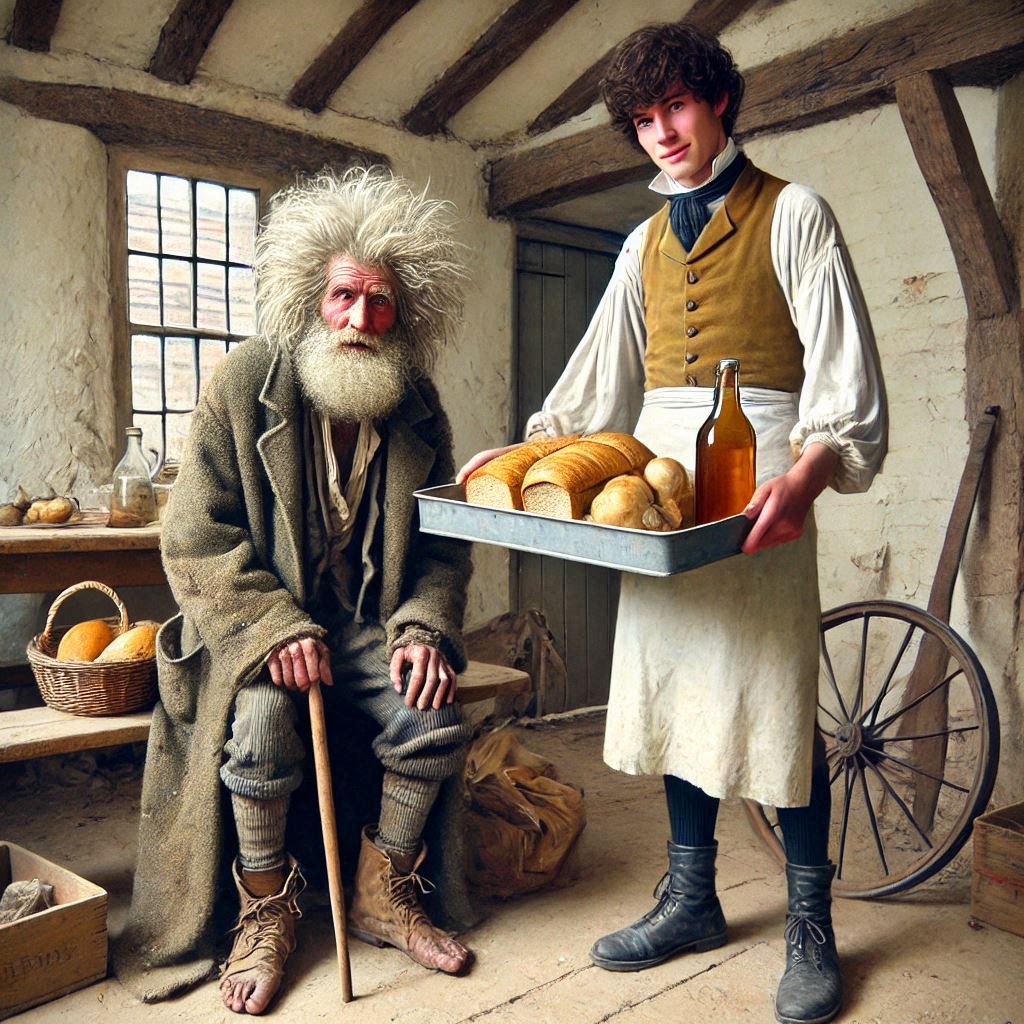
One cold winter’s night, Henry was visited by a stranger who had walked from Bristol and wanted to find friends in Nowhere. His clothes were dirty and his shoes were worn out. Henry was as kind to people as he was to his goats, welcomed the stranger into his home and gave him food and cider.

The wanderer meets the young farmer

His wife looked out some more shoes for him.  The stranger slept soundly in his clean bed that night.

The next day, the happy stranger revealed that he was, in fact, the spirit of the Apple Tree Man who had taken the form of a wanderer to test the farmer’s kindness.

The Apple Tree Man promised the farmer that as long as he continued to care for the apple trees, his orchards would make so many lovely apples every year, that he and his family would be wealthy and  joyful.

The apple trees produced many beautiful apples

The Apple Tree Man was true to his word, the orchards flourished, and the farmer and his descendants enjoyed bountiful harvests for many generations. And the people of Nowhere enjoyed their cider for years to come.


Notes on the story

Climate change: new arrivals in Nowhere Wood


The singing trees

ice freezes the pondWinter has come to Nowhere Wood and ice has formed around the fallen trees in the pond. Everything shivers and wood is silent again. Squirrels search for food in the frozen mud, but everything else is waiting, biding its time.

Silent, except for an ancient overgrown hedge formed from a row of old trees, bound together into a thicket by generations of bramble stems. These trees are singing, for this is the home of the tree sparrows. The trees are just outside the wood, next to a path much used by dogs taking their owners for a daily walk.

The tree sparrows are warm, protected from the icy wind by the layers of dead branches that surround them. Impenetrable, they are hidden amongst the branches, out of harm’s way. In this forgotten place, they thrive and they sing.


Well not quite forgotten. In the garden of a house, less than 10 metres from the singing trees, is a garden with a bird feeder, filled daily by its residents. The sparrows dart from the hedge to the feeder and then back again, hour after hour, making sure they do not go hungry.

Small acts of kindness can make a big difference to the birds in Nowhere Wood. These ancient hedges are important, too, as wildlife corridors, joining ancient woodlands together, giving animals a chance to move safely across the landscape.

  1. Why are the ancient hedges such a good place for the tree sparrows to live?
  2. Why are bird feeders so important in the winter months?


Notes on the story

Spring is coming!

Subterranean superheroes

Leaf fall in Nowhere Wood. [Photograph: Neil Ingram]
The leaves covering the floor of Nowhere Wood are slowly disappearing in the mild December nights. Fog hangs in the air. The wood is preparing for winter and everywhere is quiet and still. Most of the real action is taking place below the ground, but what is making the leaves disappear?


Earthworm [Photograph: Shutterstock 1596740926, licensed to NI]
The culprits are earthworms, the little subterranean superheroes that do most of the heavy lifting in Nowhere Wood. There is about 45 million earthworms underground in the wood, with a total biomass equal to about twenty elephants. They are easily the most abundant animal in the wood, but they are so rarely seen.


Earthworm. [Photograph: Shutterstock 171009224, licensed to NI]
Earthworms tunnel into the soil making the burrows that are their homes. At night, they come to the surface to drag fallen leaves back down into their burrows. The burrows are also perfect homes for bacteria and fungi.


Fungi mycelia. [Photograph: 159740926, licensed to NI]
The bacteria and fungi  feed on the leaves, turning them into nutrients that they use as food. This is humus. Earthworms eat the fungi and the humus-rich soil. As they do so, they glue the soil particles together into small clumps. This improves the quality of the soil, making it a perfect environment for plant roots.


Plant roots in Nowhere Wood. [Photograph: Neil Ingram]
Plant roots need plenty water, air and nutrients, all of which are given to the soil by the fungi and earthworms. We can think of earthworms as the soil’s farmers, ploughing the soil for the plants. Without their work, no life could exist in Nowhere Wood.


Charles Darwin. [Shutterstock 252138244, licensed to NI]
The famous scientist Charles Darwin studied how plants, earthworms and fungi work together to keep woods alive, and he wrote a famous book about it in 1881. He wrote about earthworms: “It may be doubted whether there are many other animals which have played so important a part in the history of the world, as have these lowly organised creatures.”

  1. In what ways do you think that soil is alive?
  2. Think about how the trees, fungi and earthworms work together to keep the wood alive.

Today, Friday 4th December 2020, is World Soil Day 2020. Here is a video celebrating our dependence on soil:

Notes on the story

Spring is coming!

Life is a relay race

This story continues the adventures of the ferns in Nowhere Wood. The first part of the story is Climbing the walls.

The genome of the fern contains essential information that the fern needs to grow and  make new cells. At different times the fern produces spores, sperm and eggs and the two forms of the plant. The genome contains information on the growth of each of these stages.

The information in the genome is the same in every cell of the fern because an identical copy of the genome is found inside the nuclei of all the cells of this fern at every stage of its life.

The genome is found in the nucleus of each cell.

Fern chromosomes

The genome is divided between a number of chromosomes. The diagram shows the genome of the Adder’s tongue fern. It has about 1440 chromosomes. This is the largest number of chromosomes of any organism in the world!

Fern genomes are larger than the genomes of other organisms, because they contain the information the fern needs to grow spores, sperms and eggs as well as the two forms of plant.

The genome contains the secrets of how to be a fern and how to move forward in the adventure. This information has been copied and passed on to each generation of ferns, ever since the first ferns evolved about 390 million years ago.

Life is like a relay race: genetic information is passed on from one generation to the next in the genomes of sperms, eggs and other gametes.

These ferns are having risky and uncertain adventures in time as well as space. If the secret information is not passed on correctly, then the species may become extinct. History shows us that most species that have ever lived on Earth are now extinct.

    1. Why do you think it is essential that the genetic information from parents to offspring is copied accurately?
    2. Why do you think the fern genome is so large, compared with other types of plant?

Notes on the story

All change!