Celebrating mushroom season!

A close up of a honey fungus, showing its gills and stem,
A close up of a honey fungus in Nowhere Wood, showing its gills and stem. [Photograph: Neil Ingram]

Everyone agrees, it is an outstanding mushroom season. The dry summer and the warm wet autumn have created the perfect conditions for these mysterious forms which spend most of their lives living underground. Quietly, but with ruthless effectiveness, they influence and shape the growth of the trees in the wood.

But, what is a mushroom? The people living in Nowhere a century and a half ago would distinguish between mushrooms (which they could eat) and toadstools (which they could not). Learning how to tell them apart was (and is) very important for mushroom foragers. Their children would have been taught that if they were not certain, they should leave well alone. Still good advice, today.

To a mycologist (a biologist of fungi) the term toadstool is not used, and the term ‘mushroom’ is used to describe the fruiting bodies of all these fungi.

Bracket fungus on the old beech tree in Nowhere Wood. [Photograph: Pat Gilbert]
This bracket fungus is growing on the old beech tree. It is probably a Giant Polyphore. [Photograph; Pat Gilbert]

So, this wonderful bracket fungus is still called a mushroom by biologists.

Honey fungus growing in Nowhere Wood.
These mushrooms may be of the honey fungus in Nowhere Wood. [Photograph: Neil Ingram]

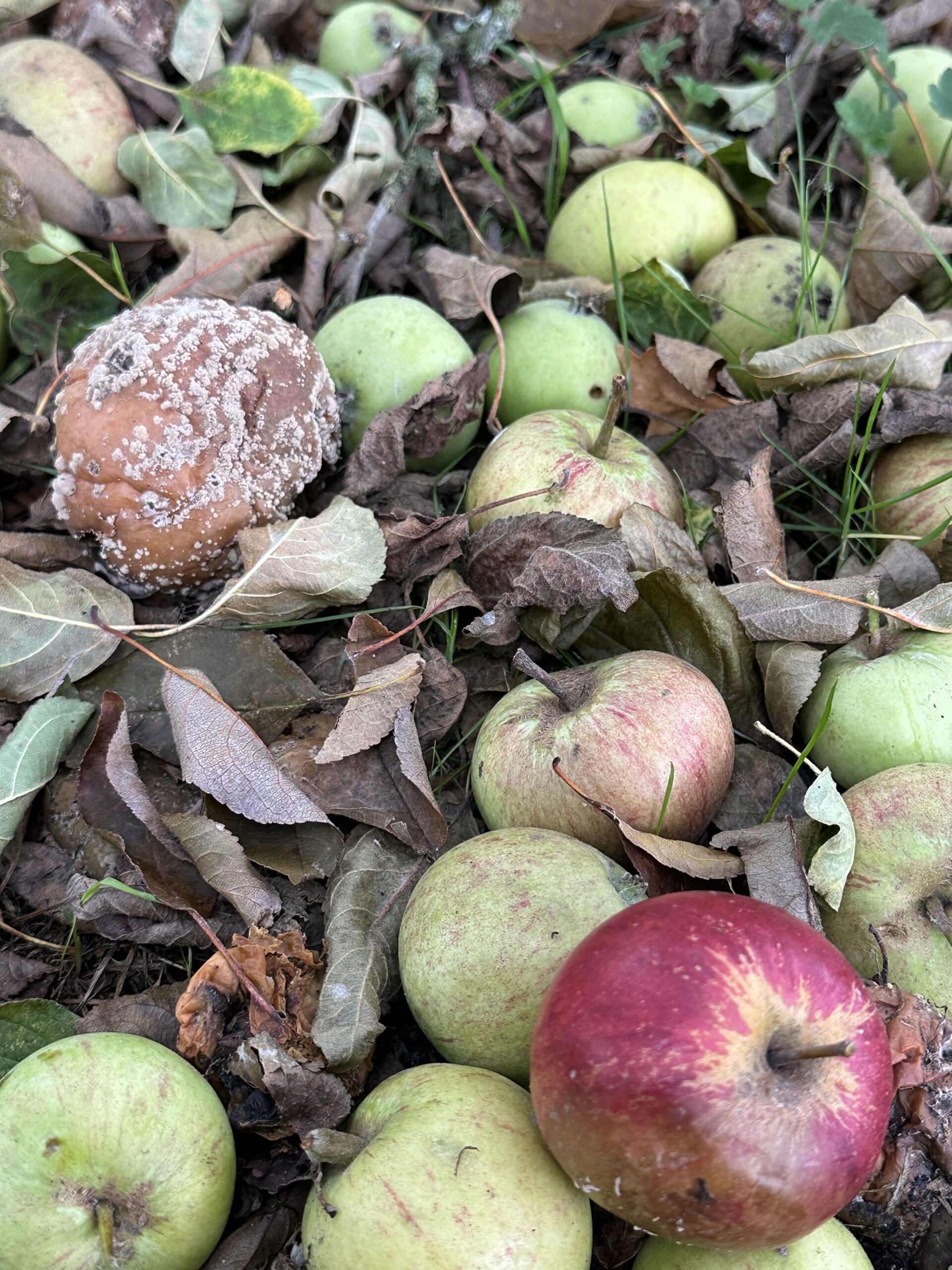
Which fungi do not produce mushrooms? Well, yeasts are single-celled fungi that do not produce mushrooms. They often grow on the surface of fruit and help to turn apples into cider. Moulds and rusts are also fungi that do not produce mushrooms. They form fuzzy or powdery growths that spread quickly.

Yeasts and other fungi on fallen apples in Tendlewood Park. [Photograph: Neil Ingram]
Mould fungi on fallen apples in Trendlewood Park. [Photograph: Neil Ingram]

Moulds play an important role in helping to break down fruits in the orchard, releasing nutrients back into the soil.

What are mushrooms for? The photograph at the top of the page shows the gills of the mushroom, under its surface. The gills make and store spores, which blow away in the wind. Spores can settle and grow into new fungi.

  1. Imagine what would the world be like without fungi.

Notes on the story

Trick or treat?

Also see: 

The fairy ring

Moving things on

A spot for parks and town centres

The “fruit” of the London plane tree is actually a dense, ball-shaped cluster of individual fruits. These hang on long stalks, often in pairs, from the tree’s branches.

Fruit of the London plane tree
Fruit of the London plane tree [photograph https://commons.wikimedia.org/wiki/User:Alvesgaspar]
The individual fruits are called achenes. Each achene contains a single seed. Attached to the base of each achene is a tuft of many thin, stiff, yellow-brown fibres. These fibres help the wind disperse the achenes to new locations.

The individual fruits (achenes) of the London plane tree, showing the dense fibres.
The individual fruits (achenes) of the London plane tree, showing the dense fibres. [Photograph: https://commons.wikimedia.org/wiki/User: Jebulon ]
The achene cluster breaks up slowly over the winter, releasing the individual achenes (each containing a single seed) to be dispersed by wind.

When the conditions are right, the seed germinates, breaking through the achene, growing roots into the soil.

  1. Fruits that are dispersed by animals (like the blackberry) are often brightly coloured, juicy and sweet tasting. Those fruits that are dispersed by the wind are often dry, small and lightweight. Why do you think this is?

Notes on the story

The end of the summer

It’s Flying Ant Day!

Today is Flying Ant Day: the day that ants take to the air and fly at the same time. The ants are from different colonies that can be several hundred metres apart.

Let’s celebrate Flying Ant Day!

Swarm of flying yellow ants in Nowhere Wood.
Swarm of flying yellow ants in Nowhere Wood. [Photograph: Andrew Town]
To some, it’s a minor nuisance. They land in your lemonade, tangle in your hair, and make picnics suddenly less romantic. A swarm of tiny aviators with no regard for personal space.

Flying ants on the flowers of common ragwort.
Flying ants on the flowers of common ragwort. [Photograph: Andrew Town]
Is there really anything much to celebrate? Would we not be better off without ants?

But pause a moment—really look. This is the wedding flight, the briefest of honeymoons, when new queens and males take to the skies to mate and search for new grounds and new beginnings. It’s a natural marvel unfolding on our doorsteps, so what is going on below the surface?

It starts underground, beneath a cracked paving stone, under a patch of sun-warmed earth:  this is the colony, the kingdom of the ants. The colony pulses with organised  purpose.

Yellow meadow worker ants.
Yellow meadow worker ants in Nowhere Wood. [Photograph: Andrew Town]
Tunnels and chambers run through the soil, branching and looping. Here, everything has a rhythm. The queen lays eggs, which are tended and nurtured. The queen is guarded with  reverence because she is the provider of life to the colony.

Their larvae are fed and thousands of identical worker ants are formed.  These do not have wings.

The power of ants lie in their numbers.

Some ants are the pirates of the wood: ferocious and aggressive, they will attack those who cannot defend themselves or have not learned to work with the ants. Like pirates, ants will protect anything that gives them what they want – usually food.

Some species roam in teams, tracking down caterpillars, beetle larvae, or even spiders. They subdue them not with brute force, but with strategy: surround, immobilise, overwhelm. A single ant may be no match for a wasp larva, but a dozen? A hundred? That’s a different story. Their venom can paralyse, their mandibles shear, and their numbers do the rest.

These ants are farming blackflies
These ants are farming blackflies. [Photograph: Andrew Town]
Other ants are the gentle manipulators of blackfly insects, tending huge herds of them.

Blackflies suck the juices of a plant, excreting sweet sticky “honey dew”, which feeds the ants in the colony. In exchange, the ants give the blackflies protection and time to reproduce. Some ants actively”farm” the blackflies, by stroking them gently with their antennae to encourage them to produce honeydew. Like milking a cow.

Biologists call ants ‘keystone’ species. In architecture, the keystone is the stone at the top of an arch that holds the whole structure together. Remove it, and everything collapses.

Ants play this role in the architecture of the wood. Their tunnelling aerates the soil, letting water and oxygen reach the roots of plants. They break down waste, dead insects, and fallen leaves—recycling the detritus of life into the ingredients for growth.

Some species plant seeds by accident, dropping them underground where they germinate safely. Others protect plants from pests or farm aphids like cattle. A colony is not just a nest: it’s an engine of fertility, a subterranean society that quietly underpins the world above.

Take them away, and you begin to see the gaps. Soils become compacted. Nutrients stop cycling. Other animals—birds, lizards, even mammals—that feed on ants start to vanish too. The threads of connection begin to unravel.

The world is a better place with ants – and the flying ants are crucial, for this is where new queens mate with males and go to form new colonies, so the cycle of life continues for one more year. As long as the old colonies have healthy queens, they will continue, so that Flying Ant Day is a way of mixing together different colonies, to make and spread new ones.

The ants benefit, and so does Nowhere Wood, so, let’s celebrate Flying Ant Day!

  1. Why is it an advantage for a new queen ant to fly away from the colony before laying her eggs?


Notes on the story

Being and becoming in Nowhere Wood

The Lords and Ladies of Nowhere Wood

Nowhere Wood in late winter is a place of bare branches, weak shadowy light and unspoken secrets, waiting for new leaves start to emerge.

Lords and ladies in January
Lords and Ladies in January [Photograph: Neil Ingram]

On the woodland floor, hidden beneath the shade of hazel and hawthorn, something strange is happening. By April, it is fully revealed.

Lords and ladies, in Nowhere Wood April
Lords and Ladies, in Nowhere Wood, April [Photograph: Neil Ingram]

It’s not flashy, no pretty flower show. Just a apple-green leaf, twisted like a bishop’s cowl. A greenish-purple hood half-hiding something inside. You’d walk past it if you didn’t know better.

The plant is Arum maculatum, but no one calls it that around here. It has lots of ancient names, some of which are so rude that they would make Geoffrey Chaucer blush! In Somerset, it was called ‘Adam and Eve’, but most places call it Lords and Ladies, and there’s a good reason for that. With a little imagination, we can see the tall upright lord dancing with his lady in the flowing green gown.

This is a flower and it is a seed making factory. It does this by subterfuge, luring insects and holding them hostage until it gets what it wants.

Lords and ladies flower exposed
Lords and Ladies flower exposed, [Photograph: Neil Ingram]

One glance inside the sheath and you’ll see the machinery of the deception: “the Lord”  is called a spadix,  sitting on top of a ring of yellow hairs that point downwards. Below them are the orange ovaries, that will become fruits containing the new seeds. These are the “Ladies”.

Beneath the ladies are the yellow pollen-making anthers, that ripen after the ovaries have received pollen from insects.

Down in the gloom of the woodland floor, the spadix heats up,  becoming  warmer than the air around it, which attracts small insects.  It also gives off a  smell of rotting meat and dung — irresistible, if you’re a midge or a small fly looking for a good meal.

They blunder in, hunting decay. Down they fall, past a ring of slippery hairs that trap them in the chamber below. There’s no nectar. No reward. But while they wander round, they give up their pollen to the ovaries. The pollen grows tubes that towards the egg cells, fertilising them, and making new seeds.

The stamens burst open with fresh pollen, which give the insects a quick meal, whilst covering their bodies in pollen.

The yellow hairs of the jail bars have withered overnight, allowing the insects to escape with their pollen load. No harm done, the insects immediately carry the pollen away to the next ripe lords and ladies flower in the wood.

lords and ladies fruits, nowhere Wood, June. [Photograph: Neil Ingram]
Lords and Ladies fruits, Nowhere Wood, June. [Photograph: Neil Ingram]

By June. the sheath is long gone. But what remains is a spike of fruits, ready to ripen in the late summer sun. As bright as traffic lights, the fruits rise like a warning from the shade. Poisonous, yes. But beautiful.

ripe fruits of lords snd ladies in Nowhere wood, July.
ripe fruits of Lords and Ladies in Nowhere Wood, July. [Photograph: Neil Ingram]
 

The autumn is a time for making food, using its large leaves that are designed to capture the dim light of the woodland floor. The food is stored underground in a rhizome.

young leaves of lords and ladies, in Nowhere Wood, January
young leaves of lords and ladies, in Nowhere Wood, January. [Photograph: Neil Ingram]

Later, the leaves disappear and the plant lives underground for the winter.

Rhizome of Lords and Ladies plant
Rhizome of Lords and Ladies plant. [Photograph: Neuchâtel Herbarium, https://commons.wikimedia.org/wiki/File:Neuch%C3%A2tel_Herbarium_-_Arum_maculatum_-_NEU000100869.jpg]

It lives on as a secretive rhizome, sleeping through the summer heat and the turning year, until — just as the bluebells fade — it returns to play its part again.

  1. Each ripe red fruit contains a seed of the Lords and Ladies plant. Birds, like thrushes and backbirds love to eat these fruits. Explain how this helps to disperse the seeds away from the parent plant.
  2. What are the advantages to small insects of going inside a Lord and Ladies flower?


Notes on the story

Echoes from Nowhere

A tale of two butterflies

It is a sunny afternoon in May and two butterflies are flying round each other in a shaft of sunlight. The smaller one chases the larger one away.

I first thought they were a courting pair, but then realised they are different types. Where do they come from and what are they doing in the sunshine?

Specked wood butterfly in Nowhere Wood, May 2025
Specked wood butterfly in Nowhere Wood, May 2025. [Photograph: Neil Ingram]
The chasing butterfly is a specked wood, seen  resting on an ivy leaf,  keen to be photographed. It is a true native of Nowhere. It started life as an egg laid during the previous autumn, perhaps on some of the long grass that skirts the wood. It probably emerged a few days ago, and has taken to flying in the same shaft of sunlight.

It is warm and bright in the sunlight and both males and females are attracted to the same spot. No wonder our male wants to chase rivals and other butterflies away!

The unfortunate butterfly to be caught up in this tussle was a red admiral. It was harder to photograph against the floor of the woodland.

Red admiral butterfly, Nowhere Wood, May 2025
Red admiral butterfly, Nowhere Wood, May 2025. [Photograph: Neil Ingram]
This butterfly was just in the wrong place at the wrong time.

The red admiral butterfly is a summer visitor to the wood, with large numbers arriving in the UK  from southern Europe and North Africa each year. They love to feed on flowers that produce a lot of nectar, so are often found in the gardens that surround the wood.

They will breed whilst they are living in the wood, and some of these new butterflies will try to fly back to Europe in the autumn. It is not clear how many of them will survive the long journey.

Others will try to survive the winter in the UK. In the past, most of these have died because of the cold, but warmer winters mean that more of them are surviving to breed in the spring.

We could be seeing a shift in their behaviour because of climate change, that could lead them to being permanent residents in the wood.

Update:

Two days later, the speckled wood was still patrolling the same patch of sunlight. Let’s hope he gets lucky soon!

A male speckled wood butterfly was found in the same spot two days later.
The male speckled wood butterfly was found in the same spot two days later. [Photograph: Neil Ingram]

  1. In Southern Europe and North Africa, red admiral butterflies can breed continuously throughout the year. Why is important in the survival of the red admiral species?
  2. Why is it an advantage for the specked wood to defend a territory in Nowhere Wood?


Notes on the story

Being and becoming in Nowhere Wood

Hard hats, safety specs and camouflage jackets

It is a January morning, misty and still. The air hangs silently in Nowhere Wood. Suddenly close,  but just out of sight, a loud and fast drumming shakes the stillness. Then a silent pause, followed by a quieter drumming coming from the other end of the wood.

Let’s find the first drummer. He’s hard to see, high up in the tree, but there he is, pressed against the tree trunk: a male great spotted woodpecker. The other drummer in the distance is a young female. The woodpeckers are having an adventure in Nowhere Wood.

A female great spotted woodpecker approaching her young in Nowhere Wood.
A female great spotted woodpecker approaching her young in Nowhere Wood. [Photograph: Andrew Town]

Our male is digging a hole in his tree, hoping to impress the female. If it works, she will lay their eggs in the hollow space in the tree. This photograph, taken a few weeks later in Nowhere Wood,  shows the new mother feeding her fledgling chick.

How can these woodpeckers drill such large holes in trees without injuring themselves? Well, it looks as if all parts of their bodies have special characteristics that enable the birds to do this. Scientists call these special characteristics, adaptations.

Look at this video of a great spotted woodpecker pecking at a tree. Look at his  feet. He has three toes on each foot, with two toes facing forwards to grip and hold onto the tree trunk. This prevents him falling off when he pecks the tree! The beak is made of a tough material that keeps growing and keeps the beak sharp.

The adaptations to the skull and tongue of the woodpecker
The adaptations to the skull and tongue of the woodpecker. [Illustration by Denise Takahashi, https://www.birdwatchingdaily.com/news/science/woodpeckers-hammer-without-headaches/]

His skull is especially strengthened, like a builder’s hard hat. The brain presses right up against it and cannot move around.

The tongue extends backwards into the head as a long thin tube of bone and cartilage that runs right round the inside of the skull of the woodpecker. This acts like a seat belt, holding the brain in place.

The tongue is especially long and sticky, so it can go right into the tree holes, searching for insects.

Close up of the woodpecker, showing the feathers that protect the eyes from wood chipping.
a close up of a woodpecker. [Photograph: https://www.core77.com/posts/81063/Why-Woodpeckers-Dont-Need-Safety-Goggles-and-Why-Their-Beaks-Never-Get-Stuck-in-the-Wood]

The eyes fit tightly inside the skull, and do not vibrate whilst the bird is pecking. Their eyes have a special transparent membrane that closes across the front of the eye to prevent splinters of wood scratching the eyes. The feathers around the eyes and beak also stop wood reaching the eyes. Together, they act as safety spectacles!

Finally, a woodpecker is quite vulnerable to attack by larger birds when it is drumming against the tree. The patterns of lines and stripes act  like a camouflage jacket, making the bird hard to see against the tree surface.

  1. Woodpeckers have a lot of adaptations to help them to survive in Nowhere Wood. This story contains a photograph that suggests that the woodpeckers are living successfully here. What does the photograph tells us about the future of woodpeckers in Nowhere Wood?
  2. Woodpeckers have developed these adaptations through evolution.  Charles Darwin is the scientist who first suggested a possible way evolution could happen. This is called natural selection. Find out what natural selection is.

Notes on the story

A different kind of woodpecker


Fruits of the autumn

Autumn fruits in Nowhere Wood
Autumn fruits in Nowhere Wood. [photograph: Neil Ingram]
Autumn is the time for fruits to become ripe enough for animals to eat. This time last year, Nowhere Wood was full of ripe acorns and the squirrels and birds had a heyday. This year, there are no acorns, at all. Life is uncertain, in Nowhere Wood.

Somewhere, inside a fruit, is a seed and seeds contain new lives – the next generation of the woodland plants.

Blackberry fruits in Nowhere Wood
Blackberry fruits in Nowhere Wood. [Photograph: Neil Ingram]

These fruits are blackberries. The seeds are found inside the berries. They are tiny, with hard tough seed coats.

Birds, especially blackbirds and thrushes, love to eat blackberry fruits. In doing so, they help the plant to spread its seeds away from the wood. The seeds are tough and survive digestion inside the backbird.

The seeds are dispersed around the wood in the blackbirds’ poo!

To survive, the blackbirds need the blackberry fruits and the blackberry plants need the blackbirds.

  1. Think about what happens to the seed when the fruit is eaten by a blackbird.
  2. How does the blackbird help the blackberry plant to spread its seeds away from the wood?

Notes on the stories


The secret of the winter flowers

If a tree falls….

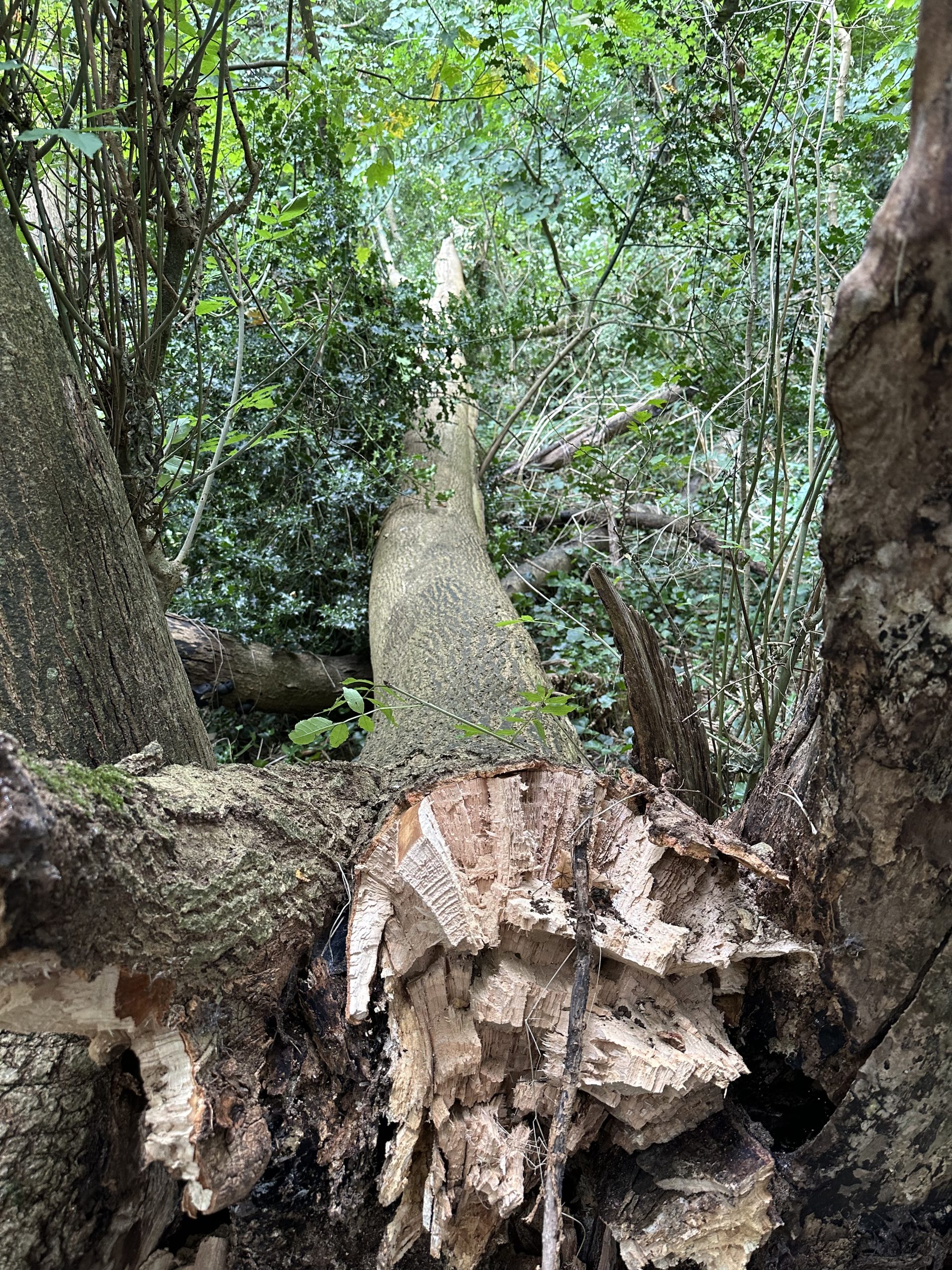
A fallen ash tree in nowhere Wood
A fallen ash tree in Nowhere Wood. [Photograph: Neil Ingram]

It was a stormy August night in Nowhere Wood. The wind was tearing through the leaves and branches and was strong enough to pull the whole tree down.

And so, a tree that had been growing in the Wood for fifty years or more was felled to the floor of the wood.


Ash dieback disease
Leaves damaged by ash dieback disease. [Photograph: https://www.rhs.org.uk/disease/ash-dieback]

In the tangled wreckage of leaves, twigs and branches, we can see the tell-tale signs of Ash-dieback disease. This probably weakened the tree, so the wind could blow it over more easily.


Most of the ash trees in this region have the disease, which is caused by a fungus that produces sores that blow away in the air, spreading easily through the wood. One day they will be cut down.

Fungi feeding in a fallen tree in Nowhere Wood
The tree is a store of nutrients. [Photograph: Neil Ingram]

Although this tree has died, its adventure through time continues. It is becoming useful because it is a large store of nutrients that other organisms in the wood will  use to survive and grow.

Over time,  insects and fungi will break down the tree wood  releasing nutrients that to the organisms in the wood.

Left undisturbed, nothing will go to waste.

New trees will grow up to replace those that have fallen, using the nutrients that are in the soil. Fallen trees are an opportunity for the wood to re-grow itself.

a fungus on a tree
Mushrooms are the fruiting bodies of some fungi. [Photograph; Neil Ingram]

There are lots of fallen trees in Nowhere Wood. The autumn is a good time to see  fungi feeding on the wood, because this is the season when they produce their fruiting bodies that make spores. Mushrooms are examples of these fruiting bodies.

  1. It is sad when we lose trees that we have known for years. Yet there is hope for the future. How does the wood recover from the loss of trees?

Notes on the story

What’s in a name?

Climate change and the air

The air is all round us and is a mixture of many different gases. 78% of the air is made of nitrogen, which  is the most common gas. This story is about two other gases found in the air – oxygen and carbon dioxide.


girl breathing out carbon dioxide and breathing in oxygen
The girl breathes out carbon dioxide and breathes in oxygen

We breathe in oxygen and use it to release energy from sugar. At the same time we make carbon dioxide – all living organisms do the same. We all  do this to stay alive.

People  also make carbon dioxide when we burn fuels, such as coal, oil, petrol and wood.

Nailsea was once a very small village. [Image from Nailsea Town.com]

If we go back over three hundred years to the 1700’s, Nailsea was a a tiny village surrounded by farms. Few people lived there, then. People burned wood or peat (from the moors) to stay warm.  They walked everywhere or travelled horse and cart.

Carbon dioxide in the air is measured in units called ‘parts per million’. Scientists  have estimated that in the early 1700’s the carbon dioxide in the air was about 280 parts per million.

An artist’s reconstruction of Middle Engine Pit, Nailsea. Artwork by Mark Hornby. From https://www.nailseatown.com/heritage-trail/middle-engine-pit/

However, things were beginning to change in Nailsea: the first coalmine was opened in 1700 and this would transform the village into a town in the next ninety years. The mines employed experienced miners who came to live in the town as well as local farmworkers.


Oil on canvas of The Old Glass Works, Nailsea in about 1810
This painting shows an appoach to Nailsea from the North. The cone of the glassworks is shown. Nailsea is changing from countryside into a town.
[Bristol City Museum and Art Gallery. Attributed to the British School.]

Plenty of cheap coal led to the opening of the glass factory and more migration of people into the town.  The arrival of the railway in 1841 provided new opportunities to trade with Bristol and its ports. The steam trains were powerful and burned coal.

In Nailsea, new houses were built together with  new roads and shops. Trendlewood quarry was opened in 1850 to provide sandstone tiles for the roofs of the new houses.


All of this activity added carbon dioxide to the air in increasing amounts.  Trees can take carbon dioxide out of the air, but the local woods were gradually chopped down to make way for the new town and for farmland. The wood was burned as fuel.

This pattern of industrialisation has taken place everywhere, all over the world since then. It continues to do so, too. In 2024, the amount of carbon dioxide in the air is estimated at 423 parts per million. This is a rise of 51% since the 1700s.

Does all of this matter? Most scientists think it matters a lot, but some politicians want to disagree.

a diagram of the greenhouse effect
The diagram shows the rays of the Sum being trapped in the atmosphere of the Earth by a layer of carbon dioxide

Carbon dioxide in the air acts like a blanket, reflecting heat energy back towards the land and the sea. In this way, it acts like glass in a greenhouse. The warming caused by the increased carbon dioxide is sometimes called “the greenhouse effect”.

Increased levels of carbon dioxide in the air affects the climate and weather patterns across the world, as we shall see in the next story.

Do you think that the businessmen of the 1700s were aware that the burning of coal could affect the climate of the Earth?

If were are aware of this now, should this affect whether  we choose to burn coal and oil.

What do you think?


Notes on the story

Climate change and the weather

The greening of Nowhere Wood

It is a cold and wet April in Nowhere Wood, which is full of birdsong and flowers.

The trees are becoming green with new leaves. Leaves grow silently that we can miss their unfolding, noticing only when they are fully opened. If you look carefully, you can see new leaves opening today.

It raises our spirits, and makes us look forward to warmer days.

New leaves grow from buds. Buds are covers that protect the developing leaves from damage during the frosty winter days.

Emerging horse chestnut leaves in Nowhere Wood.
Emerging chestnut leaves in Nowhere Wood. [Photograph: Neil Ingram]

New leaves are a special shade of green called Kelly Green. Later in the year the leaves become a darker shade of green.

The greening of Nowhere Wood.
The greening of Nowhere Wood. [Photograph: Neil Ingram]
Emerging oak leaves
Emerging oak leaves in Nowhere Wood. [Photograph: Neil Ingram]

  1. What happens to these new leaves in the autumn?
  2. Why do plants make new leaves during the summer, ready for the next spring?

Read more about leaves in the A year in the life of a sugar factory.


Notes on a story

If a tree falls…

Climate change and the weather

Most scientists think that the Earth is getting warmer and that human activities are making it worse. This story looks at some of the evidence they use.

Weather super computer
A weather super computer at National Oceanic and Atmospheric Administration [Image credit: General Dynamics Information Technology (GDIT)]

Weather experts collect millions of temperature measurements from all around the world every day. They put these results into powerful computers that build a picture of the climate across the world every day. Their results suggest that 2024 was the hottest year ever recorded.

The average October temperatures for the surface of the Earth from 1940 to 2020.
The average October temperatures for the surface of the Earth from 1940 to 2020. The warmest temperatures have been in the last ten years.

The temperature of the Earth in 2024 is about 1.5°C higher than it was in 1880, before large factories, cars, and airplanes existed. The yearly temperatures since 2020 include three of the hottest years since we started recording temperatures.

A 1.5°C rise in temperature does not sound like much, but it is having a big effect on the weather around the world.

Hurricane Beryl over Jamaca. July 2024.
There has been an increase in the number and severity of tropical storms in recent years. [Photograph from: https://www.freemalaysiatoday.com/category/world/2024/07/03/7-dead-as-hurricane-beryl-barrels-towards-jamaica/]

The temperature of the water in the seas in 2024 was the hottest ever. This causes the wind speeds to increase in tropical storms, causing huge damage when they hit coastal towns. 

Warm air can hold more water than colder air, so rainstorms can be more powerful and last longer. Flooding in low-lying areas becomes more common.

Flooding in Monmouth town centre. 1990.
Flooding in Monmouth town centre, 1990. The number and severity of such weather events is increasing. [Image: https://www.flickr.com/photos/imagined_horizons/9637969736]

The level of the sea in 2024 is about 111 mm higher than it was in 1993. This increases the risk of flooding in coastal areas.


Rising sea levels are affecting the survival of many islands.
Rising sea levels are affecting the survival of many islands. [Photograph credit: Envato Elements pic, https://www.freemalaysiatoday.com/category/leisure/2022/02/24/present-day-rise-in-sea-levels-may-have-begun-in-1863/]

Some small islands in the ocean are at risk of disappearing due to the rising sea waters. Nyangai Island off the coast of Sierra Leone has almost been lost to the waves.


Polar bears are finding it harder to hunt because of melting summer ice in the Arctic.
Polar bears are finding it harder to hunt because of melting summer ice in the Arctic. [Photograph: https://www.flickr.com/photos/gsfc/29664357826]

The rising sea levels are being made worse by the melting of the ice in the Arctic and Antarctic. Summer ice in the Arctic is disappearing by about 12% every ten years. It is affecting the survival of polar bears.


Notes on the story

Climate change: what can we do about it?

The secret of the winter flowers

A group of winter heliotrope plants.
A group of winter heliotrope plants. [Photograph: Neil Ingram]

It’s January 1st and the floor of the wood is covered with fresh new leaves, growing in dense patches. The first flowers are starting to open. Within a week, the air is scented with a sweet fragrance. This is the winter heliotrope, which is just as much at home in Nowhere as it is in its native North Africa.

The winter heliotrope was probably brought to Britain by Victorian gardeners.

 We have a large Victorian estate called Tyntesfield down the road, so originally it could easily have come from there. The plant has a big secret: its flowers are just for show!

The winter heliotrope.
The winter heliotrope. [Photograph: Neil Ingram]

The winter heliotrope is unusual because it has separate male and female plants. As far as we know, the Victorian gardeners only imported male plants into Britain, because they liked the showy flowers and its rich scent. So, although the flowers make good pollen, there are no female flowers available to receive it. These plants cannot make seeds.

How do the plants reproduce, if they  cannot make seeds?

What is its big secret?

A rhizome. [Image: Neil Ingram]

Below the soil the plant has a special underground stem, called a rhizome. During the year the rhizome stores food ready for the wintertime. Then, early in the new year, it grows new leaves and flowers.

During the summer the rhizomes grow so large, that they eventually break off and become new plants. This is a different way of reproducing, called vegetative reproduction. The plants are all clones, they have the same genetic information, which means that they all flower at more or less the same time.

So good is the winter heliotrope at growing in this way, that the plant is seen by some gardeners as an uwanted pest. It seems to grow well in Nowhere Wood, where it grows undisturbed.

1. What do you think are the advantages of being able to reproduce vegetatively, without making seeds?

2. Are there any disadvantages to having plants that all have the same genetic information. Is variation needed for the survival of plants?


Notes on the story

The greening of Nowhere Wood

Goodbye, for now

By late October, the last of the visitors are leaving Nowhere Wood. House martins are birds that build nests in the eaves of the surrounding houses. They fly by swooping up and down in the summer skies, feeding on flying insects.


Then, suddenly, as the season changes, they leave. But where do they go?

House Martin in nest. HTO, CC BY-SA 4.0 https://creativecommons.org/licenses/by-sa/4.0, via Wikimedia Commons]

Amazingly, for such confident, visible, birds, they have been able to keep this a secret from us. And, even today, we really do not know for sure. We think they fly to Africa, over the Sahara Desert, to countries like Cameroon, Congo and the Ivory Coast. That’s a journey of over 5 000 km.

There they spend the winter, feeding and resting, before making the return journey in early Spring, arriving back to Nowhere Wood by April.


If all goes well, they return to the wood, and even to the same nests. It is a dangerous adventure and not all make it back. The birds can be eaten by birds of prey, or trapped by hunters.

Above all, the declining number of insects is killing the house martins. Loss of habitats, use of pesticides and climate change are all linked to human activity, so indirectly, we are to blame. So, perhaps, in the future, it will not be goodbye for now, but goodbye forever.

  1. How does the use of pesticides across Europe and Africa affect the survival of house martins?
  2. How could we conserve our populations of house martin?

Notes on the stories

Fruits of the autumn

What is a frog?

Frog spawn in Nowhere WoodIt is late February, the cold weather has moved away and the frogs have moved back in. It’s been a couple of years since they were last here, but here are their newly-laid eggs and the female is hiding beneath the leaf in the top left corner of the photograph. What is a frog and how is it having adventures in Nowhere Wood?

Frogs reproducing
Frogs reproducing. [Photograph: JBdeHeer, https://commons.wikimedia.org/wiki/File:Frogs_in_reproduction_time.jpg]

Frogs are amphibians, animals with backbones that live for most of the year on land, but which have to return to water to breed. A female with eggs is popular with males, which compete with each other to get close to her.

When she releases here eggs into the water, the males release their sperm onto the eggs. Fertilisation takes place in the water. The female lays about 2 000 eggs and many of them die. The brown eggs in the top photograph are probably a clutch of eggs that have died.

Inside the egg, the embryo is growing into a juvenile tadpole, feeding on the jelly that surrounds it. It will grow a tail and gills and become a free swimming tadpole.

Ten-day old tadpoles
Ten-day old tadpoles [Photograph: Tarquin, https://commons.wikimedia.org/wiki/File:Tadpoles_10_days.jpg?uselang=fr]
Soon, the tadpole will break free and have to make its way as an independent animal, all of the while developing into the adult frog.

There are dangers in the water: tadpoles become carnivores and will eat each other and there are other predators, too. There is also a real chance that the water in the pond will disappear if we have a prolonged dry spell.

The frogs in Nowhere Wood are having adventures, moving forward into an unknown future, with no certainty of success. Most of these eggs will be eaten and will become food for other organisms; one or two might survive. Most years, frogs return to the water to breed, as frogs everywhere have done for the last 265 million years.

1. The survival of the frogs is not just due to chance. There is competition between male frogs to get close to the females eggs. How does this help to increase the success of the mating?

2. There is also competition between tadpoles for food. How does this help ensure that some frogs will survive to become adults that can reproduce for themselves?

3. What, do you think, is a frog?

Frog news update:

Frog spawn in Nowhere Wood [Photograph: Neil Ingram]

One week on, and the spawn has floated to the edge of the pond and the adds are swollen because they have taken up water. They still look healthy. Fingers crossed for the next stage!

Notes on the story

Early risers!

Spring is coming!

The shortest day
The shortest day. [Image adapted from https://simple.wikipedia.org/wiki/Winter_solstice#/media/File:Earth-lighting-winter-solstice_EN.png]
Nowhere Wood on December 23rd was silent and still. The wood was in midwinter, at its furthest point from the Sun on its journey through the seasons. At only 7 hours and 49 minutes, this was the shortest day  and darkness ruled the wood. From now onwards the days will get longer by about two minutes each day until midsummer’s day in July.

The air was was misty and damp. No birds sang. The only movements were from ten or more baby squirrels running up and down trees, looking for food. The plentiful acorns in the autumn gave their parents the nutrients the needed to produce a special autumn litter.

Robin, in Nowhere Wood
Robin, in Nowhere Wood. [Photograph: Neil Ingram]
Even by January, the wood had moved onwards and the days were drawing out. Robins sang from high branches of trees, marking out the wood into their territories, preparing for the coming spring.

Jay versus magpie
Jay versus magpie. [Photograph: Alex Appleby, https://www.ephotozine.com/photo/magpie-vs-jackdaw-59874975]
Jackdaws and magpies fought for the right to control the high airspaces and the food that the neighbouring houses throw away. The wood was bustling with movement and sound.

Snowdrops in Nowhere Wood
Snowdrops in Nowhere Wood. [Photograph: Neil Ingram]
Today is February 1st, the day that the Celtic peoples call Imbolc, the first day of spring. The flowers are opening and the frogs will soon return to our ponds to breed. Look upwards to the sky.

Spring is coming!

  1. Think about the acorns that filled the floor of Nowhere Wood in September. How have they led to the birth of the new squirrels?
  2. What changes have you seen in your neighbourhood in the last few weeks since January?

Notes on the story

What is a frog?

Subterranean superheroes

Leaf fall in Nowhere Wood. [Photograph: Neil Ingram]
The leaves covering the floor of Nowhere Wood are slowly disappearing in the mild December nights. Fog hangs in the air. The wood is preparing for winter and everywhere is quiet and still. Most of the real action is taking place below the ground, but what is making the leaves disappear?


Earthworm [Photograph: Shutterstock 1596740926, licensed to NI]
The culprits are earthworms, the little subterranean superheroes that do most of the heavy lifting in Nowhere Wood. There is about 45 million earthworms underground in the wood, with a total biomass equal to about twenty elephants. They are easily the most abundant animal in the wood, but they are so rarely seen.


Earthworm. [Photograph: Shutterstock 171009224, licensed to NI]
Earthworms tunnel into the soil making the burrows that are their homes. At night, they come to the surface to drag fallen leaves back down into their burrows. The burrows are also perfect homes for bacteria and fungi.


Fungi mycelia. [Photograph: 159740926, licensed to NI]
The bacteria and fungi  feed on the leaves, turning them into nutrients that they use as food. This is humus. Earthworms eat the fungi and the humus-rich soil. As they do so, they glue the soil particles together into small clumps. This improves the quality of the soil, making it a perfect environment for plant roots.


Plant roots in Nowhere Wood. [Photograph: Neil Ingram]
Plant roots need plenty water, air and nutrients, all of which are given to the soil by the fungi and earthworms. We can think of earthworms as the soil’s farmers, ploughing the soil for the plants. Without their work, no life could exist in Nowhere Wood.


Charles Darwin. [Shutterstock 252138244, licensed to NI]
The famous scientist Charles Darwin studied how plants, earthworms and fungi work together to keep woods alive, and he wrote a famous book about it in 1881. He wrote about earthworms: “It may be doubted whether there are many other animals which have played so important a part in the history of the world, as have these lowly organised creatures.”

  1. In what ways do you think that soil is alive?
  2. Think about how the trees, fungi and earthworms work together to keep the wood alive.

Today, Friday 4th December 2020, is World Soil Day 2020. Here is a video celebrating our dependence on soil:

Notes on the story

Spring is coming!

A year in the life of a sugar factory

The leaves of plants are everywhere in Nowhere Wood, helping to keep the wood alive. Leaves are organs: collections of living tissues and cells, having adventures in time and space. This is the story of a year in the life of an oak leaf.

Leaves are factories for making sugar from sunlight, water and carbon dioxide from the air. No human factory can do this, which is why we, and all other organisms, are so dependent on plants. Leaves are the producers of food.

Buds of the English oak.
Buds of the English oak. [Photograph: https://commons.wikimedia.org/wiki/File:English_Oak_(Quercus_robur)_buds_(8535459373).jpg]
In is late November and the cells that will divide to make the new leaf are protected safely inside the scales of the bud. Early in March, when the days warm and get longer, stem cells within the bud start to divide many times, producing all of the cells of the new leaf. To start with, the cells are very small and all look the same.

Emerging leaves. [Photograph: shutterstock_244078297, licensed by NI]
Soon, the cells take up water and get much larger. They escape the protection of the bud and the new leaf emerges. The new cells no longer look the same: they are on different journeys of development, becoming all of the different cells and tissues that make up the leaf.


New leaves. [Photograph: Stutterstock 671376856, licensed by NI]
The leaf is a factory for making sugar. Like any factory, it has a source of energy and transport systems to get the raw materials into the factory.  It also moves the manufactured sugar out to the places in the plant where it is needed. The heart of the factory is the production line where sugar is made. These are called chloroplasts and the leaf has millions of them, all making sugar whenever the sun shines. The Spring and Summer are sugar making seasons.

Oak leaves in autumn. [Photograph: Neil Ingram]
Gradually, in the autumn, when the days get cooler and shorter, the sugar factories are shut down and abandoned. The chloroplasts lie in ruins as everything useful is recycled back into the branches of the tree. All that remain are the frameworks of cell walls, turning brown as they dry in the autumn air.


Dead leaves
Dead leaves. [Photograph: Neil Ingram]
Finally, the oak tree makes a special layer of cells that separates the old leaf from the stem, and the leaf is ready to fall when the wind blows strongly. The fallen leaves are not wasted, becoming energy stores for the organisms that feed on them. Next year’s buds are forming and wait for spring and the production of new leaves.

If leaves are factories form making sugar, then trees are factories for making leaves.

Everything has its own season in Nowhere Wood.

  1. Think about how the leaf is a factory for making sugar. Where does its energy store come from? How do the raw materials get to the production line?
  2. The production of leaves is sustainable in Nowhere Wood. What do you think this sentence means?

Notes on the story

Subterranean superheroes

All change!

[Image: https://www.clipartof.com/portfolio/sajem/illustration/happy-moodie-character-looking-at-his-reflection-in-a-mirror-227335.html]
When you next look into a mirror ask yourself if you are the same person as you were yesterday. Well, of course you are.

Even people who last met you ten years ago can still recognise you and call you by your name. Although they might add, “My, how you have grown!”

And yet, if we could see under your skin, we would find that you are not the same. One of the biggest mysteries in biology is how we can change all of the time, whilst still staying the same.

Your skin cells live for about two weeks, so every month they are completely replaced. Red blood cells live for about 100 days and about two million are made in your body in every second.

Some of the chemicals in your cells exist for only minutes or seconds.

There is an energy store called ATP, which is needed for muscle contraction. ATP is made and broken down within 15 seconds.  Cells need glucose to make ATP and this explains why muscle cells need a continuous supply of glucose to stay alive. This comes from our food.

[Image: https://www.clipartmax.com/middle/m2i8d3m2Z5d3G6d3_hm00260-%5B1%5D-digestive-system-close-up/]
Even large organs, like the liver, are replaced regularly. You grow a new liver every year. The cells in the alveoli of your lungs are renewed every eight days. Even the bone cells in our skeleton are replaced every three months. Your entire skeleton is remade every ten years.


[Image: http://halloween.phillipmartin.info/halloween_skeleton.htm]
So, when your friend sees you after ten years and calls out your name, there is not a single part of your body that was the same as when you last met. You have been completely remade and remodelled. And the same is true of your friend.


So, how can this be? New cells are made when one cell divides to make two cells. The information in the genome is copied before cells divide, so the new cells always receive the same information as the old cells.

The new cells use this information to grow bigger and to develop. So, you stay the same because of how your new cells use the information in their genomes.

Living organisms are alive because they actively remake themselves. No man-made machine can do this. Which is, perhaps, just as well.

  1. In what ways have you changed in the last ten years?
  2. In what ways have you stayed the same?
  3. Why do need to eat food everyday?

Notes on the story

A year in the life of a sugar factory

Life is a relay race

This story continues the adventures of the ferns in Nowhere Wood. The first part of the story is Climbing the walls.

The genome of the fern contains essential information that the fern needs to grow and  make new cells. At different times the fern produces spores, sperm and eggs and the two forms of the plant. The genome contains information on the growth of each of these stages.

The information in the genome is the same in every cell of the fern because an identical copy of the genome is found inside the nuclei of all the cells of this fern at every stage of its life.

The genome is found in the nucleus of each cell.

Fern chromosomes

The genome is divided between a number of chromosomes. The diagram shows the genome of the Adder’s tongue fern. It has about 1440 chromosomes. This is the largest number of chromosomes of any organism in the world!

Fern genomes are larger than the genomes of other organisms, because they contain the information the fern needs to grow spores, sperms and eggs as well as the two forms of plant.

The genome contains the secrets of how to be a fern and how to move forward in the adventure. This information has been copied and passed on to each generation of ferns, ever since the first ferns evolved about 390 million years ago.

Life is like a relay race: genetic information is passed on from one generation to the next in the genomes of sperms, eggs and other gametes.

These ferns are having risky and uncertain adventures in time as well as space. If the secret information is not passed on correctly, then the species may become extinct. History shows us that most species that have ever lived on Earth are now extinct.

    1. Why do you think it is essential that the genetic information from parents to offspring is copied accurately?
    2. Why do you think the fern genome is so large, compared with other types of plant?

Notes on the story

All change!

Climbing the walls

Hart’s tongue fern growing on the sandstone walls of Nowhere Wood. [Photograph: Neil Ingram]
A hundred years ago, Nowhere Wood was a sandstone quarry, and there is still a cliff face at the end of the wood.
How can this hart’s tongue fern grow on a vertical cliff face about two metres from the ground.

That is quite an adventure in time and space. This story explains how this fern can climb walls.


Ferns are an ancient group of plants, first appearing on Earth about 390 million years ago. That’s about 260 million years before the emergence of flowering plants.

Spores on the under surface of a fern leaf. Nowhere Wood. [Photograph: Neil Ingram]
Like fungi, another ancient group, ferns produce spores. They are the brown dots on the underside of this fern leaf. Spores are light and float in the air like particles of dust.

One spore floats up to a small crack in the rock face. Rainwater and the decaying remains of a leaf have formed a sticky, jam-like, humus inside the crack.  The spore sticks to the humus and germinates, developing into a tiny little plant, about 10 mm long.

Drawing of a gametophyte of a fern. [Image: https://picryl.com/media/prothallus-gametophyte-0bab1a ]
This is a fern, but it is not the mature adult form. It has tiny roots that grow into the humus, drawing nutrients from it.
This small plant is called a gametophyte because it makes gametes for sexual reproduction. Gametes are sperm and egg cells. 


These gametes will come together to make the adult fern on the surface of the tiny gametophyte.

Sperm from ferns. [Image: https://upload.wikimedia.org/wikipedia/commons/d/d7/Fern_sperm.jpg]
The gametophyte makes many small sperm that swim in the water on the surface of the plant. They swim towards eggs, which are much larger. This photograph shows a fern sperm fertilising a fern egg.

The sperm and the egg join together. A single cell is produced that will grow into the adult fern. Eventually this fern will make spores of its own.

This may sound like a long-winded and complicated adventure, but it seems to work well, because there are so many ferns in Nowhere Wood.

The fern exists in several different forms during its adventure: spores, eggs, sperm, gametophyte and adult plants. What do they have in common?

Each of these forms is made of one or many cells. Each cell contains a nucleus, and inside each nucleus is a genome. Genomes contain information. The information in the genome is the same in all of the different forms of the fern.

The genome contains the secrets of how to be a fern and how to move forward in the next step of the adventure.

  1. The fern exist in several different forms during its adventure: spores, eggs, sperm, gametophyte and adult plants. Think why is important that the genome in every form is the same? 

Notes on the story

Life is a relay race