
The other day I counted four Holly Blue butterflies around the park.

It doesn’t sound many. But it is.
Most summers I am pleased to see one or two. This year they seem to be everywhere. A flash of blue rises from the brambles, another circles the holly before disappearing into the canopy, while a third settles briefly amongst the ivy before vanishing as quickly as it arrived.
The Holly Blue is easy to miss. It is a small butterfly, and unlike peacocks or red admirals, it rarely sits still for long. It spends much of its life around the shrubs and trees that edge the woodland, where the sunlight comes and goes in shifting patches.
Yet once you begin looking for it, you realise that this really is a good year.
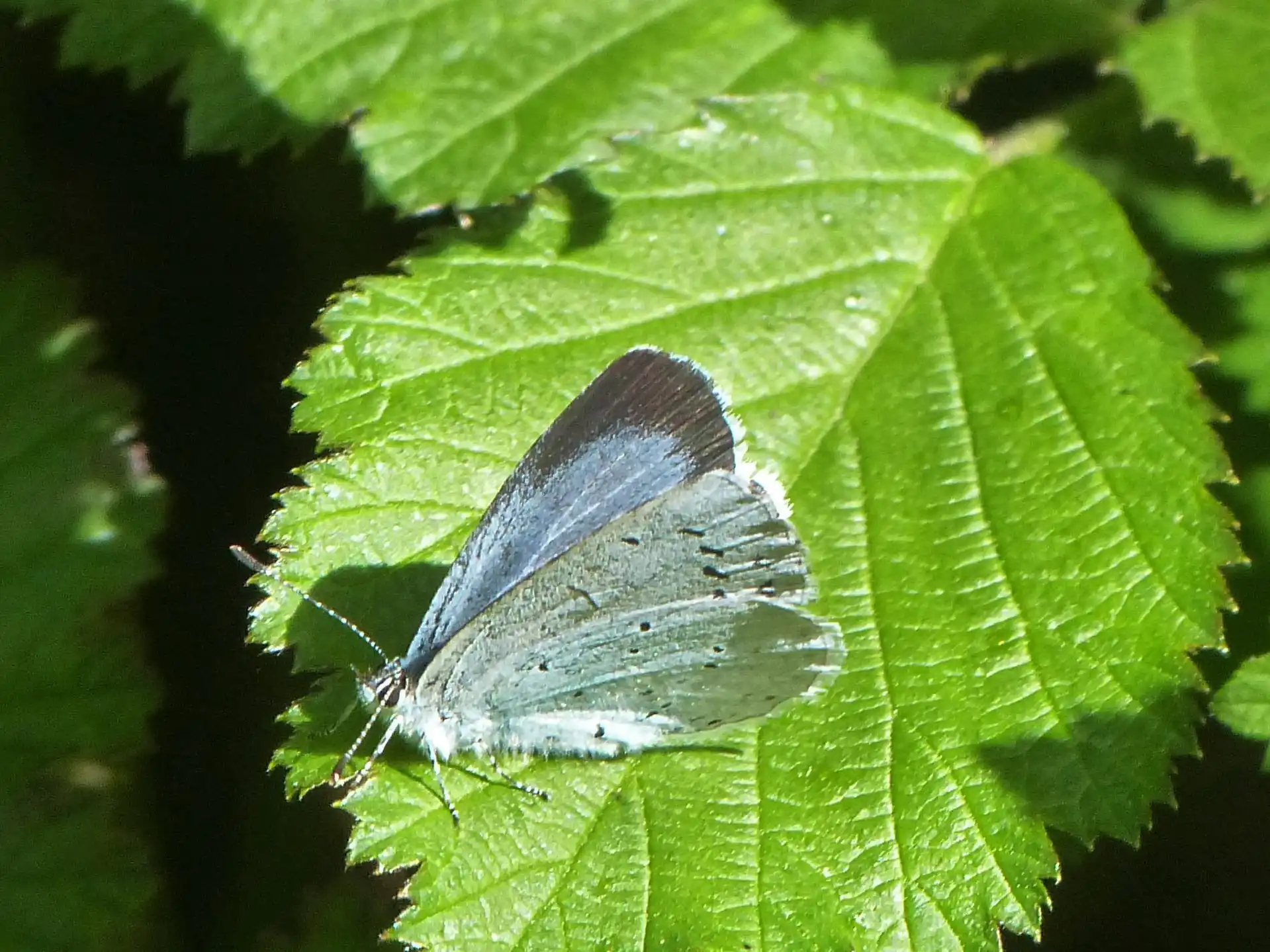
When we notice that one species has become unusually common, our first instinct is to look for a simple explanation. Perhaps it was a warm spring. Perhaps there were more flowers. Perhaps the weather was just right. Or perhaps all of these.
Sometimes, though, the answer lies somewhere completely unexpected.
Hidden amongst the leaves are tiny caterpillars feeding on holly in spring and ivy later in the year. They are almost impossible to find.
Harder still to find is something looking for them.
A minute parasitic wasp, Listrodomus nycthemerus, searches patiently amongst the foliage. When it finds a Holly Blue caterpillar, it lays a single egg inside it. The caterpillar continues feeding, apparently unharmed, carrying a passenger it will never know is there.
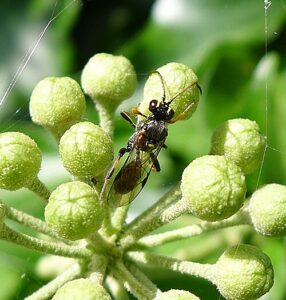
gailhampshire, creative commons licence: https://commons.wikimedia.org/wiki/File:Listrodromus_nycthemerus.png]

Eventually the young wasp completes its development, and the caterpillar dies.
It sounds brutal.
But it is also one of the reasons I have seen so many Holly Blues this summer.
When butterfly numbers are high, the wasps have plenty of caterpillars in which to lay their eggs. Their own numbers begin to rise. In time, more caterpillars are parasitised and fewer butterflies emerge. A few years later, with fewer caterpillars available, the wasps begin to decline as well. Slowly the butterflies recover, until another good summer arrives.
Neither species is in control.
Each shapes the future of the other.

This graph shows what happens. The black figures show actual numbers of Holly Blues recored in Yorkshire. The red figures are estimates of likely parasite numbers.
Standing in Nowhere Wood this week, surrounded by more Holly Blues than I have seen for years, it is tempting to believe that the butterflies are simply having a particularly successful season.
Perhaps they are.
Or perhaps I am seeing the result of something that began several summers ago, when there were too few tiny wasps moving quietly through the leaves for anyone to notice.
Nature often keeps its most important stories hidden.
We admire the butterflies because we can see them. The wood, however, is also full of creatures that are measured in millimetres rather than centimetres; creatures that never catch our eye, yet quietly determine whether future summers will be filled with blue wings or empty spaces.
The Holly Blues will almost certainly become scarce again.
When they do, I shall try to remember that they have not really gone anywhere.
They will simply be waiting, unseen, for the wood to keep another appointment.
- Have a good look at the black line on the chart – estimate the time elapsed between the high points. Can you spot any regular cycles?
- Compare the black lines and the red lines. What do you notice?

Leave a Reply