The shortest day in Nowhere Wood

On the shortest day, 21st December 2025, under heavy skies, the light arrived reluctantly, like a visitor creeping late into a church service, hoping to be unnoticed. It arrived in Nowhere Wood as a diffused light, fading the dark into a gloomy, dignified grey.

The leaf litter lay sodden and heavy, mud tugging at every step with a damp, muffled pull, as though the wood itself were slowing its thoughts.

Nothing much happened, which was precisely the point. 

Robins rehearsed their winter song from the holly trees, thinner than summer, but more earnest. Magpies bustled about, dodging the raven.

Robin, in Nowhere Wood
Robin, in Nowhere Wood. [Photograph: Neil Ingram]

Somewhere deeper in, a squirrel sat high in a tree, eating an acorn. 

A grey squirrel in Nowhere Wood. [Photograph: Andrew Town]

A greenfinch launches an aerial parade, searching up and down for seeds and insects, pecking at the branches of the holly.

A greenfinch in Nowhere Wood on the shortest day. [Photograph: Neil Ingram]

The wood pond lay full to its edges, deep and cloudy, reflecting the grey sky hiding the sun. It is giving little warmth today. There is no wind to disturb the dark surface water, either.

By mid-afternoon the day was already tired. Shadows thickened around the trunks, joining up like old friends. This was the hour when the wood seemed to draw inward, not asleep, not awake, but attentive. If you stood still long enough, you might feel it: a collective pause, the held breath of roots and stones and sleeping insects. The turning point is always quiet. Nothing announces it. There is no drum roll when the year changes its mind.

At 3.03 pm, though no one checked a watch, Nowhere Wood reached its farthest point from the sun. This is the winter solstice.

The sun reached its weakest moment and fell below the surface.  It has stopped retreating. The orbit of the Earth round the sun will slowly draw Nowhere Wood closer to the sun. That is enough, for today. Somewhere beneath the cloudy skies, the trees receive the signal of change and keep it to themselves. Spring is coming!

Day length is not the only cue they use, and the warm wet winter has already drawn hazel catkins and alder into flower.

Hazel catkins in Nowhere Wood on the shortest day. [Photograph: Neil Ingram]

Darkness came early and properly, as it should on such a day. Yet it was not an ending. Lights were lit in the houses beyond the wood. Foxes and badgers began their evening patrols. The slivery moon lifted, pale and weak, took over the night.

In Nowhere Wood, the shortest day passed almost unnoticed, which is how the most important things usually happen. The light had given its least—and that, quietly, is the beginning. From now onwards the days will get longer by about two minutes each day until midsummer’s day in July.

Slowly, slowly, Spring is coming. 

Season’s greetings from Nowhere Wood!

Notes on the story

Spring is coming!

Time travellers to Nowhere (1)

A landscape of the Carboniferous era
A landscape of the Carboniferous era. [Image: https://upload.wikimedia.org/wikipedia/commons/thumb/0/0a/Bulgo_Sandstone_biota.jpg/1456px-Bulgo_Sandstone_biota.jpg]

Imagine you had a Time Machine: where and when would you go to? Come with me back to Nowhere Wood, about 310 million years ago. That is long before humans, mammals or even dinosaurs existed, but frogs laid their eggs in pools, much as they do today.

Today it is hot, humid and very quiet: with no birdsong or animal noise, apart from the distant croaking of frogs.

Extinct tree ferns from the Carboniferous era
Extinct tree ferns from the Carboniferous era. [Image: https://upload.wikimedia.org/wikipedia/commons/thumb/3/3e/Lepidodendrales_reconstrucci%C3%B3n.jpg/1280px-Lepidodendrales_reconstrucci%C3%B3n.jpg]

We are in the northern foothills of an enormous mountain range, bigger than the Himalayas. It is unbearably hot and humid.  We are next to a river flowing from the Southern mountains, surrounded by thin horsetails that grow up to 10 metres tall. Tomorrow, there will be a raging tropical storm and the mountains will be pounded by its violence. The rain will flow in torrents in rivers towards us.

Nowhere Wood is located just below the equator, and we are looking up at the aftermath of a series of global catastrophes, which has taken hundreds of million years to happen. Two continents collided and sent shockwaves through the land, pushing upwards to form the mountains that we can see to the South of us. We are in a valley, downstream from the mountain peaks.

Muddy water flowing in a stream
Muddy water flowing in a stream. [Image: https://upload.wikimedia.org/wikipedia/commons/thumb/3/37/Uruzi_hamwe_n%27ikirere.jpg/2560px-Uruzi_hamwe_n%27ikirere.jpg]

The mountain rock is soft and is easily weathered by the stormy wind and rain. Cascades of small, eroded particles surge down the mountain slopes, transported in the muddy river waters.

Mountains become tiny grains of sand settling at the bottom of the smaller rivers and streams running through and around Nowhere Wood. The streams are running from South to North, and criss-cross each other to form  a network of channels.

Layers of sandstone on Nowhere Wood.
Layers of sandstone on Nowhere Wood. [Photograph: Neil Ingram]

Layers upon layers of sediment are depositing in the streams, blocking the channels. Over time, the increasing weight of sand squeezes the water out. Minerals like feldspar and mica help to cement the grains together to form sandstone. These are the cliffs that we can see today at the far end of Nowhere Wood.

Pennant sandstone was used to make flat roof tiles
Pennant sandstone was used to make flat roof tiles. [Photograph: https://www.beechfieldreclamation.co.uk/shop/paving/reclaimed-welsh-pennant/]

Pennant sandstone used to be  quarried to make roof tiles for the people of the town and local areas.

It is easy to think of living organisms having uncertain adventures through time and space. But the same is true of rocks, although on a much larger time scale.

[updated 14/02/2025]

1. Find out where the matter that makes up planet Earth originally came from.

2. Think about what has happened to the sandstone in Nowhere Wood since it was formed.

Notes on the story

Time travellers to Nowhere (2)

Time travellers to Nowhere (2)

A forest of tree ferns.
A forest of tree ferns. [Image: ttps://www.laterredufutur.com/accueil/la-plus-vieille-foret-du-monde-a-ete-decouverte-dans-letat-de-new-york/foret-380millions-dannees/]

We are not alone in Nowhere Wood, about 300 million years ago. We are deep in a forest of tree ferns, towering above us, fifteen metres high. The damp air has a sweet and woody fragrance, heavy with spores, heavy with promise.

Carboniferous trees
Carboniferous trees [Image: https://forces.si.edu/atmosphere/02_02_06.html]

The plants are silently photosynthesising, growing ever taller and adding oxygen to the air. Year after year, generation after generation.

Stages in the formation of coal.
Stages in the formation of coal. [Image: https://www.manalifelab.com/the-science]
The wood in the tree stems is a new invention of evolution: no other plants have wood and fungi have yet to discover a way to eat it. This means that when the trees die and fall into the swampy wet soil, they do not decay, but stayed for thousands of years, gradually becoming compressed together to form deposits of coal.

The formation of most of our coal brought Earth close to global glaciation.
The formation of most of our coal brought Earth close to global glaciation. [Image: George Feulner, https://www.pnas.org/doi/10.1073/pnas.1712062114]

The tree ferns took carbon dioxide from the air and locked it away as wood and coal. They took so much and the amount of carbon dioxide in the air fell so much, that the  climate cooled, lead to the destruction of the tropical forests.

Today, humans have found the coal and burned it, putting the hidden carbon dioxide back into the air, re-warming the planet. No we face a global warming, not a global cooling. Perhaps, one day, Nowhere Wood will be destroyed for a second time.

  1. Think about how interconnected the rocks, the trees, the atmosphere and the climate are. How does a change to one thing affect everything else?
  2. Ferns are the first group of plants to develop proper roots. Think about why it would be an advantage for the early tree ferns to grow into sandstone.

Back then, the tree ferns grew through sandstone much as the smaller ferns in Nowhere Wood do today. Read more about this in another story: Climbing the walls.

Notes on the story

Time travellers to Nowhere (3)

Time travellers to Nowhere (3)

Carboniferous dragonfly
Carboniferous dragonfly, with 1.5m wingspan. [image: https://upload.wikimedia.org/wikipedia/commons/thumb/8/81/Meganeura.png/1280px-Meganeura.png]

We are in Nowhere Wood, about 300 million years ago, staring at a forest of tree ferns, watching them make oxygen. Over the years, these tree ferns have made so much oxygen that its concentration in the air has risen to about 35%, (compare that with the 21% found in the 21st century).

Wildfires in Chile
Wildfires in Chile. [Photograph: https://globalclimatecare.in/climate-asia/f/man-made-or-nature-made-chile%E2%80%99s-forest-fire-creates-global-threat]
There is so much oxygen that the lightning strikes produce frequent explosions in the air, causing forest fires. Nowhere Wood is a dangerous place to be, sometimes.

Arthropleura, a giant millipede.
Arthropleura, a giant millipede. [Image: https://en.wikipedia.org/wiki/Arthropleura#/media/File:ArthropleuraSide.jpg]
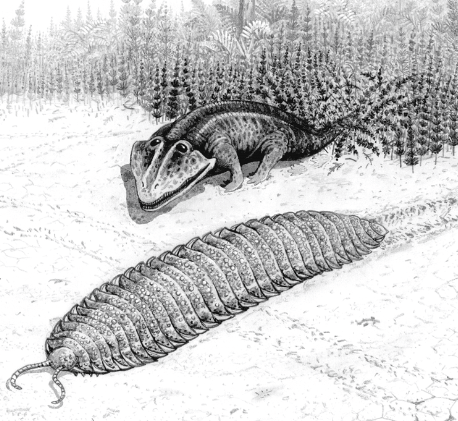
The animals are using the oxygen to grown large: some millipedes are 1.5 metres in length and 0.5 metres wide. Some dragonflies have 70 cm wingspans.

Hylonomous lizard
Hylonomous lizard [Image: https://commons.wikimedia.org/wiki/File:Hylonomus_BW.jpg]
 With all of this food available, there are opportunities for new  carnivorous lizards to appear, including Hylonomus. This is one of the first creatures to have a new  eggs with membranes inside, a characteristic later shown by all birds.

Eryops stalking Arthropleura in the Carboniferous period
[Image: https://www.darwinsdoor.co.uk/feed/the-giant-arthropods-of-the-carboniferous.html]
 Also the flesh-eating Anthracosaurs first appeared at this time. These are the direct ancestors of the dinosaurs, that appeared millions of years later.

In Nowhere Wood, everything is connected together, in space and in time.

So many adventures in space and time, so much opportunity for the evolution of new forms. All of which depends on the formation of sandstone in Nowhere Wood.

  1. Imagine what it was like to live in Nowhere Wood 300 million years ago. What would be the same and what would be different.
  2. How do you think the world will change in the future?

Notes on the story

Safety in numbers