

This is the second part of a two-part story in the sustainable park series.
Every year, the flow of the spring is rather erratic. In some winters it barely registers above ground, in other years it can flood the walkways and paths around the park. To reduce the risk of flooding, the Friends of Trendlewood Park decided to build a permanent pond to hold back the water, reducing the risk of flooding and (hopefully) providing new habitats for wetland creatures.
The pond was to be built next to the old oak and ancient willow, which are listed for protection by North Somerset Council. This means that the construction of the pond needed to be sustainable – with no artificial tools (like earthmovers) or materials (like plastic liners). The pond was to be built the hard way: with lots of manual labour and (mostly) natural ingredients.

First, the dimensions of the pond were determined and marked with poles and string.

Then teams of volunteers started the heavy spade work. It took time, but the efforts started to bear fruit.

The pond is designed to be tiered into layers. This creates ledges of different depths, that different plants and animals can utilise. It diversifies the habitat and creates new opportunities for animals and plants to live in the pond.

An earthen dam has also been built to reduce the risk of the water flooding out of the area onto the path around the park. A drainage channel has been dug into a nearby gulley to take the flood water away. In a rare concession to modern technology, the pipes are plastic sewer pipes. but covered in bentonite clay. We shall see if it can withstand the heavy winter rains.

It has taken over a year to build the pond and we know from last summer’s trial that dragonflies were seen on the dry edges of the pond.
There were plant arrivals, too. Gypsywort, hop sedge and yellow loosestrife.
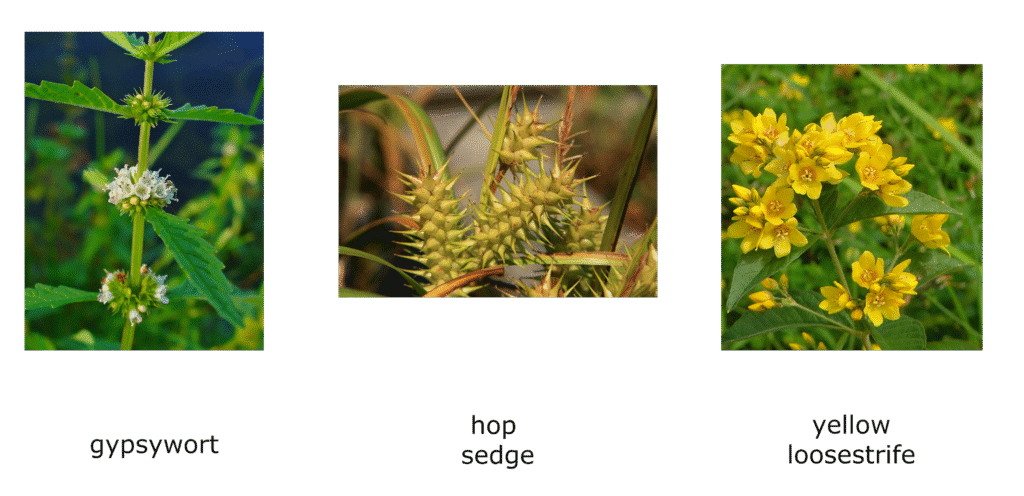
It is unlikely that the pond will remain throughout the next year, that will depend on how dry and hot it will be, but it will be interesting finding out.
The Friends of Trendlewood Park Committee would like to thank: North Somerset Council for its permission for us to build the pond and for their ongoing support of the project and whole of Trendlewood Community Park. Nailsea Town Council for its enthusiasm and financial support for the materials needed to build the pond. Linsday Moore for her botanical expertise. Thank you to the many people who gave their time, energy and expertise to work on the project, including the Somerset Wood Recycling (the Green Team), and volunteers from the Wildlife Action Group volunteers, the Belmont Estate corporate workday volunteers and the Friends of Trendlewood Park.
Image attributions:
Yellow loosestrife, Photograph by: NaJina McEnany, under the Creative Commons Attribution-Share Alike 2.5 Generic licence, via Wikimedia Commons,.
Hop Sedge, Photograph by: Quinn Dombrowski, under the Creative Commons Attribution-Share Alike 2.0 Generic licence, via Wikimedia Commons.
‘Creating ponds are ways of increasing the biodiversity of a habitat’. What does this mean, and why is it generally thought to be a good idea?

Leave a Reply