It is mid-July and it has rained for the first time in several weeks. Gentle warm rain, interspersed with strong sunshine. These are the days of gentle ripening, to complete the work that started in in the blossom season of the early spring.
The orchard in Trendlewood Park has a collection of ripening fruit trees and we hope that the Apple Tree Man of Nowhere will bless the harvest of apples, pears and plums.
Apple fruits ripening in the orchard on Trendlewood Park. [Photograph: Neil Ingram]Pear fruits ripening in the orchard on Trendlewood Park. [Photograph: Neil Ingram]Plum fruits ripening in the orchard on Trendlewood Park. [Photograph: Neil Ingram]
In the autumn, these fruits will be ripe enough for animals to eat. What happens as fruit ripen?
Update: 22/7/25
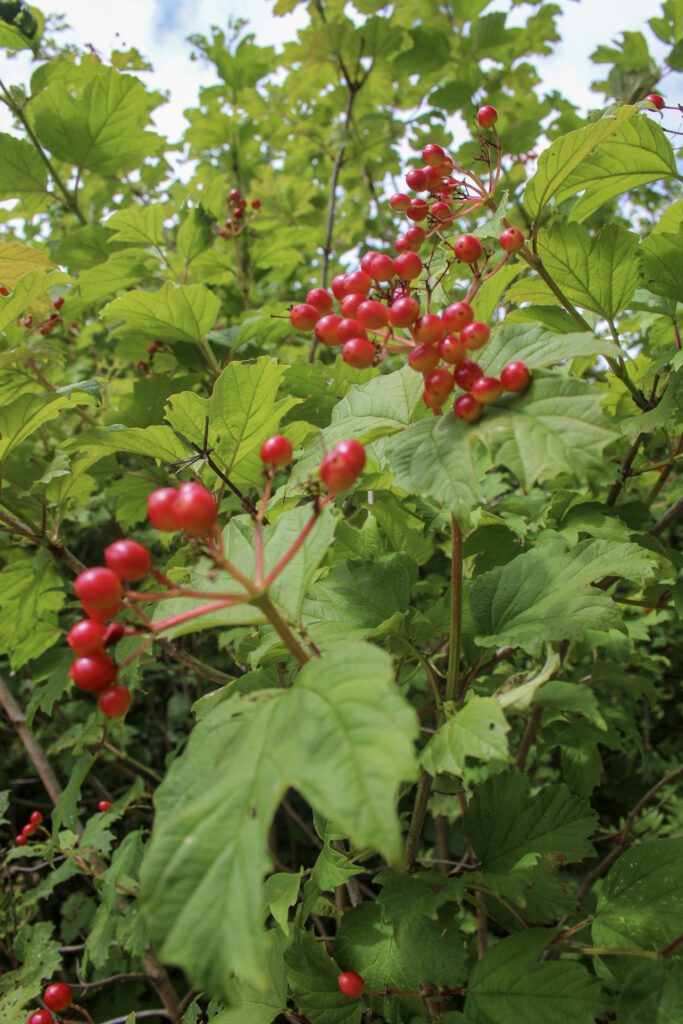
I could not resist the ripening of the Guelder Rose, Viburnum opals, but do not eat it them, else you may fall ill.
Guelder rose on Trendlewood Park. [Photograph: Neil Ingram]
The old oak tree said to the traveller passing by:
“You know me, you see me everyday. I am that oak tree that has stood here longer than any of can you remember.”
The oak tree in Trendlewood Park, viewed from the author’s study. [Photograph: Neil Ingram]
“I am on the 1840 Ordnance Survey map and I was a sturdy tree, even back then. Let’s say, I’m two hundred years old? I am still in my prime, though. I won’t be celebrated as old for another two or three hundred years. Don’t wait up for me.”
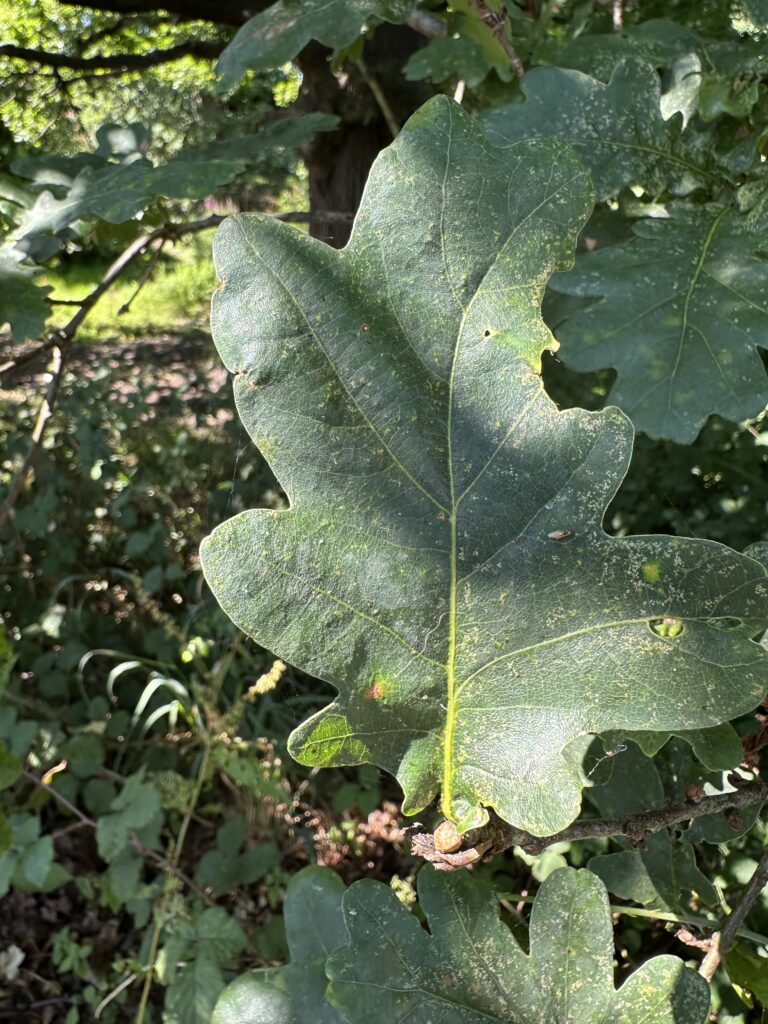
A leaf of an English oak. [Photograph: Neil Ingram]
“I am a patriot, a true blue English oak: look at the ear-shaped lobes at the bottom of my leaves and the very short leaf stalks. Pedigree characteristics, those.”
Long stalks on the growing acorns of an English oak tree. [Photograph: Neil Ingram]
“And look at the length of the stalks that hold up my acorns – the longer the better. Need I say more, I am as English as St George, cricket and cider.”
“I have never been a wildwood oak: a farmer’s tree, that’s me. My roots are deep in the clay, fed by a spring that kept the animals safe and watered. I had space: my limbs lifted upwards to touch the sky. I’ve seen the storms lash the fields and the brambles come and go. I wear the years in my bark and the seasons in my leaves.”
The oak tree is about 200 years old. [Photograph: Neil Ingram]
“I am a good neighbour – well after all of this time, why not? In the summer I play host to lots of welcome visitors.”
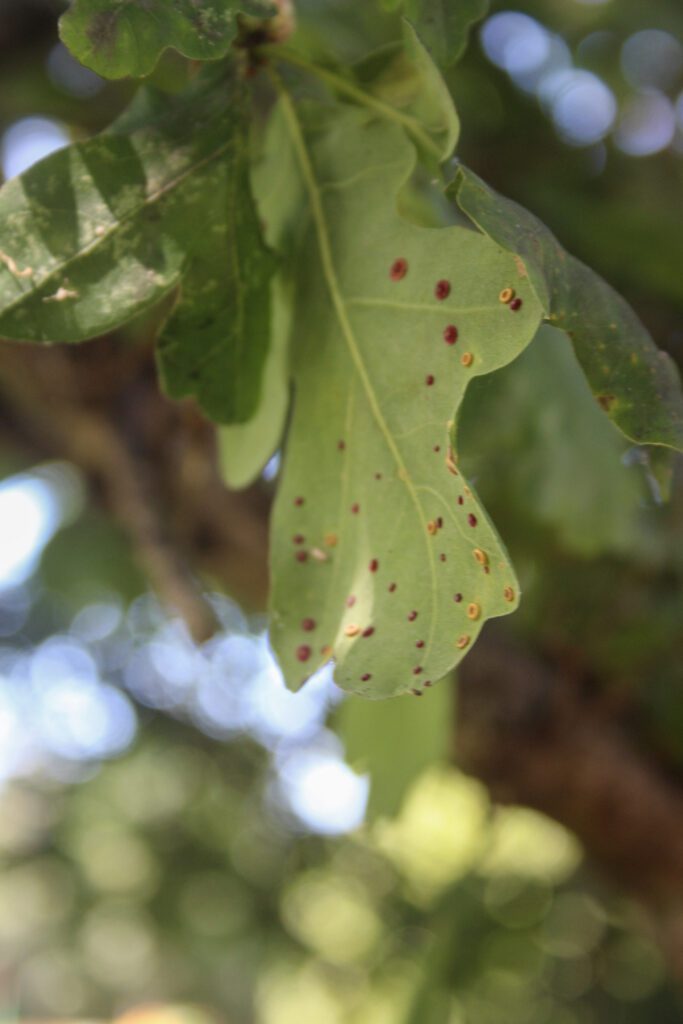
Spangle gall on an oak leaf. [Photograph: Neil Ingram]
“The gall wasp comes to lay her eggs on my new leaves and I make spangle cradles to help to keep them safe.”
oak galls. [Photograph” Neil Ingram]
“It happens again and again. Not just the spangles. Look beneath my leaves and you might find round, knobbly balls, like hard brown marbles. These are oak apples, swollen with the same curious purpose. A different gall wasp requests a grander chamber, and I oblige. Within each one lives a single larva, safe and fed by the very cells I’ve grown to protect my own buds.
Why do I do it? I don’t know. Perhaps I am too old to care. Or perhaps I understand that these wasps—these minute engineers—are part of the pattern. They do no great harm. My crown still grows. My acorns still drop. My fungi and birds and lichens still cling and sing and creep through me.
So I let them stay.
When my leaves fall, the spangles fall with them. Some young mothers emerge come spring, and they begin again—quietly weaving their lives into mine, asking nothing more than a shelter made of leaf or bark.
I am not hollowed by this. I am enriched. Insects, wind, rain, rot, and sunlight—they all shape me. I am a home, not a fortress. I bear their homes, too.
And you, traveller —if you lie on your back and look up through my summer canopy, you might see more than green. You might see a world.”
Jules Acton’s book, Oaklore, Greystone books, 2024, is an essential companion piece to this story. Jules helps us to think about all of the things that the English oak tree has given us as society and individuals.
Update, 20/07/25:
A new gall has appeared on our favourite oak tree. This is a Knopper gall, caused by the gall wasp Andricus quercuscalicis. The wasp secretes chemicals that distort the growth of an acorn. This is a rather more serious pest to the tree than the two show above, because it can reduce fertility of the tree.
Protected inside the gall is a developing larva, which will develop into a pupa and will emerge as an adult wasp in the next spring.
The effects of horse chestnut leaf miners, on a horse chestnut tree in Trendlewood Park, July 2025 {Photograph: Neil Ingram]
By the high summer of July, the new fresh leaves of the horse chestnut are losing their lustre. The proud spread of leaves are now crumpled and marked—creased with dry, papery wounds edged in rust. At first glance, it looks like disease or drought. But the truth is stranger, and smaller.
These are the workings of a moth barely visible to us—Cameraria ohridella, the horse chestnut leaf miner.
The horse-chestnut leaf miner insect. [Photograph: Soebe https://commons.wikimedia.org/wiki/File:Cameraria_ohridella_8419.jpg]
The insect arrived in Britain around 1990, a quiet traveller from North Macedonia, and it has found homes wherever horse chestnuts grow. As the climate warms, insects from the southern regions are able to live successfully in more northern areas.
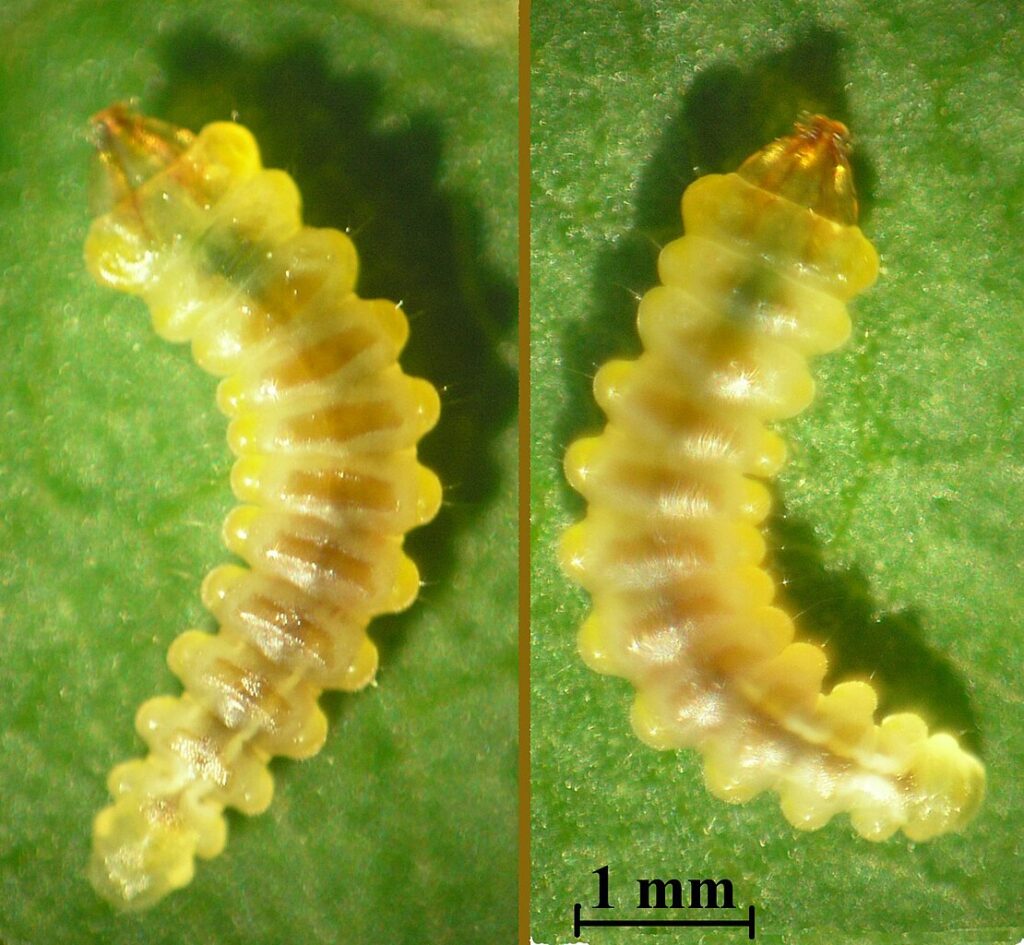
The female lays her eggs on the newly opened leaf, which hatch to form lavae (caterpillars).
The larva of the holly leaf miner insect. [Photograph: Been-tree https://commons.wikimedia.org/wiki/File:Cameraria_ohridella_larva_beentree.jpg]The larvae feed within the leaf itself, tunnelling through the soft tissue, leaving behind pale blotches that crackle in the sun.
What’s remarkable is how unnoticed it all is. The adult moth is just five millimetres long and flits at dusk, almost never seen. The eggs are microscopic. The caterpillar never breaks the surface of the leaf. And yet, whole avenues of horse chestnut trees wear the evidence every July—brown-scarred leaves fluttering like worn-out flags, months before autumn should arrive.
The tree will survive. The damage is cosmetic, mostly. But it leaves a strange melancholy in the woods: an early whisper of decline in the green heart of summer. A reminder that even the mighty horse chestnut has its unseen vulnerabilities. And that nature’s smallest players are often the most quietly transformative.
What benefits do the horse chestnut leaf miner gain from living with the horse chestnut tree. What benefits does the horse chestnut tree get from the arrangement?