Celebrating mushroom season!

A close up of a honey fungus, showing its gills and stem,
A close up of a honey fungus in Nowhere Wood, showing its gills and stem. [Photograph: Neil Ingram]

Everyone agrees, it is an outstanding mushroom season. The dry summer and the warm wet autumn have created the perfect conditions for these mysterious forms which spend most of their lives living underground. Quietly, but with ruthless effectiveness, they influence and shape the growth of the trees in the wood.

But, what is a mushroom? The people living in Nowhere a century and a half ago would distinguish between mushrooms (which they could eat) and toadstools (which they could not). Learning how to tell them apart was (and is) very important for mushroom foragers. Their children would have been taught that if they were not certain, they should leave well alone. Still good advice, today.

To a mycologist (a biologist of fungi) the term toadstool is not used, and the term ‘mushroom’ is used to describe the fruiting bodies of all these fungi.

Bracket fungus on the old beech tree in Nowhere Wood. [Photograph: Pat Gilbert]
This bracket fungus is growing on the old beech tree. It is probably a Giant Polyphore. [Photograph; Pat Gilbert]

So, this wonderful bracket fungus is still called a mushroom by biologists.

Honey fungus growing in Nowhere Wood.
These mushrooms may be of the honey fungus in Nowhere Wood. [Photograph: Neil Ingram]

Which fungi do not produce mushrooms? Well, yeasts are single-celled fungi that do not produce mushrooms. They often grow on the surface of fruit and help to turn apples into cider. Moulds and rusts are also fungi that do not produce mushrooms. They form fuzzy or powdery growths that spread quickly.

Yeasts and other fungi on fallen apples in Tendlewood Park. [Photograph: Neil Ingram]
Mould fungi on fallen apples in Trendlewood Park. [Photograph: Neil Ingram]

Moulds play an important role in helping to break down fruits in the orchard, releasing nutrients back into the soil.

What are mushrooms for? The photograph at the top of the page shows the gills of the mushroom, under its surface. The gills make and store spores, which blow away in the wind. Spores can settle and grow into new fungi.

  1. Imagine what would the world be like without fungi.

Notes on the story

Trick or treat?

Also see: 

The fairy ring

Moving things on

The fairy ring

Fairy ring fungus
Fairy ring fungus [Photograph: Andrew Town]

Just outside of Nowhere Wood, next to the school playing fields, you can, on a summer evening, sometimes see a fairy ring. The photograph shows parts of this fairy ring: sometimes you can find rings that form a perfect circle.


How many fungi can you see here? There are about 15 mushrooms – the fruiting bodies, but only one fungus. In the soil, the fungus exists as a tangle of small thin threads called hyphae. The hyphae, which make up bodies of all fungi,  are called mycelia.

Fungal mycelia can grow to enormous sizes. There is a fungus in a forest in Oregon, USA, which is 3.5 miles across and covers over 2000 acres. It could be up to 8.5 thousand years old!

The grass growing around a fairy ring fungus
The grass growing around a fairy ring fungus [Photograph: Andrew Town]

The fungus is good at feeding on dead organisms, and returning the nutrients to the soil. This helps the grass growing around the circle to grow taller than the grass growing further away from the fungus.


Fairies dancing in a fairy ring
Fairies dancing in a fairy ring [image: Walter Jenks, The fairy ring. https://britishfairies.wordpress.com/tag/down-tor/]

People love fairy rings and make up stories about them. In English folklore, fairy rings are caused by fairies dancing in a circle. Be careful if you see one though. The stories say that if people join in the dance they would be punished by the fairies, and made to dance in the ring until they fall asleep. 


  1. Why do you think that fungi are useful in our woods and fields?
  2. William Shakespeare is thought to have written these lines:
“If you see a fairy ring
In a field of grass,
Very lightly step around,
Tiptoe as you pass;
Last night fairies frolicked there,
And they’re sleeping somewhere near.
If you see a tiny fay
Lying fast asleep,
Shut your eyes”


William Shakespeare wrote “A Midsummer’s Night’s Dream” in about 1596.  In the play a group of powerful fairies cast spells on people, making their lives very difficult. Many people believed in such ideas in Elizabethan times.
 
Why do you think many people no longer think like this?


Notes on the story

Hard hats, safety specs and camouflage jackets

A year in the life of a sugar factory

The leaves of plants are everywhere in Nowhere Wood, helping to keep the wood alive. Leaves are organs: collections of living tissues and cells, having adventures in time and space. This is the story of a year in the life of an oak leaf.

Leaves are factories for making sugar from sunlight, water and carbon dioxide from the air. No human factory can do this, which is why we, and all other organisms, are so dependent on plants. Leaves are the producers of food.

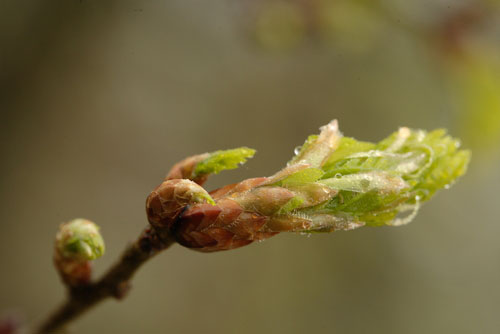
Buds of the English oak.
Buds of the English oak. [Photograph: https://commons.wikimedia.org/wiki/File:English_Oak_(Quercus_robur)_buds_(8535459373).jpg]
In is late November and the cells that will divide to make the new leaf are protected safely inside the scales of the bud. Early in March, when the days warm and get longer, stem cells within the bud start to divide many times, producing all of the cells of the new leaf. To start with, the cells are very small and all look the same.

Emerging leaves. [Photograph: shutterstock_244078297, licensed by NI]
Soon, the cells take up water and get much larger. They escape the protection of the bud and the new leaf emerges. The new cells no longer look the same: they are on different journeys of development, becoming all of the different cells and tissues that make up the leaf.


New leaves. [Photograph: Stutterstock 671376856, licensed by NI]
The leaf is a factory for making sugar. Like any factory, it has a source of energy and transport systems to get the raw materials into the factory.  It also moves the manufactured sugar out to the places in the plant where it is needed. The heart of the factory is the production line where sugar is made. These are called chloroplasts and the leaf has millions of them, all making sugar whenever the sun shines. The Spring and Summer are sugar making seasons.

Oak leaves in autumn. [Photograph: Neil Ingram]
Gradually, in the autumn, when the days get cooler and shorter, the sugar factories are shut down and abandoned. The chloroplasts lie in ruins as everything useful is recycled back into the branches of the tree. All that remain are the frameworks of cell walls, turning brown as they dry in the autumn air.


Dead leaves
Dead leaves. [Photograph: Neil Ingram]
Finally, the oak tree makes a special layer of cells that separates the old leaf from the stem, and the leaf is ready to fall when the wind blows strongly. The fallen leaves are not wasted, becoming energy stores for the organisms that feed on them. Next year’s buds are forming and wait for spring and the production of new leaves.

If leaves are factories form making sugar, then trees are factories for making leaves.

Everything has its own season in Nowhere Wood.

  1. Think about how the leaf is a factory for making sugar. Where does its energy store come from? How do the raw materials get to the production line?
  2. The production of leaves is sustainable in Nowhere Wood. What do you think this sentence means?

Notes on the story

Subterranean superheroes

Moving things on

The weather is warm and wet in Nowhere Wood.

These are perfect conditions for growing the fungi that spread  everywhere throughout the soil of Nowhere Wood. Fungi are Nature’s recyclers, feeding on the fallen leaves, fruits and wood.

Mycelia of fungi. [Photograph: Neil Ingram]
Fungi feed on the wood of the dead oak trees, turning it into nutrients that provide energy and chemicals needed  to grow new fungal cells.  (These cells form long threads called hyphae). Some fungi can spread out over really large areas, several kilometres wide.

At this time of the year, the fungi are busy ‘ being’.

Fungi in Nowhere Wood. [Photograph: Neil Ingram]
Then one night, silently and without warning, the fungi do something else.

They produce structures that we call “mushrooms” **.

Mushrooms are  fruiting bodies. They produce thousands of tiny spores.

Spores are small and light. They are carried on air currents to new places in Nowhere Wood, where they will germinate and grow into new hyphae.

Fungus in Nowhere Wood. [Photograph: Neil Ingram]
Spores have often been found in the filters of jet aircraft flying at the edge of the atmosphere, so some spores can travel right round the world. When fungi produce spores they are ‘becoming’ something new: small, light and mobile versions of themselves.

Decaying fungus in Nowhere Wood. [Photograph: Neil ingram]
Then, almost as soon as they arrive, it is all over. The fruiting bodies die and become food for other fungi and bacteria in Nowhere Wood.

This is how it is. The precious molecules are used, recycled and become part of the growth of new organisms. Nothing is ever wasted.

  1. Nearly all of the atoms present on Earth when life began to evolve about 3.7 billion years ago are still found on Earth today. Many of them are found locked inside living organisms. Sooner or later, all of these organisms will die. Imagine what life would be like without Nature’s recyclers.
  2. You are a collection of recycled atoms. Think about how carbon atoms enter and leave your body. [Hint, carbon atoms are found in carbohydrates and in carbon dioxide.]

You can read more about ‘being and becoming’ here.


**Some mushrooms are good to eat, others are really poisonous and can kill us. It is hard to tell them apart unless you are an expert, so it is sensible not to touch or eat any mushrooms you find in a wood.

Notes on the story

Climbing the walls