The end of the summer

Nowhere Wood has a weary silence, as the heat stifles its life. It is ready with its autumn plans, which cannot start until it rains. 

Rain, the life-giver. Yet in flood, rain is the also the destroyer. It is a question of balance. Is the balance changing in the wood? Is the balance changing in the world? This has been the hottest summer the wood has ever known. People across the world are saying the same things. 

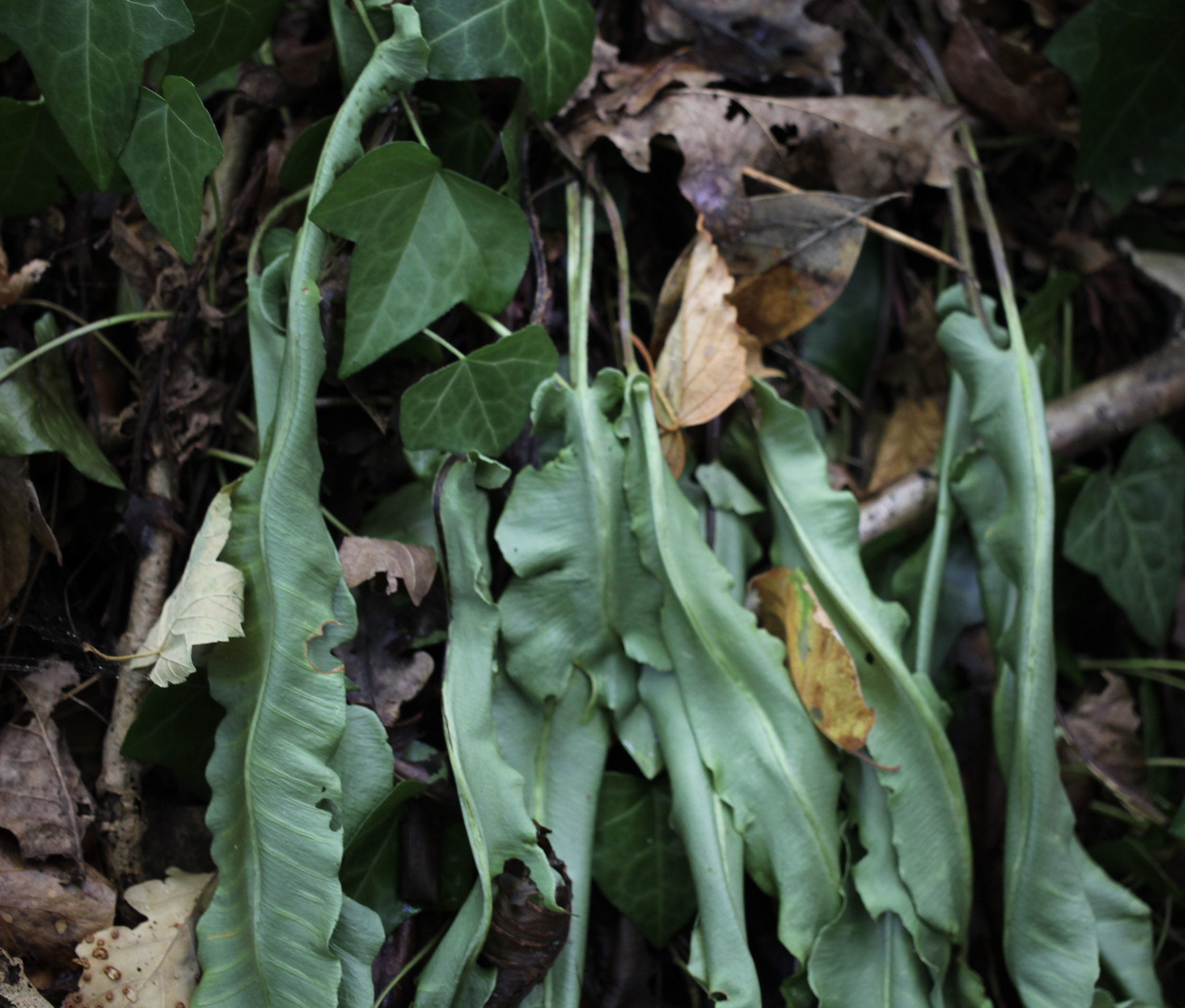
Fern leaves wilting in the summer heat in Nowhere Wood
Fern leaves wilting in the summer heat in Nowhere Wood. [Photograph: Neil Ingram]

Even the fern leaves are wilting for want of water. Holly trees have deeper roots, but they are suffering, too. The soil in the wood is very thin, because it used to be a stone quarry, and the roots cannot grow deep enough to find water.

Holly leaves wilting in the summer heat in Nowhere Wood.
Holly leaves wilting in the summer heat in Nowhere Wood. [Photograph: Neil Ingram]

Then, the remains of a hurricane in the Caribbean barrels westwards, bringing with it strong westerly winds, which blow the summer away in a moment.

The first autumn rain falls in Trendlewood Park.
The first autumn rain falls in Trendlewood Park. [Photograph: Neil Ingram]

The rain falls, gently at first, then much stronger. The smell of the wood changes as the plants take up the water and everything seems to relax.

Droplets of rain on a leaf of a snowberry plant
Droplets of rain on a leaf of a snowberry plant in Nowhere Wood. [Photograph: Neil Ingram]

Nowhere Wood is lucky. Somalia in East Africa it has not had any significant rain for two years and a quarter of the population faces “crisis-level food insecurity” (near-starvation). Yet, in 2023, October floods killed hundreds of people and washed away thousands of homes. The harvest was ruined, leading towards more famine.

It is the unpredictability of the weather that causes most concern. Farmers sow their seeds not knowing whether it will produce enough food. And that is now the same everywhere across the world, including Great Britain. Time will tell what will happen in the future. 

Meanwhile Nowhere Wood celebrates the arrival of the rain in autumn as the fruit ripens and the wood moves forward into the next stage of its adventure.

Apples ripening in the rain in the orchard in Trendlewood Park.
Apples ripening in the rain in the orchard in Trendlewood Park. [Photograph: Neil Ingram]

1. Imagine that the autumn rains did not come. What would happen to Nowhere Wood?


Notes on the story

Climate Change and the Weather


Update: 

A few days alter, after real rain, the fern has recovered and perked up. 

After a few days rain, the fern recovers.
After a few days rain, the fern recovers. [Photograph: Neil Ingram]

Climate change and new arrivals

Some animals and plants can’t live in Nowhere Wood because it’s too cold or too wet for them. But the climate has warmed by about 1°C since the 1970s. This small change has allowed new species to come and live in the wood because the climate now suits them better.

Rosel's bush cricket
A pair of Rosel’s bush crickets were found on Golden Vallety field in 2019. [Photograph: Andrew Town]
In 2019, a pair of Roesel’s bush crickets were found in Golden Valley field. They seem to have bred successfully. The warmer climate has helped them find more places to live. They are moving northwards from the South of England and have migrated more than 50 miles over the past 20 years.


Downland Villa bee fly
This Downland Villa bee fly looks like a bee, but it is actually a fly. [Photograph: Andrew Town]
The Downland Villa bee fly was first seen in Sussex in 2016 and has been moving northwards, probably because of the warmer climate. These flies look like solitary bees, which are bees that do not live in hives or colonies. The bee fly feeds on solitary bees by dropping their eggs into the bees’ nest, where they hatch and eat the bee larvae.

Scientists think there may be over fifty species of animals arriving in the UK because of climate change, although most of them have not yet arrived in Nowhere Wood!

  1. Crickets eat grass. Do you think the arrival of the Roesel’s bush crickets will harm or help the wild life that live on Golden Valley fields?
  2. Roesel’s bush crickets seem to have bred successfully on Golden Valley. What does this mean? How will this help the survival of the crickets in the area?
  3. How might the arrival of the Downland Villa bee fly affect the solitary bees in Nowhere Wood?

Update, 7/5/25: New bee arrival!

Orchard bee
Orchard bee. [Photograph: USGS Bee watch]
The orchard bee is a solitary bee that is spreading rapidly in the south of England, which was once too cold for it. It won’t be long before it reaches Nowhere Wood! Read more here.


Notes on the story

Climate change and the leavers

A tale of two butterflies

It is a sunny afternoon in May and two butterflies are flying round each other in a shaft of sunlight. The smaller one chases the larger one away.

I first thought they were a courting pair, but then realised they are different types. Where do they come from and what are they doing in the sunshine?

Specked wood butterfly in Nowhere Wood, May 2025
Specked wood butterfly in Nowhere Wood, May 2025. [Photograph: Neil Ingram]
The chasing butterfly is a specked wood, seen  resting on an ivy leaf,  keen to be photographed. It is a true native of Nowhere. It started life as an egg laid during the previous autumn, perhaps on some of the long grass that skirts the wood. It probably emerged a few days ago, and has taken to flying in the same shaft of sunlight.

It is warm and bright in the sunlight and both males and females are attracted to the same spot. No wonder our male wants to chase rivals and other butterflies away!

The unfortunate butterfly to be caught up in this tussle was a red admiral. It was harder to photograph against the floor of the woodland.

Red admiral butterfly, Nowhere Wood, May 2025
Red admiral butterfly, Nowhere Wood, May 2025. [Photograph: Neil Ingram]
This butterfly was just in the wrong place at the wrong time.

The red admiral butterfly is a summer visitor to the wood, with large numbers arriving in the UK  from southern Europe and North Africa each year. They love to feed on flowers that produce a lot of nectar, so are often found in the gardens that surround the wood.

They will breed whilst they are living in the wood, and some of these new butterflies will try to fly back to Europe in the autumn. It is not clear how many of them will survive the long journey.

Others will try to survive the winter in the UK. In the past, most of these have died because of the cold, but warmer winters mean that more of them are surviving to breed in the spring.

We could be seeing a shift in their behaviour because of climate change, that could lead them to being permanent residents in the wood.

Update:

Two days later, the speckled wood was still patrolling the same patch of sunlight. Let’s hope he gets lucky soon!

A male speckled wood butterfly was found in the same spot two days later.
The male speckled wood butterfly was found in the same spot two days later. [Photograph: Neil Ingram]

  1. In Southern Europe and North Africa, red admiral butterflies can breed continuously throughout the year. Why is important in the survival of the red admiral species?
  2. Why is it an advantage for the specked wood to defend a territory in Nowhere Wood?


Notes on the story

Being and becoming in Nowhere Wood

Climate change and the leavers

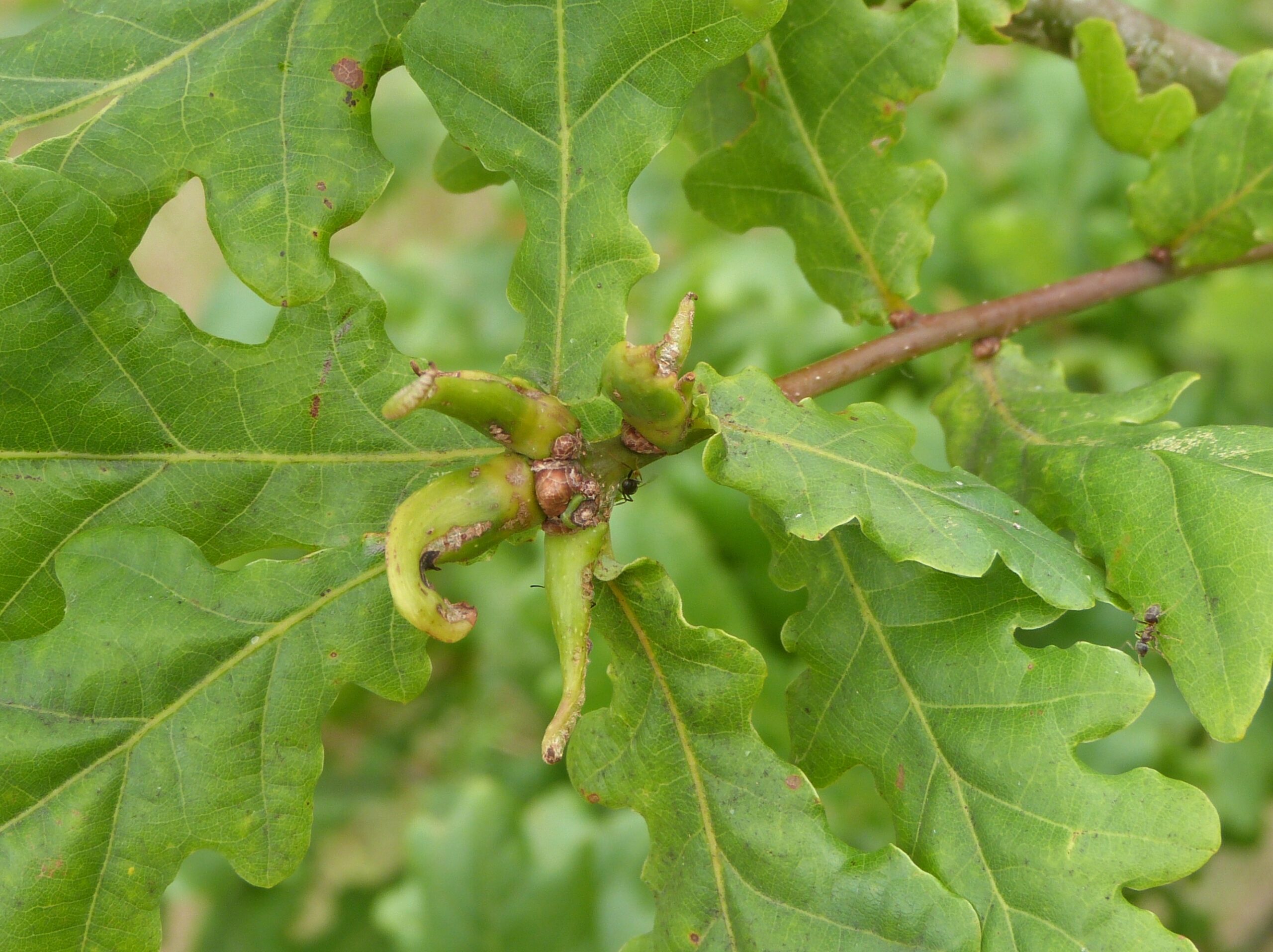
Rams horn gall oak wasp
The ram’s horn gall oak wasp was first found in Berkshire in 1997. It is now quite common in the Park [Photograph – Andrew Town].

We can spot new arrivals in Nowhere Wood, if we have time and patience. Anyone can do this if they walk through the wood often, thinking about what they see. It is much harder to notice species that disappear because the changing climate does not suit them. Species come and go from the wood all of the time.


So how do we know which species have left permanently because of climate change?

News article about declining number of insects
This news article from the Natural History Museum is about declining number of insects. From: https://www.nhm.ac.uk/

One way is to combine our observations of Nowhere Wood with observations from other woods across the country. This helps us to see the ‘bigger picture’.

When we do this, we can see that we do have a problem: London’s Natural History Museum reports that “UK’s flying insects have declined by 60% in 20 years”.


Three reasons are given for this fall in numbers,  rising temperatures caused by climate change,  loss of suitable habitats and the use of harmful chemicals as pesticides.

The hairy-footed flower bee, pollinating a lungwort flower
The hairy-footed flower bee, pollinating a lungwort flower [Photograph – Andrew Town].

Losing insects could have serious effects on Nowhere Wood and the surrounding farmlands. Bees are insects that are suffering this fall in numbers. They help to pollinate many crops, including the apple trees in the orchards.


Many insects are food for birds and other animals. A loss of insects could lead to a reduction in the number of these animal, too.

  1. Bee hotels are sometimes used as a way to help encourage solitary bees to breed and survive. Learn how to do this here.
  2. Imagine what a world would look like without insects.  Does it matter if we lose our insects?


Notes on the story

Climate change and the weather

The Apple Tree Man of Nowhere

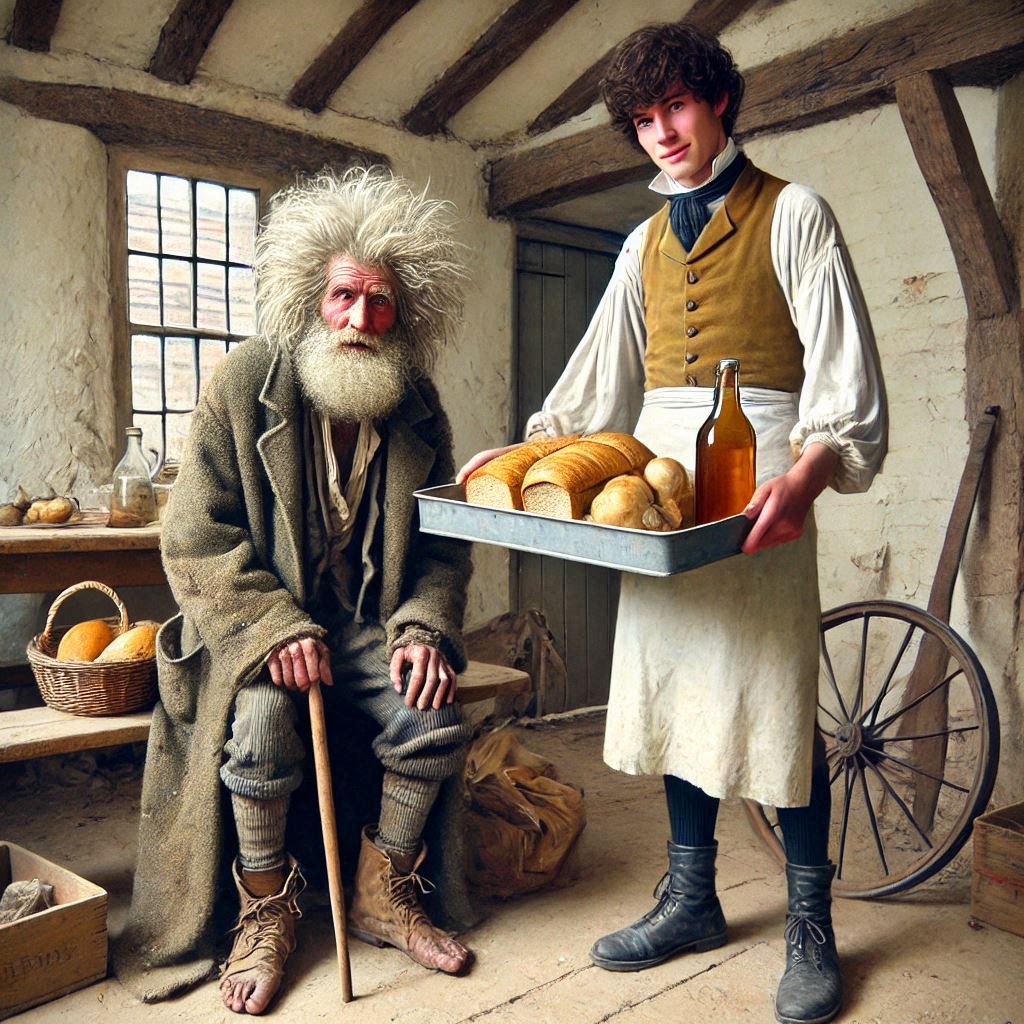
Once upon a time, there lived a young man called Henry Summers, who lived at the Farmhouse over at the East End, just below the quarry. He was a wise man, strong in the arm and of calm manner. He never beat his animals or his wife. The family farmed ten fields and had several beautiful apple orchards.

Among the trees, there was one particularly ancient apple tree that Henry’s great grandfather planted and around which all of his children had played. The tree stood tall and strong, even though it was very old.

Henry believed that this tree was extra special, and he called it the ‘Apple Tree Man’. Henry always took great care of this tree, speaking to it kindly and ensuring it had plenty of water and cider at the wassail.

One cold winter’s night, Henry was visited by a stranger who had walked from Bristol and wanted to find friends in Nowhere. His clothes were dirty and his shoes were worn out. Henry was as kind to people as he was to his goats, welcomed the stranger into his home and gave him food and cider.

The wanderer meets the young farmer

His wife looked out some more shoes for him.  The stranger slept soundly in his clean bed that night.

The next day, the happy stranger revealed that he was, in fact, the spirit of the Apple Tree Man who had taken the form of a wanderer to test the farmer’s kindness.

The Apple Tree Man promised the farmer that as long as he continued to care for the apple trees, his orchards would make so many lovely apples every year, that he and his family would be wealthy and  joyful.

The apple trees produced many beautiful apples

The Apple Tree Man was true to his word, the orchards flourished, and the farmer and his descendants enjoyed bountiful harvests for many generations. And the people of Nowhere enjoyed their cider for years to come.


Notes on the story

Climate change: new arrivals in Nowhere Wood


Climate change: what can we do about it?

The average global temperature is now two degrees warmer than it was in the 1700s.
The average global temperature is now two degrees warmer than it was in the 1700s. [Image generated by AI]

The climate of the whole world  is changing because of the rising temperatures. Scientists think that  increasing levels of carbon dioxide gas in the air are  making these changes worse.

The Earth is now an average of two degrees warmer than it was in the 1700s, before the start of the industrial revolution.

We should try to do two things: to reduce the amount of carbon dioxide in the air and to try to look after and encourage the wildlife in our local areas.

Wind energy is renewable and helps to reduce global warming
Wind energy is renewable and helps to reduce global warming. [Image from https://www.peterduffyltd.com/old-whittington-wind-turbine-generator/]

Burning fuels, such as coal, petrol, gas and oil are the main ways that we add carbon dioxide to the air. As a country we are aiming to increase the amount of energy we produce from “renewable ” sources of energy that do produce carbon dioxide. Last year 45% of the UK’s energy was produced from such sources, which include wind, solar, hydroelectric and nuclear power.

We can think about switching from petrol to electric cars and to insulate our homes better to reduce the heat we lose to the air. We use less electricity and gas and save money at the same time!


Food and drink cans inside a recycling bin.
We can recycle our food and drink cans [Photograph: https://commons.wikimedia.org/wiki/File:Food_and_drink_cans_in_recycling_bin.jpg, creative commons licence]

We can recycle our waste, so it gets reused and this reduces the amount of energy needed to produce new goods. Reducing aluminium food trays, cans and foil can save about 95% of the energy needed to replace these products from raw materials.


We can grow more plants and grow more trees. Plants are very good at removing carbon dioxide from the air. Scientists are trying to restore lost habitats like forests, wetlands and marshes, that are very good at removing carbon dioxide from the air. This is called ‘rewilding’.

The Meadows next to Nowhere Wood is a rewilding project.

A bee hotel for sale in a local supermarket
A bee hotel for sale in a local supermarket. [Photograph: Neil Ingram]

We can encourage the wildlife in our gardens, parks and school grounds. Bird and bat boxes and bee hotels can provide places where birds, bats and solitary bees can live safely.

one candle does not produce much light, but many candles can make a bright light.
One candle on its own does not produce much light, but many candles can make a bright light. [Image: Neil Ingram and Google Gemini AI]


Solving the problem of climate change is difficult and needs all of us to work together to make it happen. Every person can make a small difference, but these differences add together to make a big change.


Notes on the story

A tribute to fallen trees

Apples and the new year

Let’s travel back in time three hundred years or more, to the East End Farm, near the hamlet of Nowhere. 

East End farm has a few sheep and goats, some vegetables and several apple orchards.


Children in Bridport, Dorset, wassailing in a community orchard
Children in Bridport, Dorset, wassailing in a community orchard. [Photograph, https://upload.wikimedia.org/wikipedia/commons/thumb/2/25/Bridport_Community_Orchard_Wassail_2022_%2851830797371%29.jpg/1024px-Bridport_Community_Orchard_Wassail_2022_%2851830797371%29.jpg]
Tonight the orchards are surrounded by farm workers and villagers from Nowhere, all singing and banging pots and pans. Children hang pieces of toast soaked in cider from the tree branches. 

For tonight, January 5th, is the wassail, the twelfth night of Christmas.


Small orchards in Somerset
The orchards contain a number of apple trees. [Photograph: David Smith, https://www.geograph.org.uk/photo/5606792
Apples grow all across the county of Somerset, and are especially important to Nowhere and its bigger neighbour, Nailsea. Every farm brews cider, which they give to the farm hands as part of their wages. 

(Centuries later, cider would be brewed and sold in large factories. Nailsea hosted  Coates factory for over 150 years. These days, the Thatcher family brews cider at Sandford, ten miles to the southwest.)  

Wassailing at night
Wassailing at night. [Photograph: Steven Brace, https://www.flickr.com/photos/30399879@N03/3286351432]
Back in Nowhere, apple trees are a sign of a healthy farm. Wise famers celebrate the good health of their orchards with a wassail.

Their people visit the apple trees by the light of burning torches.  Singing songs to them and making a lot of noise to ward off evil spirits. Hopefully, this should be enough to ensure a good harvest in the next year. 

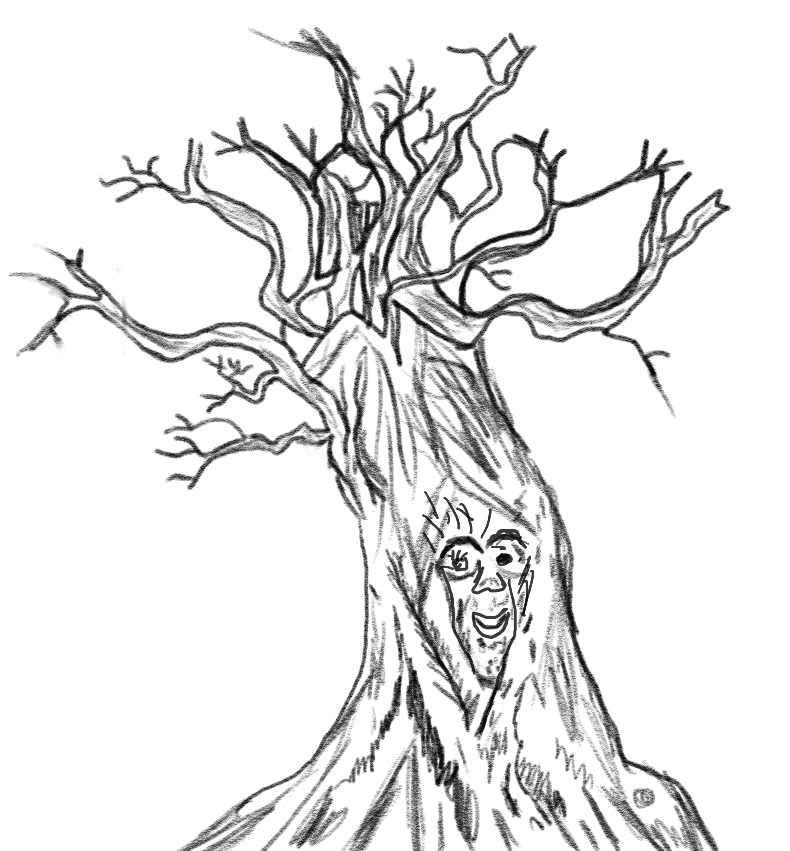
The oldest tree in the orchard is given the greatest respect, and he is called the ‘Apple Tree Man’. [Image: Neil Ingram]

 The Apple Tree Man decides how many apples will grow in the next year. Farmers keep the Apple tree Man happy by pouring cider over his roots. 

There are several old folk tales told in Somerset about the Apple Tree Man. The next story is a modern retelling of one of these old tales.


Notes on the story

The Apple Tree Man of Nowhere

What can eat a tree like this?

This story is about how a pair of tiny insects about 6mm long and their very hungry caterpillars can eat a large tree.

Bark of a mature European Ash tree (Fraxinus excelsior)
Bark of a mature European Ash tree (Fraxinus excelsior). Photograph: Ash Bark – geograph.org.uk – 645097.jpg

Ash trees are beautiful: young trees have smooth grey bark, whilst older trees have bark that cracks to form diamond shapes,  like the pattern we see on a chain-link fence.

No one likes to see these wonderful trees cut down in their prime. One of the problems with ash dieback disease is that there is often little to see on the outside. Yet the tree is damaged on the inside.

The trunk of an ash tree damaged by ash dieback disease.
The trunk of an ash tree damaged by ash dieback disease. Photograph: Neil Ingram

Some beetles can bore into wood of infected trees, as the  photograph shows. The beetles have made many round holes  as well as carving the thin curved galleries in the wood of the tree.

The oak pinhole borer beetle
An adult oak pinhole borer beetle, which can attack ash trees. Image: John Curtis (1791–1862).

It is hard to say what type of beetle caused this damage, but one likely culprit is the oak pinhole borer,  which (despite its name) can attack weakened ash trees. The infection probably occurred during the summer months, when a male digs a hole a few centimetres deep in the bark of the tree.. The female inspects the hole  and then returns to the surface to mate with the male.

The female then re-enters the hole and the male follows her in. She digs deeper into  the tunnel, working in a curve.  The female eats the wood and excretes the fine wood fragments  in her feces.  This is called frass. The males help to keep the tunnels clear, by moving the grass out of the way.

The insects’ bodies are covered in spores of a group of fungi, called ambrosia fungi.

Ambrosia fungus, grown in a laboratory, seen under a microscope.
Ambrosia fungus, grown in a laboratory, seen under a microscope. Photograph: Kathie Hodge, https://www.flickr.com/photos/cornellfungi/6185749769

These fungi grow in the galleries made by the female. The eggs of the insects hatch to form larvae, which feed on the ambrosia fungi.

The round holes are part of the tunnels that reach the surface of the wood, allowing the new adult borers to leave the tree.

It is an interesting relationship between the insects and the fungi, because both depend on each other for their survival.

We talk in these stories about how energy flows through ecosy stems and how atoms are recycled by other organisms. The ash tree,  the ash dieback fungus, the beetles and the ambrosia fungi are component parts of an ecosystem.

Explain how energy flows through the ecosystem and how atoms are reused.


Notes on the story

Yellow flowers

If a tree falls….

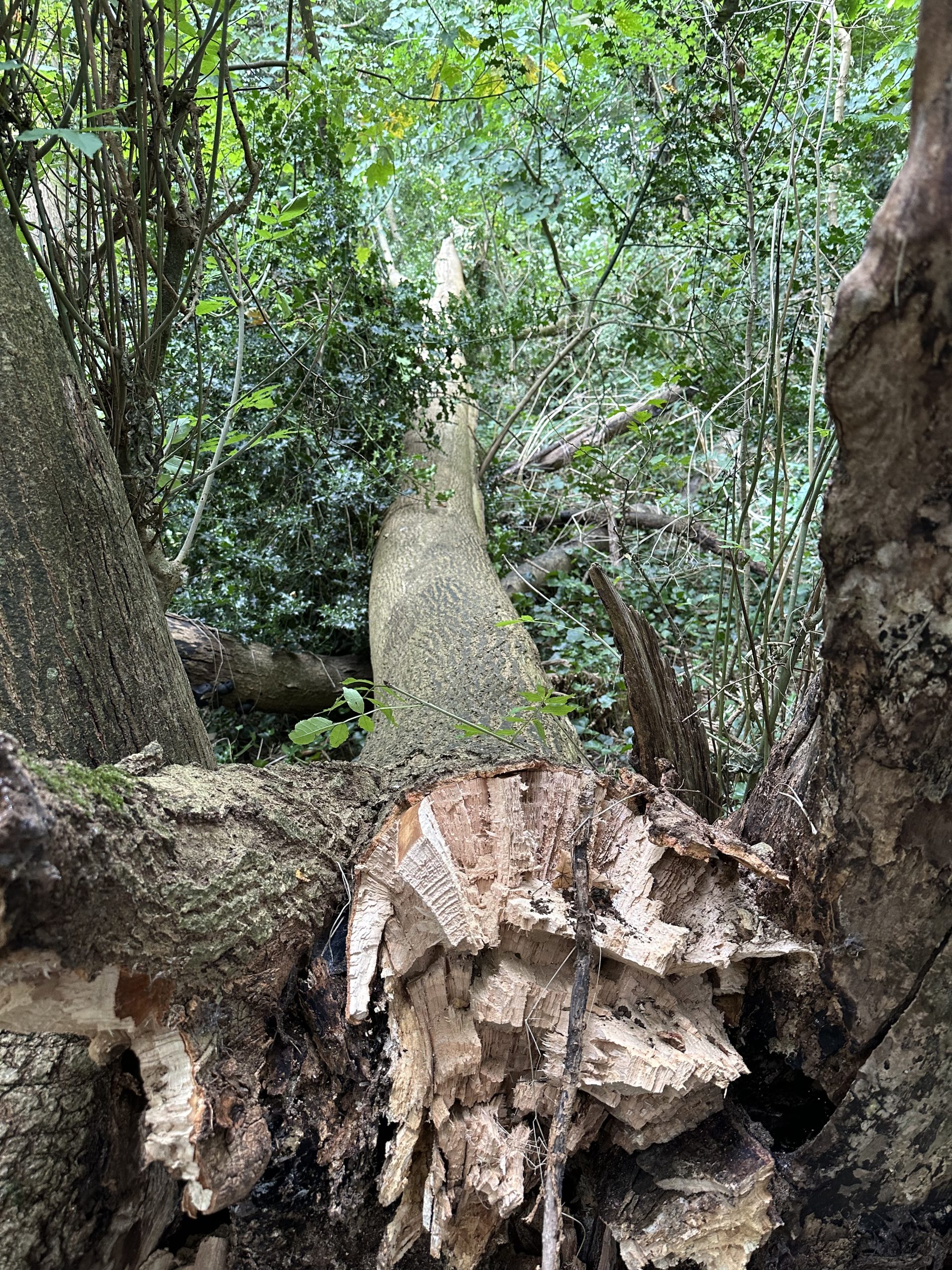
A fallen ash tree in nowhere Wood
A fallen ash tree in Nowhere Wood. [Photograph: Neil Ingram]

It was a stormy August night in Nowhere Wood. The wind was tearing through the leaves and branches and was strong enough to pull the whole tree down.

And so, a tree that had been growing in the Wood for fifty years or more was felled to the floor of the wood.


Ash dieback disease
Leaves damaged by ash dieback disease. [Photograph: https://www.rhs.org.uk/disease/ash-dieback]

In the tangled wreckage of leaves, twigs and branches, we can see the tell-tale signs of Ash-dieback disease. This probably weakened the tree, so the wind could blow it over more easily.


Most of the ash trees in this region have the disease, which is caused by a fungus that produces sores that blow away in the air, spreading easily through the wood. One day they will be cut down.

Fungi feeding in a fallen tree in Nowhere Wood
The tree is a store of nutrients. [Photograph: Neil Ingram]

Although this tree has died, its adventure through time continues. It is becoming useful because it is a large store of nutrients that other organisms in the wood will  use to survive and grow.

Over time,  insects and fungi will break down the tree wood  releasing nutrients that to the organisms in the wood.

Left undisturbed, nothing will go to waste.

New trees will grow up to replace those that have fallen, using the nutrients that are in the soil. Fallen trees are an opportunity for the wood to re-grow itself.

a fungus on a tree
Mushrooms are the fruiting bodies of some fungi. [Photograph; Neil Ingram]

There are lots of fallen trees in Nowhere Wood. The autumn is a good time to see  fungi feeding on the wood, because this is the season when they produce their fruiting bodies that make spores. Mushrooms are examples of these fruiting bodies.

  1. It is sad when we lose trees that we have known for years. Yet there is hope for the future. How does the wood recover from the loss of trees?

Notes on the story

What’s in a name?

The sustainable park (2)


An ash tree showing symptoms of ash dieback disease
An ash tree showing symptoms of ash dieback disease. [Photograph: M. J. Richardson, https://www.geograph.org.uk/photo/5465604]
We did not want those trees in Nowhere Wood to be felled, but we accepted that the trees were infected with Ash die-back disease and had to go. 

Growing and managing trees is something that people of done for tens of thousands of years. One secret is to use every part of the tree mindfully, to benefit the community.

And so it was that fifteen volunteers from the Friends of Trendlewood group came together to drag the fallen branches (“brash”) to the edge of the pond.

Dragging Ash branches to the pond
Dragging Ash branches to the pond. [Photograph: Neil Ingram]
We worked alongside the council parks team, who piled wooden stakes in the ground across the edge of the pond. We then weaved layers of  branches between the stakes to create a “dead hedge”, separating the pond from the children’s playground. 

Laying a dead hedge, using ash branches
Laying a dead hedge, using ash branches. [Photograph: Neil Ingram]
The pond is fed by streams and disappeared for many decades, only to return as a permanent feature in the last few years. Watercress plants grow in the water, as they would have done in the 1800’s, when people used to collect them to eat.

Water cress plants
Water cress is a salad crop. [Photograph: Laura Whitehead, https://www.flickr.com/photos/thewhiteheads/8693844036]
It took a morning to build the dead hedge, which will help to protect children and dogs from getting wet in the pond. It is a good use of waste wood  that would otherwise be burned. Burning wood releases stored carbon into the atmosphere as carbon dioxide.

The completed dead hedge.
The completed dead hedge. [Photograph: Simon Stannard]
It is another example of how the park is managed in sustainable ways.

Sustainability is an important idea. The United Nations has a sustainable development goal for life on land, (number 15). Find out what it says and why it is important.


Notes on the story

What can eat a tree like this?

A tribute to fallen trees

The trees in Nowhere Wood are always there, going quietly through the motions of the seasons: noticed only when we stop to look and reflect. But we feel their presence strongly, just out of sight and mind.

Until today, when their absence feels like the loss of dear friends. 

Fallen ash tree trunks at the quarry face of Nowhere Wood. [Picture: Neil Ingram]
Fallen ash tree trunks at the quarry face of Nowhere Wood. [Photograph: Neil Ingram]
It only took a morning, and nearly 100 years of growth has ended. Yes, they had Ash dieback disease and were marked with a red spot. Yes, they were unstable on the quarry floor.  Even so, we feel their loss keenly.

Trees with Ash dieback disease are marked with a red spot. [Picture: Neil Ingram]
Trees with Ash dieback disease are marked with a red spot. [Photograph: Neil Ingram]
The wood will regenerate, but only if we can remove the trunks from the woodland floor. Else we shall see little re-development in our lifetimes. This problem is one that we have to own.

The robin is an optimistic opportunist. Making the best of new opportunities amongst the fallen branches of ash.
The robin is an optimistic opportunist. Making the best of new opportunities amongst the fallen branches of ash. [Photograph: Neil Ingram]
In the mean time, life goes on amidst the debris of fallen trees.


Notes on the story

The sustainable park (2)

The sustainable park (1)

The old willow tree in Trendlewood park
The old willow tree in Trendlewood park. [Photograph: Neil Ingram]
This willow tree in the park is very old. Maybe a hundred years or so. Look how its bark is gnarled and twisted. It is a great friend of the park and is home to many different insects and birds. One year, a female mallard duck even made a nest on the flat top of the tree!

The willow keeps on growing because every few years, it’s friends cut off all of its branches!

This really does encourage the tree to grow strongly. 

We call the removal of the branches ‘pollarding’.

This ancient willow tree has recently been pruned
Pollarding trees is a way of keeping them alive. [Photograph: Neil Ingram]
This week, it was the old willow’s turn to be pollarded. You can see the cut stumps where the branches used to be.

Woods have always been important to people. In the 17th century, new forests were planted to provide enough timber for the boats for the Royal Navy.

People have pollarded woodland trees for thousands of years.  It was their main source of wood for building, making furniture, for charcoal and for fuel to heat their homes.


Wood is a very useful sustainable resource, when managed in this way. It is sustainable because the tree carries on growing and making new wood.

Pollarded willow wood is special. It is used to make cricket bats and weave baskets.  For generations, this provided income for poor families  in Somerset.

It is also a good way of making new fences. This is because cut branches of willow will grow new roots when they are placed in water.

The cut stems will grow into new trees and can become a hedge when they are planted closely together.

Two volunteers from the Friends of Trendlewood Park soaking the branches of willow
Two volunteers from the Friends of Trendlewood Park soaking the branches of willow. [Photograph: Neil Ingram]
The photograph shows two volunteers from the Friends of Trendlewood Park preparing willow branches to build into a new hedge in the area near the playing fields.

They place the cut ends of the branches into water.

A newly planted willow hedge in Tendlewood Park
A newly planted willow hedge in Tendlewood Park. [Photograph: Neil Ingram]
In a few months’ time, when the weather is warmer, this hedge should be growing strongly and could grow for many years.

  1. This species of willow is called the brittle willow, because branches break off easily. Suggest why it is an advantage to the willow for these branches to be able to grow into new trees.
  2. This species of willow has two ways of reproducing. It flowers and makes seed and also can propagate through fallen branches. Find out why it is useful for the species to be able to reproduce in these two ways.

After the story:

Just after I finished writing this story, it was announced that young trees grown from seeds of the Sycamore Gap tree are to be given to charities, groups and individuals as “trees of hope“. This ancient sycamore tree, from Northumberland, was cut down in September 2023.

new growth from there Sycamore gap tree
Image from https://www.thesill.org.uk/sycamore-gap-tree-is-sprouting/

This is a lovely, kind idea. The tree lives on, not only through its seeds, but  also in the new stems that are growing from its cut stem. This shows the power of nature to recover and re-grow. Life is resilient, it does not give up.


Notes on the story

Apples and the New Year

Climate change and the air

The air is all round us and is a mixture of many different gases. 78% of the air is made of nitrogen, which  is the most common gas. This story is about two other gases found in the air – oxygen and carbon dioxide.


girl breathing out carbon dioxide and breathing in oxygen
The girl breathes out carbon dioxide and breathes in oxygen

We breathe in oxygen and use it to release energy from sugar. At the same time we make carbon dioxide – all living organisms do the same. We all  do this to stay alive.

People  also make carbon dioxide when we burn fuels, such as coal, oil, petrol and wood.

Nailsea was once a very small village. [Image from Nailsea Town.com]

If we go back over three hundred years to the 1700’s, Nailsea was a a tiny village surrounded by farms. Few people lived there, then. People burned wood or peat (from the moors) to stay warm.  They walked everywhere or travelled horse and cart.

Carbon dioxide in the air is measured in units called ‘parts per million’. Scientists  have estimated that in the early 1700’s the carbon dioxide in the air was about 280 parts per million.

An artist’s reconstruction of Middle Engine Pit, Nailsea. Artwork by Mark Hornby. From https://www.nailseatown.com/heritage-trail/middle-engine-pit/

However, things were beginning to change in Nailsea: the first coalmine was opened in 1700 and this would transform the village into a town in the next ninety years. The mines employed experienced miners who came to live in the town as well as local farmworkers.


Oil on canvas of The Old Glass Works, Nailsea in about 1810
This painting shows an appoach to Nailsea from the North. The cone of the glassworks is shown. Nailsea is changing from countryside into a town.
[Bristol City Museum and Art Gallery. Attributed to the British School.]

Plenty of cheap coal led to the opening of the glass factory and more migration of people into the town.  The arrival of the railway in 1841 provided new opportunities to trade with Bristol and its ports. The steam trains were powerful and burned coal.

In Nailsea, new houses were built together with  new roads and shops. Trendlewood quarry was opened in 1850 to provide sandstone tiles for the roofs of the new houses.


All of this activity added carbon dioxide to the air in increasing amounts.  Trees can take carbon dioxide out of the air, but the local woods were gradually chopped down to make way for the new town and for farmland. The wood was burned as fuel.

This pattern of industrialisation has taken place everywhere, all over the world since then. It continues to do so, too. In 2024, the amount of carbon dioxide in the air is estimated at 423 parts per million. This is a rise of 51% since the 1700s.

Does all of this matter? Most scientists think it matters a lot, but some politicians want to disagree.

a diagram of the greenhouse effect
The diagram shows the rays of the Sum being trapped in the atmosphere of the Earth by a layer of carbon dioxide

Carbon dioxide in the air acts like a blanket, reflecting heat energy back towards the land and the sea. In this way, it acts like glass in a greenhouse. The warming caused by the increased carbon dioxide is sometimes called “the greenhouse effect”.

Increased levels of carbon dioxide in the air affects the climate and weather patterns across the world, as we shall see in the next story.

Do you think that the businessmen of the 1700s were aware that the burning of coal could affect the climate of the Earth?

If were are aware of this now, should this affect whether  we choose to burn coal and oil.

What do you think?


Notes on the story

Climate change and the weather

Climate change and the weather

Most scientists think that the Earth is getting warmer and that human activities are making it worse. This story looks at some of the evidence they use.

Weather super computer
A weather super computer at National Oceanic and Atmospheric Administration [Image credit: General Dynamics Information Technology (GDIT)]

Weather experts collect millions of temperature measurements from all around the world every day. They put these results into powerful computers that build a picture of the climate across the world every day. Their results suggest that 2024 was the hottest year ever recorded.

The average October temperatures for the surface of the Earth from 1940 to 2020.
The average October temperatures for the surface of the Earth from 1940 to 2020. The warmest temperatures have been in the last ten years.

The temperature of the Earth in 2024 is about 1.5°C higher than it was in 1880, before large factories, cars, and airplanes existed. The yearly temperatures since 2020 include three of the hottest years since we started recording temperatures.

A 1.5°C rise in temperature does not sound like much, but it is having a big effect on the weather around the world.

Hurricane Beryl over Jamaca. July 2024.
There has been an increase in the number and severity of tropical storms in recent years. [Photograph from: https://www.freemalaysiatoday.com/category/world/2024/07/03/7-dead-as-hurricane-beryl-barrels-towards-jamaica/]

The temperature of the water in the seas in 2024 was the hottest ever. This causes the wind speeds to increase in tropical storms, causing huge damage when they hit coastal towns. 

Warm air can hold more water than colder air, so rainstorms can be more powerful and last longer. Flooding in low-lying areas becomes more common.

Flooding in Monmouth town centre. 1990.
Flooding in Monmouth town centre, 1990. The number and severity of such weather events is increasing. [Image: https://www.flickr.com/photos/imagined_horizons/9637969736]

The level of the sea in 2024 is about 111 mm higher than it was in 1993. This increases the risk of flooding in coastal areas.


Rising sea levels are affecting the survival of many islands.
Rising sea levels are affecting the survival of many islands. [Photograph credit: Envato Elements pic, https://www.freemalaysiatoday.com/category/leisure/2022/02/24/present-day-rise-in-sea-levels-may-have-begun-in-1863/]

Some small islands in the ocean are at risk of disappearing due to the rising sea waters. Nyangai Island off the coast of Sierra Leone has almost been lost to the waves.


Polar bears are finding it harder to hunt because of melting summer ice in the Arctic.
Polar bears are finding it harder to hunt because of melting summer ice in the Arctic. [Photograph: https://www.flickr.com/photos/gsfc/29664357826]

The rising sea levels are being made worse by the melting of the ice in the Arctic and Antarctic. Summer ice in the Arctic is disappearing by about 12% every ten years. It is affecting the survival of polar bears.


Notes on the story

Climate change: what can we do about it?

Subterranean superheroes

Leaf fall in Nowhere Wood. [Photograph: Neil Ingram]
The leaves covering the floor of Nowhere Wood are slowly disappearing in the mild December nights. Fog hangs in the air. The wood is preparing for winter and everywhere is quiet and still. Most of the real action is taking place below the ground, but what is making the leaves disappear?


Earthworm [Photograph: Shutterstock 1596740926, licensed to NI]
The culprits are earthworms, the little subterranean superheroes that do most of the heavy lifting in Nowhere Wood. There is about 45 million earthworms underground in the wood, with a total biomass equal to about twenty elephants. They are easily the most abundant animal in the wood, but they are so rarely seen.


Earthworm. [Photograph: Shutterstock 171009224, licensed to NI]
Earthworms tunnel into the soil making the burrows that are their homes. At night, they come to the surface to drag fallen leaves back down into their burrows. The burrows are also perfect homes for bacteria and fungi.


Fungi mycelia. [Photograph: 159740926, licensed to NI]
The bacteria and fungi  feed on the leaves, turning them into nutrients that they use as food. This is humus. Earthworms eat the fungi and the humus-rich soil. As they do so, they glue the soil particles together into small clumps. This improves the quality of the soil, making it a perfect environment for plant roots.


Plant roots in Nowhere Wood. [Photograph: Neil Ingram]
Plant roots need plenty water, air and nutrients, all of which are given to the soil by the fungi and earthworms. We can think of earthworms as the soil’s farmers, ploughing the soil for the plants. Without their work, no life could exist in Nowhere Wood.


Charles Darwin. [Shutterstock 252138244, licensed to NI]
The famous scientist Charles Darwin studied how plants, earthworms and fungi work together to keep woods alive, and he wrote a famous book about it in 1881. He wrote about earthworms: “It may be doubted whether there are many other animals which have played so important a part in the history of the world, as have these lowly organised creatures.”

  1. In what ways do you think that soil is alive?
  2. Think about how the trees, fungi and earthworms work together to keep the wood alive.

Today, Friday 4th December 2020, is World Soil Day 2020. Here is a video celebrating our dependence on soil:

Notes on the story

Spring is coming!

All change!

[Image: https://www.clipartof.com/portfolio/sajem/illustration/happy-moodie-character-looking-at-his-reflection-in-a-mirror-227335.html]
When you next look into a mirror ask yourself if you are the same person as you were yesterday. Well, of course you are.

Even people who last met you ten years ago can still recognise you and call you by your name. Although they might add, “My, how you have grown!”

And yet, if we could see under your skin, we would find that you are not the same. One of the biggest mysteries in biology is how we can change all of the time, whilst still staying the same.

Your skin cells live for about two weeks, so every month they are completely replaced. Red blood cells live for about 100 days and about two million are made in your body in every second.

Some of the chemicals in your cells exist for only minutes or seconds.

There is an energy store called ATP, which is needed for muscle contraction. ATP is made and broken down within 15 seconds.  Cells need glucose to make ATP and this explains why muscle cells need a continuous supply of glucose to stay alive. This comes from our food.

[Image: https://www.clipartmax.com/middle/m2i8d3m2Z5d3G6d3_hm00260-%5B1%5D-digestive-system-close-up/]
Even large organs, like the liver, are replaced regularly. You grow a new liver every year. The cells in the alveoli of your lungs are renewed every eight days. Even the bone cells in our skeleton are replaced every three months. Your entire skeleton is remade every ten years.


[Image: http://halloween.phillipmartin.info/halloween_skeleton.htm]
So, when your friend sees you after ten years and calls out your name, there is not a single part of your body that was the same as when you last met. You have been completely remade and remodelled. And the same is true of your friend.


So, how can this be? New cells are made when one cell divides to make two cells. The information in the genome is copied before cells divide, so the new cells always receive the same information as the old cells.

The new cells use this information to grow bigger and to develop. So, you stay the same because of how your new cells use the information in their genomes.

Living organisms are alive because they actively remake themselves. No man-made machine can do this. Which is, perhaps, just as well.

  1. In what ways have you changed in the last ten years?
  2. In what ways have you stayed the same?
  3. Why do need to eat food everyday?

Notes on the story

A year in the life of a sugar factory

Life is a relay race

This story continues the adventures of the ferns in Nowhere Wood. The first part of the story is Climbing the walls.

The genome of the fern contains essential information that the fern needs to grow and  make new cells. At different times the fern produces spores, sperm and eggs and the two forms of the plant. The genome contains information on the growth of each of these stages.

The information in the genome is the same in every cell of the fern because an identical copy of the genome is found inside the nuclei of all the cells of this fern at every stage of its life.

The genome is found in the nucleus of each cell.

Fern chromosomes

The genome is divided between a number of chromosomes. The diagram shows the genome of the Adder’s tongue fern. It has about 1440 chromosomes. This is the largest number of chromosomes of any organism in the world!

Fern genomes are larger than the genomes of other organisms, because they contain the information the fern needs to grow spores, sperms and eggs as well as the two forms of plant.

The genome contains the secrets of how to be a fern and how to move forward in the adventure. This information has been copied and passed on to each generation of ferns, ever since the first ferns evolved about 390 million years ago.

Life is like a relay race: genetic information is passed on from one generation to the next in the genomes of sperms, eggs and other gametes.

These ferns are having risky and uncertain adventures in time as well as space. If the secret information is not passed on correctly, then the species may become extinct. History shows us that most species that have ever lived on Earth are now extinct.

    1. Why do you think it is essential that the genetic information from parents to offspring is copied accurately?
    2. Why do you think the fern genome is so large, compared with other types of plant?

Notes on the story

All change!

Moving things on

The weather is warm and wet in Nowhere Wood.

These are perfect conditions for growing the fungi that spread  everywhere throughout the soil of Nowhere Wood. Fungi are Nature’s recyclers, feeding on the fallen leaves, fruits and wood.

Mycelia of fungi. [Photograph: Neil Ingram]
Fungi feed on the wood of the dead oak trees, turning it into nutrients that provide energy and chemicals needed  to grow new fungal cells.  (These cells form long threads called hyphae). Some fungi can spread out over really large areas, several kilometres wide.

At this time of the year, the fungi are busy ‘ being’.

Fungi in Nowhere Wood. [Photograph: Neil Ingram]
Then one night, silently and without warning, the fungi do something else.

They produce structures that we call “mushrooms” **.

Mushrooms are  fruiting bodies. They produce thousands of tiny spores.

Spores are small and light. They are carried on air currents to new places in Nowhere Wood, where they will germinate and grow into new hyphae.

Fungus in Nowhere Wood. [Photograph: Neil Ingram]
Spores have often been found in the filters of jet aircraft flying at the edge of the atmosphere, so some spores can travel right round the world. When fungi produce spores they are ‘becoming’ something new: small, light and mobile versions of themselves.

Decaying fungus in Nowhere Wood. [Photograph: Neil ingram]
Then, almost as soon as they arrive, it is all over. The fruiting bodies die and become food for other fungi and bacteria in Nowhere Wood.

This is how it is. The precious molecules are used, recycled and become part of the growth of new organisms. Nothing is ever wasted.

  1. Nearly all of the atoms present on Earth when life began to evolve about 3.7 billion years ago are still found on Earth today. Many of them are found locked inside living organisms. Sooner or later, all of these organisms will die. Imagine what life would be like without Nature’s recyclers.
  2. You are a collection of recycled atoms. Think about how carbon atoms enter and leave your body. [Hint, carbon atoms are found in carbohydrates and in carbon dioxide.]

You can read more about ‘being and becoming’ here.


**Some mushrooms are good to eat, others are really poisonous and can kill us. It is hard to tell them apart unless you are an expert, so it is sensible not to touch or eat any mushrooms you find in a wood.

Notes on the story

Climbing the walls

Squirrel wars

One hundred and fifty years ago, the oak woods near Nowhere would have been home to red squirrels. Now they have all disappeared.

A red squirrel. [Photograph: https://upload.wikimedia.org/wikipedia/commons/e/e1/Red_Squirrel_-_Lazienki.JPG]
The red squirrels have been replaced by grey squirrels that were introduced into the UK from the United States in the 1870s.

Grey squirrels spread to nearly all parts of the UK, replacing the red squirrels wherever they went. Now red squirrels are only found in a few places, where they are protected.

Grey squirrels are 60% better at digesting oak acorns than red squirrels, which seem to prefer hazel nuts. Oak acorns are much more common in Nowhere Wood than hazel nuts, and this favours the grey squirrel.

Grey Squirrel. [Photograph: Gary Helm, https://www.flickr.com/photos/ghelm/8645487905]
The success of grey squirrels at surviving and breeding in Nowhere Wood is due to the production of acorns, which varies from year to year.

Survival is a risky journey for any squirrel: the arrival of new competitors or interruptions to the food supply can pose real challenges.


Their lives are  adventures.

The word ‘adventure’ has two parts:

Ad means moving towards something.

Venture means attempting something dangerous or difficult, that is risky, with no guarantee of success.

Put the two together and you get the idea that the lives of all living organisms are risky journeys into the future, with no guarantee of success or survival.

If you like, you can think of life as:

organisms having adventures in time and space

  1. Think about the squirrels and the oak trees. In what ways are their lives adventures?  [Hint: think about what the word adventure means.]


Notes on the story

Moving things on