The Queen of May

May Day is gathered together in Nowhere Wood. The guests are all assembled, having arrived in timely order, ready for the magical day.

First to arrive was the wild garlic, clean and green with the freshness of a memory of good times around the family table.

Wild garlic in Nowhere Wood [Photograph: Neil Ingram]

Then the first bluebell opened up to the sky, followed by the others, forming a coloured haze beneath the trees, daring the sky to lose its heavy April clouds to show its true May colours.

A haze of bluebells in Nowhere Wood [Photograph: Neil Ingram]

Then the big oaks open their leaves, delicate and shimmering in the sunshine, before they darken and spread a curtain over the wood.

Fresh unfolding oak leaves, translucent in the sunshine. [Photograph: Neil Ingram]

Oceans of cow parsley flow over the floor of the cleared wood, where tall, sickly, ash trees once stood. This is the First of May, celebrating new starts and the freedom to enjoy the light.

And, finally, the Queen of May, the Hawthorn, blooming proudly here and across the Park.

The hawthorn in May [Photograph: Neil Ingram]

Hers is the glory, the scent and the crisp whiteness. Entwined together, the branches strengthen their appeal and magic.

Once in this place, the villagers would plait her blossoms into a crown and choose the fairest maid to be their Queen of the May. This is not a crown of thorns: today it is a crown of promise.

A hawthorn crown [Image by AI]

Then, the village children would dance and twist their maypole ribbons to form a perfect spiral of red and white. This was one day when they could leave the chalky gloom of their school rooms and breathe.

Maypole dancing in Bedfordshire, [Photograph: geograph.org.uk – 3445844.jpg, Creative Commons license]

In the engine room of wood, it is just another working day, the animals are busy with family business, since being and becoming is a lifetime’s quest: nests need to be built up, offspring fed and protected from danger. The real magic is that it all works: the dance of the DNA spiral that continues year after year, in a stately and predictable procession.

But perhaps, the wood also senses that today is a special day.

Happy May Day!

  1. Why do you think it is an advantage for small plants living on the floor of the wood (like bluebells) to flower early, before the tall trees get their new leaves?
  2. Why do you think celebrating May Day was important part of village life in Nowhere?


Notes on the story

Being and becoming in Nowhere Wood

The mistletoe bough and New Year’s Eve

Some of the trees in Trendlewood Park play host to mistletoe, an ancient plant with mythological powers. Mistletoe is easiest to see in winter. when the trees have given up their leaves.

When older trees stand bare against the low sky, mistletoe hangs in their branches like dark thoughts. From the ground it looks an accident: round, self-contained worlds lodged high in the branches like lost balloons. Neither leafless nor quite at home.

Mistletoe growing on a tree in Trendlewood Park.
Mistletoe growing on a tree in Trendlewood Park. [Photograph: Neil Ingram]

In fact, evolution has shaped mistletoe into a highly effective machine for stealing space and water from mature trees. Firstly, there are separate male and female plants, each bearing flowers that produce pollen and fruits, respectively.

Female flowers of mistletoe. [Photograph: Neil Ingram]

These are the female flowers, with their orange stigmas that catch pollen carried by late winter insects in February–March. These early insects are attracted by scent rather than colour. As a reward, the insects receive precious food, at a time when few other nectar foods are available. The seed is held inside a white translucent globe, that is the fruit.

White mistletoe berries. [Photograph: Schnobby, under the Creative Commons Attribution-Share Alike 3.0 Unported license. https://commons.wikimedia.org/wiki/File:Mistletoe_with_berries.jpg]

The seed inside is wrapped in viscin, a gluey substance that stretches into threads when pulled apart. Mistle thrushes, blackcaps, and other winter birds gorge on the pearly berries when little else is available.

Birds wipe the sticky remains from their bills onto a branch, or pass the seed whole, leaving it stuck to the bark like a stain. There it waits, fixed fast against rain and frost, until spring warmth draws it into life. Germination begins not with invasion but with patience.

Mistletoe does not grow on a tree so much as into it. Its seeds, carried there by birds, germinate where they land and push a root-like structure—called a haustorium—through the bark and into the living wood. 

Mistletoe growing into a rowan branch. [Photograph: Neil Ingram]

From there it draws water and mineral salts from its host, tapping the tree’s transport system while still making its own sugars by photosynthesis. It is a hemiparasite: dependent, but not helpless; taking, but also growing greenly on its own account. The host tree bears the cost quietly, ring by ring, while the mistletoe thickens above, each year adding another fork to its slow, spherical architecture.

Gradually, over decades, the tree weakens and will eventually fail, as it plays host to more and more uninvited guests.

A protected Norway Maple tree, heavy with mistletoe. [Photograph: Neil Ingram]

Despite this quiet parasitism, mistletoe gives generously to the wood. Its evergreen leaves offer shelter in winter; its flowers feed early insects; its berries are a crucial cold-season resource for birds. In Trendlewood Park, the thrush that guards a mistletoe clump does so fiercely, chasing off rivals with sharp calls and sudden wingbeats. The plant becomes a defended territory, a winter larder, a node of life when the rest of the canopy is stripped to essentials.

Long before botanists described haustoria and hemiparasites, mistletoe had already rooted itself in British imagination. To the Druids, it was a plant apart, especially when found on oak, rare and therefore potent. Pliny the Elder described how it was cut with a golden sickle and caught in a white cloth so that it never touched the ground, as if earth itself might dilute its power. It was associated with fertility, protection, and the suspension of ordinary rules—a plant that belonged neither fully to sky nor soil, growing between worlds.

Druids cutting mistletoe with a golden scythe in the style of a medieval woodcut.

That sense of being between has never quite left it. Mistletoe grows easily upon apple trees, and in orchards it has a magical significance. Cut on New Year’s Eve and hung in houses, it provides protections against witches and goblins. The old branch, taken down on New Year’s Eve must be burnt.

Hung in gloomy houses at bleak midwinter, mistletoe became a licence for closeness, an excuse for kissing when the year is at its darkest. The custom is gentler than the old rituals but carries the same implication: that life persists, that green things endure, that intimacy and renewal are possible even now.

In Nowhere Wood, when the light is low and the paths are slick with fallen leaves, the mistletoe bough watches from above, evergreen and unapologetic. It lives by taking, but also by giving—food, shelter, stories. It reminds the trees, and those who walk beneath them, that survival is always a matter of connection, and that even the strangest relationships can bind a landscape together.

Happy New Year from Nowhere Wood.

  1. Summarise how the mistletoe plant makes seeds and how these seeds are spread to new trees

Notes on the story

The Apple Tree Man of Nowhere

Apples and the New Year

The tunnelling armies beneath carpets of gold


It is early November in the park, and carpets of fallen leaves are piling up across the earth in sodden heaps, driven by the autumn winds and rains. The browns of the oak, the sycamore ambers and the golds of the beeches.

A carpet of fallen leaves in Nowhere Wood. [Photograph: Neil Ingram]

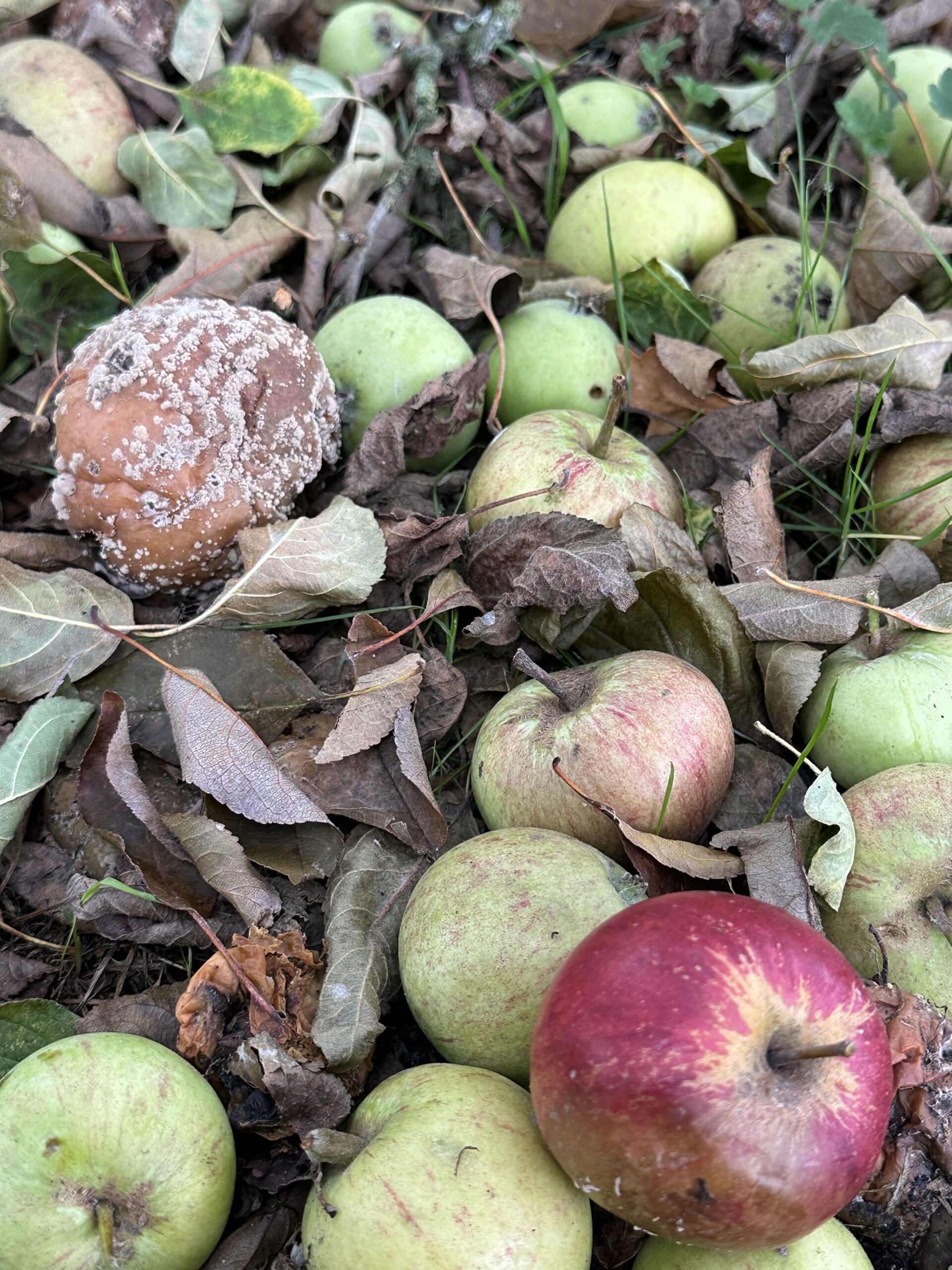
Beneath the old apple tree, the king of the orchard, fallen apples lie on top of the leaf-litter, wind-shaken and bruised. Their skins cracked, their flesh softening, their scent faintly sweet but sharp in the still air. To almost every walker, they are simply decaying fruit to be sidestepped or stepped on. But down below, for the mini beasts of the soil, these apples are the food for their futures.

Fallen apples in Trendlewood Park
Fallen apples in Trendlewood Park. [Photograph: Neil Ingram]

These apples, built by the tree from sunlight and salts, now become a banquet for a micro-world. First slugs and woodlice nibble the breaking skins.

As leaves and apple flesh break down, bacteria and fungi colonise. Fungi thread through leaves, breaking tough lignin and cellulose into sugars. Bacteria feed on these sugars and their growth increases.

Then the springtails and mites gather. But the major transformation begins when the earthworms arrive.

In this video from @PlayEarth we can see how apples are consumed by earthworms: in our park, the same players are at work, but working at much slower rhythms.

As the earthworms burrow, they drag down leaves and fragments of apple into the soil, creating tunnels rich in oxygen and moisture. The earthworms grind the material in their guts, making it more digestible for microbial armies.

As they pass through, the earthworms consume the microbe-rich soil, expelling the soil as finely ground particles. Their work accelerates the breakdown of the leaves and apples.

The result? The fallen apples, once crisp and bright, become part of the soil. Nutrients such as nitrogen, phosphorus and potassium return to the ground. The soil structure improves. Tiny pores hold water. Seeds waiting in the seed-bank sense the difference. Saplings in spring find richer soil, more ready to grow.

In our small park, what seems like waste—leaves and fallen apples— are the lifeblood of food webs, cycles and renewal. Life depends on life. The work of the worms and other soil organisms is quiet, unseen, but foundational. Without it, the leaf carpet would build up, decomposition would slow, nutrients would be locked away.  Instead, the earth beneath is alive and renewing, waiting for the spring.

  1. Many people tidy up the fallen leaves from their garden lawns and flower beds. Why might it be better to leave them where they fell? 


Notes on the story

Trampling acorns underfoot 


You might also like to read: