The mistletoe bough and New Year’s Eve

Some of the trees in Trendlewood Park play host to mistletoe, an ancient plant with mythological powers. Mistletoe is easiest to see in winter. when the trees have given up their leaves.

When older trees stand bare against the low sky, mistletoe hangs in their branches like dark thoughts. From the ground it looks an accident: round, self-contained worlds lodged high in the branches like lost balloons. Neither leafless nor quite at home.

Mistletoe growing on a tree in Trendlewood Park.
Mistletoe growing on a tree in Trendlewood Park. [Photograph: Neil Ingram]

In fact, evolution has shaped mistletoe into a highly effective machine for stealing space and water from mature trees. Firstly, there are separate male and female plants, each bearing flowers that produce pollen and fruits, respectively.

Female flowers of mistletoe. [Photograph: Neil Ingram]

These are the female flowers, with their orange stigmas that catch pollen carried by late winter insects in February–March. These early insects are attracted by scent rather than colour. As a reward, the insects receive precious food, at a time when few other nectar foods are available. The seed is held inside a white translucent globe, that is the fruit.

White mistletoe berries. [Photograph: Schnobby, under the Creative Commons Attribution-Share Alike 3.0 Unported license. https://commons.wikimedia.org/wiki/File:Mistletoe_with_berries.jpg]

The seed inside is wrapped in viscin, a gluey substance that stretches into threads when pulled apart. Mistle thrushes, blackcaps, and other winter birds gorge on the pearly berries when little else is available.

Birds wipe the sticky remains from their bills onto a branch, or pass the seed whole, leaving it stuck to the bark like a stain. There it waits, fixed fast against rain and frost, until spring warmth draws it into life. Germination begins not with invasion but with patience.

Mistletoe does not grow on a tree so much as into it. Its seeds, carried there by birds, germinate where they land and push a root-like structure—called a haustorium—through the bark and into the living wood. 

Mistletoe growing into a rowan branch. [Photograph: Neil Ingram]

From there it draws water and mineral salts from its host, tapping the tree’s transport system while still making its own sugars by photosynthesis. It is a hemiparasite: dependent, but not helpless; taking, but also growing greenly on its own account. The host tree bears the cost quietly, ring by ring, while the mistletoe thickens above, each year adding another fork to its slow, spherical architecture.

Gradually, over decades, the tree weakens and will eventually fail, as it plays host to more and more uninvited guests.

A protected Norway Maple tree, heavy with mistletoe. [Photograph: Neil Ingram]

Despite this quiet parasitism, mistletoe gives generously to the wood. Its evergreen leaves offer shelter in winter; its flowers feed early insects; its berries are a crucial cold-season resource for birds. In Trendlewood Park, the thrush that guards a mistletoe clump does so fiercely, chasing off rivals with sharp calls and sudden wingbeats. The plant becomes a defended territory, a winter larder, a node of life when the rest of the canopy is stripped to essentials.

Long before botanists described haustoria and hemiparasites, mistletoe had already rooted itself in British imagination. To the Druids, it was a plant apart, especially when found on oak, rare and therefore potent. Pliny the Elder described how it was cut with a golden sickle and caught in a white cloth so that it never touched the ground, as if earth itself might dilute its power. It was associated with fertility, protection, and the suspension of ordinary rules—a plant that belonged neither fully to sky nor soil, growing between worlds.

Druids cutting mistletoe with a golden scythe in the style of a medieval woodcut.

That sense of being between has never quite left it. Mistletoe grows easily upon apple trees, and in orchards it has a magical significance. Cut on New Year’s Eve and hung in houses, it provides protections against witches and goblins. The old branch, taken down on New Year’s Eve must be burnt.

Hung in gloomy houses at bleak midwinter, mistletoe became a licence for closeness, an excuse for kissing when the year is at its darkest. The custom is gentler than the old rituals but carries the same implication: that life persists, that green things endure, that intimacy and renewal are possible even now.

In Nowhere Wood, when the light is low and the paths are slick with fallen leaves, the mistletoe bough watches from above, evergreen and unapologetic. It lives by taking, but also by giving—food, shelter, stories. It reminds the trees, and those who walk beneath them, that survival is always a matter of connection, and that even the strangest relationships can bind a landscape together.

Happy New Year from Nowhere Wood.

  1. Summarise how the mistletoe plant makes seeds and how these seeds are spread to new trees

Notes on the story

The Apple Tree Man of Nowhere

Apples and the New Year

A year in the life of a sugar factory

The leaves of plants are everywhere in Nowhere Wood, helping to keep the wood alive. Leaves are organs: collections of living tissues and cells, having adventures in time and space. This is the story of a year in the life of an oak leaf.

Leaves are factories for making sugar from sunlight, water and carbon dioxide from the air. No human factory can do this, which is why we, and all other organisms, are so dependent on plants. Leaves are the producers of food.

Buds of the English oak.
Buds of the English oak. [Photograph: https://commons.wikimedia.org/wiki/File:English_Oak_(Quercus_robur)_buds_(8535459373).jpg]
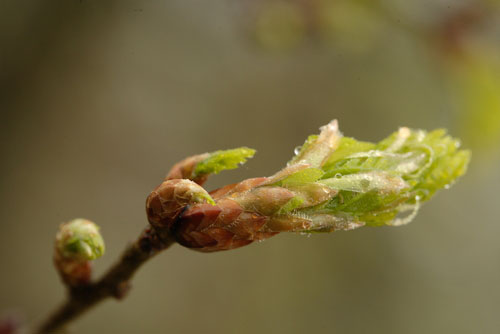
In is late November and the cells that will divide to make the new leaf are protected safely inside the scales of the bud. Early in March, when the days warm and get longer, stem cells within the bud start to divide many times, producing all of the cells of the new leaf. To start with, the cells are very small and all look the same.

Emerging leaves. [Photograph: shutterstock_244078297, licensed by NI]
Soon, the cells take up water and get much larger. They escape the protection of the bud and the new leaf emerges. The new cells no longer look the same: they are on different journeys of development, becoming all of the different cells and tissues that make up the leaf.


New leaves. [Photograph: Stutterstock 671376856, licensed by NI]
The leaf is a factory for making sugar. Like any factory, it has a source of energy and transport systems to get the raw materials into the factory.  It also moves the manufactured sugar out to the places in the plant where it is needed. The heart of the factory is the production line where sugar is made. These are called chloroplasts and the leaf has millions of them, all making sugar whenever the sun shines. The Spring and Summer are sugar making seasons.

Oak leaves in autumn. [Photograph: Neil Ingram]
Gradually, in the autumn, when the days get cooler and shorter, the sugar factories are shut down and abandoned. The chloroplasts lie in ruins as everything useful is recycled back into the branches of the tree. All that remain are the frameworks of cell walls, turning brown as they dry in the autumn air.


Dead leaves
Dead leaves. [Photograph: Neil Ingram]
Finally, the oak tree makes a special layer of cells that separates the old leaf from the stem, and the leaf is ready to fall when the wind blows strongly. The fallen leaves are not wasted, becoming energy stores for the organisms that feed on them. Next year’s buds are forming and wait for spring and the production of new leaves.

If leaves are factories form making sugar, then trees are factories for making leaves.

Everything has its own season in Nowhere Wood.

  1. Think about how the leaf is a factory for making sugar. Where does its energy store come from? How do the raw materials get to the production line?
  2. The production of leaves is sustainable in Nowhere Wood. What do you think this sentence means?

Notes on the story

Subterranean superheroes

All change!

[Image: https://www.clipartof.com/portfolio/sajem/illustration/happy-moodie-character-looking-at-his-reflection-in-a-mirror-227335.html]
When you next look into a mirror ask yourself if you are the same person as you were yesterday. Well, of course you are.

Even people who last met you ten years ago can still recognise you and call you by your name. Although they might add, “My, how you have grown!”

And yet, if we could see under your skin, we would find that you are not the same. One of the biggest mysteries in biology is how we can change all of the time, whilst still staying the same.

Your skin cells live for about two weeks, so every month they are completely replaced. Red blood cells live for about 100 days and about two million are made in your body in every second.

Some of the chemicals in your cells exist for only minutes or seconds.

There is an energy store called ATP, which is needed for muscle contraction. ATP is made and broken down within 15 seconds.  Cells need glucose to make ATP and this explains why muscle cells need a continuous supply of glucose to stay alive. This comes from our food.

[Image: https://www.clipartmax.com/middle/m2i8d3m2Z5d3G6d3_hm00260-%5B1%5D-digestive-system-close-up/]
Even large organs, like the liver, are replaced regularly. You grow a new liver every year. The cells in the alveoli of your lungs are renewed every eight days. Even the bone cells in our skeleton are replaced every three months. Your entire skeleton is remade every ten years.


[Image: http://halloween.phillipmartin.info/halloween_skeleton.htm]
So, when your friend sees you after ten years and calls out your name, there is not a single part of your body that was the same as when you last met. You have been completely remade and remodelled. And the same is true of your friend.


So, how can this be? New cells are made when one cell divides to make two cells. The information in the genome is copied before cells divide, so the new cells always receive the same information as the old cells.

The new cells use this information to grow bigger and to develop. So, you stay the same because of how your new cells use the information in their genomes.

Living organisms are alive because they actively remake themselves. No man-made machine can do this. Which is, perhaps, just as well.

  1. In what ways have you changed in the last ten years?
  2. In what ways have you stayed the same?
  3. Why do need to eat food everyday?

Notes on the story

A year in the life of a sugar factory

Organise and stay alive

Living organisms have very organised structures.

Everything depends upon the way that the different parts of their bodies work together.

The parts of this watch work together, so that the hands of the watch move round in a rhythm that we use to tell the time. The hands do this because of the precise organisation of all of the parts of the watch.

The ability to tell the time emerges from the watch, only when all of the parts move together smoothly. If anything goes wrong, the watch “stops” and the ability to tell the time disappears.

Living organisms are alive because they are organised. Everything depends upon the way that the different parts of their bodies work together.

For an organism, life emerges and exists for only as long as its parts work together smoothly.

If anything goes wrong, the organism becomes ill. If it is very serious, then the organism dies and its life disappears. This is difficult to think about, but it is a fact of life.

  1. One of the important features of human society is that we have learned how to care for the sick and the elderly. Hows does this help the survival of humanity?

Notes on the story

Squirrel wars