The Queen of May

May Day is gathered together in Nowhere Wood. The guests are all assembled, having arrived in timely order, ready for the magical day.

First to arrive was the wild garlic, clean and green with the freshness of a memory of good times around the family table.

Wild garlic in Nowhere Wood [Photograph: Neil Ingram]

Then the first bluebell opened up to the sky, followed by the others, forming a coloured haze beneath the trees, daring the sky to lose its heavy April clouds to show its true May colours.

A haze of bluebells in Nowhere Wood [Photograph: Neil Ingram]

Then the big oaks open their leaves, delicate and shimmering in the sunshine, before they darken and spread a curtain over the wood.

Fresh unfolding oak leaves, translucent in the sunshine. [Photograph: Neil Ingram]

Oceans of cow parsley flow over the floor of the cleared wood, where tall, sickly, ash trees once stood. This is the First of May, celebrating new starts and the freedom to enjoy the light.

And, finally, the Queen of May, the Hawthorn, blooming proudly here and across the Park.

The hawthorn in May [Photograph: Neil Ingram]

Hers is the glory, the scent and the crisp whiteness. Entwined together, the branches strengthen their appeal and magic.

Once in this place, the villagers would plait her blossoms into a crown and choose the fairest maid to be their Queen of the May. This is not a crown of thorns: today it is a crown of promise.

A hawthorn crown [Image by AI]

Then, the village children would dance and twist their maypole ribbons to form a perfect spiral of red and white. This was one day when they could leave the chalky gloom of their school rooms and breathe.

Maypole dancing in Bedfordshire, [Photograph: geograph.org.uk – 3445844.jpg, Creative Commons license]

In the engine room of wood, it is just another working day, the animals are busy with family business, since being and becoming is a lifetime’s quest: nests need to be built up, offspring fed and protected from danger. The real magic is that it all works: the dance of the DNA spiral that continues year after year, in a stately and predictable procession.

But perhaps, the wood also senses that today is a special day.

Happy May Day!

  1. Why do you think it is an advantage for small plants living on the floor of the wood (like bluebells) to flower early, before the tall trees get their new leaves?
  2. Why do you think celebrating May Day was important part of village life in Nowhere?


Notes on the story

Being and becoming in Nowhere Wood

Cuckoo flowers in the spring

Spring has arrived—but the world is not yet settled.

In an uncertain climate, people choose uncertainty and so does the weather. Sun, rain, frost and wind – the persistent wind blowing through the meadows. Spring marches onwards, regardless.

The cuckoo flower in Trendlewood Meadows. [Photograph: Neil Ingram]

The cuckoo flower with its dainty lilac flowers hides in the unmown grass, shielded from the biting winds. Some look white at a distance, as pretty as a lady’s smock, which is another of its names. And ladies always want to look their best in spring.

Springtime when, historically, milkmaids and farm boys thought of romance, and their parents looked away. It captured Shakespeare’s imagination, too:

“When daisies pied and violets blue,
And lady-smocks all silver-white,
And cuckoo-buds of yellow hue,
Do paint the meadows with delight,
The cuckoo then, on every tree,
Mocks married men; for thus sings he:
“Cuckoo! Cuckoo, cuckoo!”
O, word of fear,
Unpleasing to a married ear!”

The ladies smock in in Trendlewood Meadows. [Photograph: Neil Ingram]

In the days when country gentlemen wrote letters on paper to the Times, each year there was a race to announce that the first returning cuckoo had been heard in England. 

The flowering of this meadow beauty coincided with the returning cuckoos, and so the name also became a signifier of spring.

Cuckoos are cheating birds, deceiving male birds of other species into raising their young for them. This is how a wife’s infidelity became the ‘cuckolding’ of her innocent husband.

The cuckoo flower became tainted by these unsavoury associations. They were not thought to be appropriate to pick and bring into the house, in case they brought bad luck.

The cuckoo flower needed saving from this undeserved fate, and in some parts of the country they became associated with the purity of the Virgin Mary.

The cuckoo flower in Trendlewood Meadows. [Photograph: Neil Ingram]

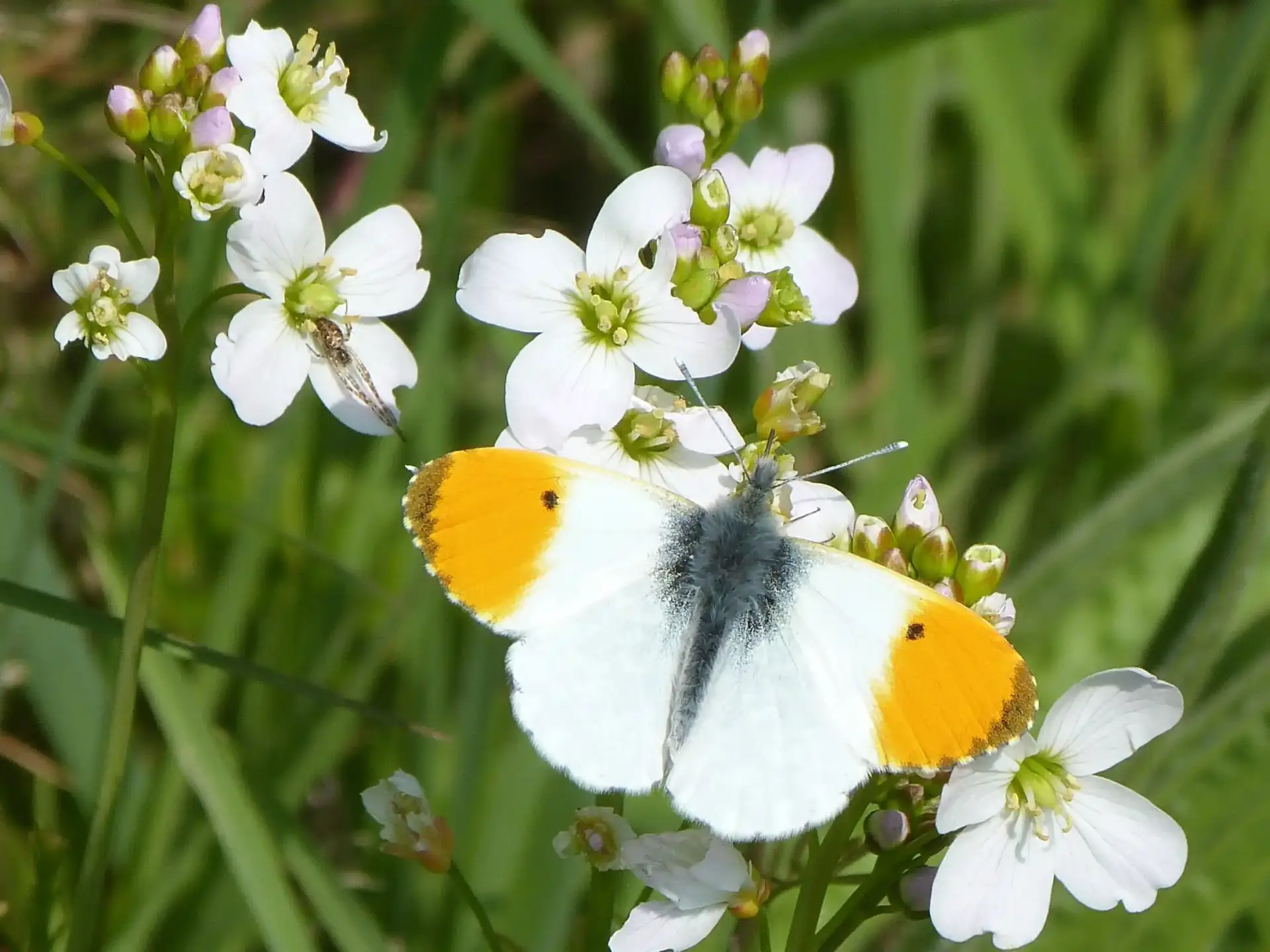
Country folk live with these flowers and their stories, which have become part of our culture. We love them in the park because they are food plants for the caterpillar of the orange tip butterfly, which is also friend of the park. Each female lays one egg beneath a cuckoo flower, and the emerging caterpillar feeds on the seeds of the plant.

Orange tip butterfly in Trendlewood Park. [Photograph Andrew Town]
A single egg of an orange tip butterfly on a cuckoo plant in the Meadows, Nowhere Wood, 22/04/26. [Photograph: Neil Ingram]

  1. Find out how the orange tip butterfly depends upon the cuckoo flower.


Notes on the story

A tale of two butterflies

The mistletoe bough and New Year’s Eve

Some of the trees in Trendlewood Park play host to mistletoe, an ancient plant with mythological powers. Mistletoe is easiest to see in winter. when the trees have given up their leaves.

When older trees stand bare against the low sky, mistletoe hangs in their branches like dark thoughts. From the ground it looks an accident: round, self-contained worlds lodged high in the branches like lost balloons. Neither leafless nor quite at home.

Mistletoe growing on a tree in Trendlewood Park.
Mistletoe growing on a tree in Trendlewood Park. [Photograph: Neil Ingram]

In fact, evolution has shaped mistletoe into a highly effective machine for stealing space and water from mature trees. Firstly, there are separate male and female plants, each bearing flowers that produce pollen and fruits, respectively.

Female flowers of mistletoe. [Photograph: Neil Ingram]

These are the female flowers, with their orange stigmas that catch pollen carried by late winter insects in February–March. These early insects are attracted by scent rather than colour. As a reward, the insects receive precious food, at a time when few other nectar foods are available. The seed is held inside a white translucent globe, that is the fruit.

White mistletoe berries. [Photograph: Schnobby, under the Creative Commons Attribution-Share Alike 3.0 Unported license. https://commons.wikimedia.org/wiki/File:Mistletoe_with_berries.jpg]

The seed inside is wrapped in viscin, a gluey substance that stretches into threads when pulled apart. Mistle thrushes, blackcaps, and other winter birds gorge on the pearly berries when little else is available.

Birds wipe the sticky remains from their bills onto a branch, or pass the seed whole, leaving it stuck to the bark like a stain. There it waits, fixed fast against rain and frost, until spring warmth draws it into life. Germination begins not with invasion but with patience.

Mistletoe does not grow on a tree so much as into it. Its seeds, carried there by birds, germinate where they land and push a root-like structure—called a haustorium—through the bark and into the living wood. 

Mistletoe growing into a rowan branch. [Photograph: Neil Ingram]

From there it draws water and mineral salts from its host, tapping the tree’s transport system while still making its own sugars by photosynthesis. It is a hemiparasite: dependent, but not helpless; taking, but also growing greenly on its own account. The host tree bears the cost quietly, ring by ring, while the mistletoe thickens above, each year adding another fork to its slow, spherical architecture.

Gradually, over decades, the tree weakens and will eventually fail, as it plays host to more and more uninvited guests.

A protected Norway Maple tree, heavy with mistletoe. [Photograph: Neil Ingram]

Despite this quiet parasitism, mistletoe gives generously to the wood. Its evergreen leaves offer shelter in winter; its flowers feed early insects; its berries are a crucial cold-season resource for birds. In Trendlewood Park, the thrush that guards a mistletoe clump does so fiercely, chasing off rivals with sharp calls and sudden wingbeats. The plant becomes a defended territory, a winter larder, a node of life when the rest of the canopy is stripped to essentials.

Long before botanists described haustoria and hemiparasites, mistletoe had already rooted itself in British imagination. To the Druids, it was a plant apart, especially when found on oak, rare and therefore potent. Pliny the Elder described how it was cut with a golden sickle and caught in a white cloth so that it never touched the ground, as if earth itself might dilute its power. It was associated with fertility, protection, and the suspension of ordinary rules—a plant that belonged neither fully to sky nor soil, growing between worlds.

Druids cutting mistletoe with a golden scythe in the style of a medieval woodcut.

That sense of being between has never quite left it. Mistletoe grows easily upon apple trees, and in orchards it has a magical significance. Cut on New Year’s Eve and hung in houses, it provides protections against witches and goblins. The old branch, taken down on New Year’s Eve must be burnt.

Hung in gloomy houses at bleak midwinter, mistletoe became a licence for closeness, an excuse for kissing when the year is at its darkest. The custom is gentler than the old rituals but carries the same implication: that life persists, that green things endure, that intimacy and renewal are possible even now.

In Nowhere Wood, when the light is low and the paths are slick with fallen leaves, the mistletoe bough watches from above, evergreen and unapologetic. It lives by taking, but also by giving—food, shelter, stories. It reminds the trees, and those who walk beneath them, that survival is always a matter of connection, and that even the strangest relationships can bind a landscape together.

Happy New Year from Nowhere Wood.

  1. Summarise how the mistletoe plant makes seeds and how these seeds are spread to new trees

Notes on the story

The Apple Tree Man of Nowhere

Apples and the New Year

Apples and the new year

Let’s travel back in time three hundred years or more, to the East End Farm, near the hamlet of Nowhere. 

East End farm has a few sheep and goats, some vegetables and several apple orchards.


Children in Bridport, Dorset, wassailing in a community orchard
Children in Bridport, Dorset, wassailing in a community orchard. [Photograph, https://upload.wikimedia.org/wikipedia/commons/thumb/2/25/Bridport_Community_Orchard_Wassail_2022_%2851830797371%29.jpg/1024px-Bridport_Community_Orchard_Wassail_2022_%2851830797371%29.jpg]
Tonight the orchards are surrounded by farm workers and villagers from Nowhere, all singing and banging pots and pans. Children hang pieces of toast soaked in cider from the tree branches. 

For tonight, January 5th, is the wassail, the twelfth night of Christmas.


Small orchards in Somerset
The orchards contain a number of apple trees. [Photograph: David Smith, https://www.geograph.org.uk/photo/5606792
Apples grow all across the county of Somerset, and are especially important to Nowhere and its bigger neighbour, Nailsea. Every farm brews cider, which they give to the farm hands as part of their wages. 

(Centuries later, cider would be brewed and sold in large factories. Nailsea hosted  Coates factory for over 150 years. These days, the Thatcher family brews cider at Sandford, ten miles to the southwest.)  

Wassailing at night
Wassailing at night. [Photograph: Steven Brace, https://www.flickr.com/photos/30399879@N03/3286351432]
Back in Nowhere, apple trees are a sign of a healthy farm. Wise famers celebrate the good health of their orchards with a wassail.

Their people visit the apple trees by the light of burning torches.  Singing songs to them and making a lot of noise to ward off evil spirits. Hopefully, this should be enough to ensure a good harvest in the next year. 

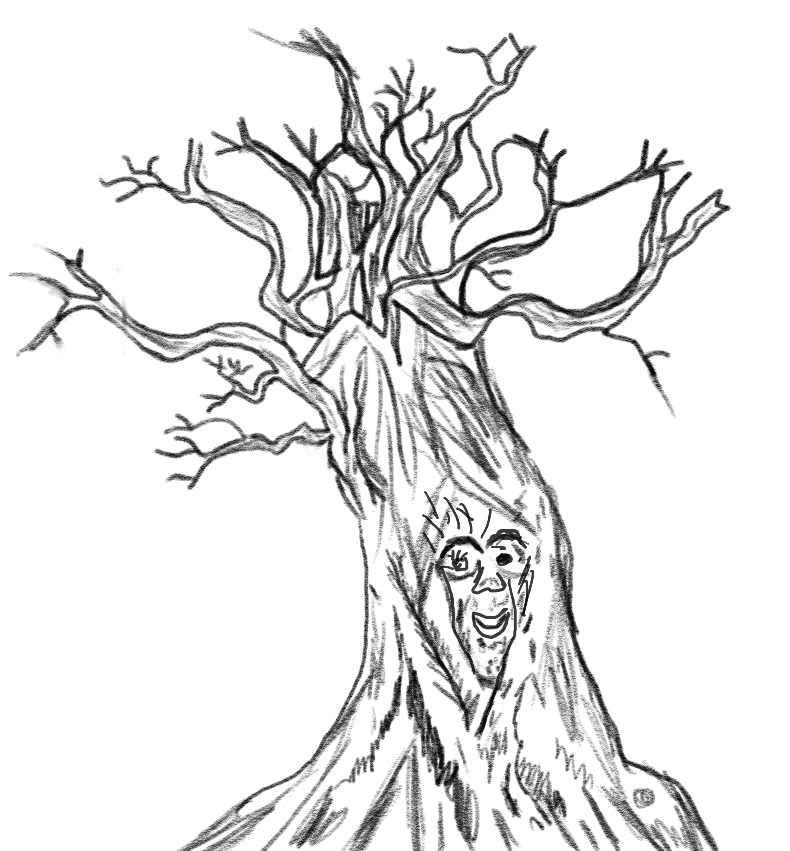
The oldest tree in the orchard is given the greatest respect, and he is called the ‘Apple Tree Man’. [Image: Neil Ingram]

 The Apple Tree Man decides how many apples will grow in the next year. Farmers keep the Apple tree Man happy by pouring cider over his roots. 

There are several old folk tales told in Somerset about the Apple Tree Man. The next story is a modern retelling of one of these old tales.


Notes on the story

The Apple Tree Man of Nowhere

The Apple Tree Man of Nowhere

Once upon a time, there lived a young man called Henry Summers, who lived at the Farmhouse over at the East End, just below the quarry. He was a wise man, strong in the arm and of calm manner. He never beat his animals or his wife. The family farmed ten fields and had several beautiful apple orchards.

Among the trees, there was one particularly ancient apple tree that Henry’s great grandfather planted and around which all of his children had played. The tree stood tall and strong, even though it was very old.

Henry believed that this tree was extra special, and he called it the ‘Apple Tree Man’. Henry always took great care of this tree, speaking to it kindly and ensuring it had plenty of water and cider at the wassail.

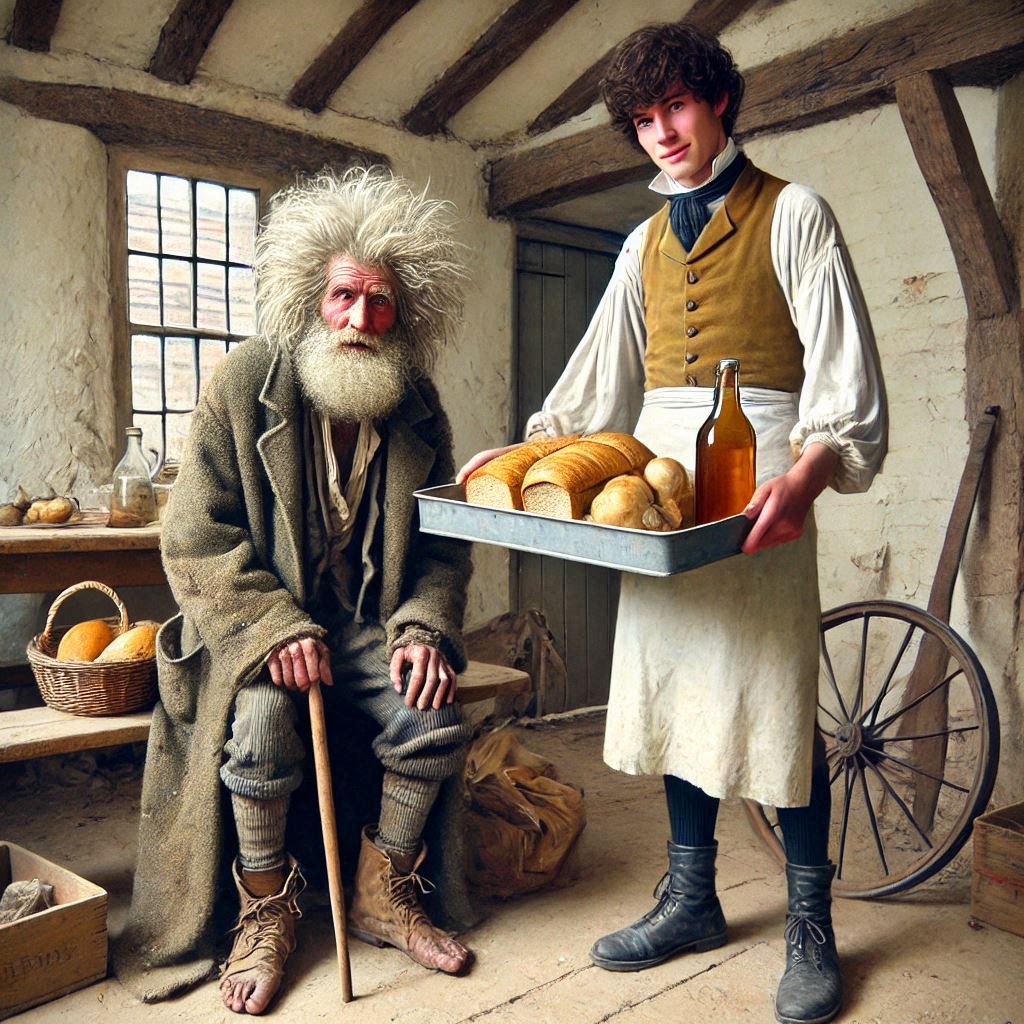
One cold winter’s night, Henry was visited by a stranger who had walked from Bristol and wanted to find friends in Nowhere. His clothes were dirty and his shoes were worn out. Henry was as kind to people as he was to his goats, welcomed the stranger into his home and gave him food and cider.

The wanderer meets the young farmer

His wife looked out some more shoes for him.  The stranger slept soundly in his clean bed that night.

The next day, the happy stranger revealed that he was, in fact, the spirit of the Apple Tree Man who had taken the form of a wanderer to test the farmer’s kindness.

The Apple Tree Man promised the farmer that as long as he continued to care for the apple trees, his orchards would make so many lovely apples every year, that he and his family would be wealthy and  joyful.

The apple trees produced many beautiful apples

The Apple Tree Man was true to his word, the orchards flourished, and the farmer and his descendants enjoyed bountiful harvests for many generations. And the people of Nowhere enjoyed their cider for years to come.


Notes on the story

Climate change: new arrivals in Nowhere Wood